All Articles (page 4)

All 193 articles, newest first

Latest articles

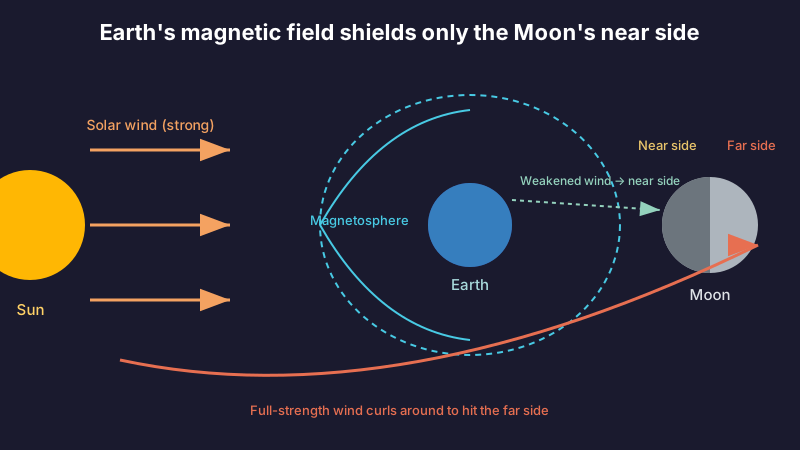
Sand from the Moon's Far Side Reveals Earth's Magnetic Field Only Shields the Near Side

China's Chang'e-6 mission brought back 1.935 grams of sand from the Moon's far side, and it turned out to carry solar wind particles buried deeper than in near-side samples. Earth's magnetic field, it seems, was slowing the wind from 400 km/s to 200 km/s before it ever reached the near side. SORABUMI explains why the same Moon has two very different sunburn histories.

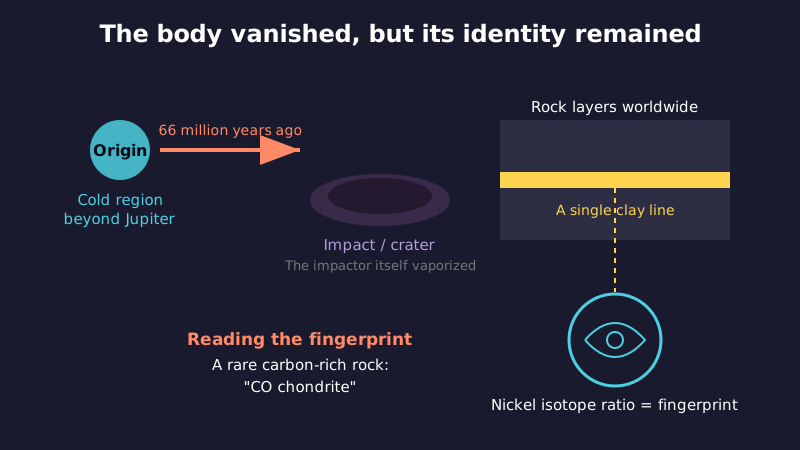
The Rock That Killed the Dinosaurs Left Behind a Nickel Signature From Beyond Jupiter

The impactor that wiped out the dinosaurs 66 million years ago vaporized on contact — no fragment of it survives today. Yet nickel isotopes buried in a thin clay layer found across the globe reveal what it was: a rare carbon-rich 'CO chondrite,' born in the cold reaches beyond Jupiter. SORABUMI breaks down the science.

How Scientists Detect Air on Planets Dozens of Light-Years Away

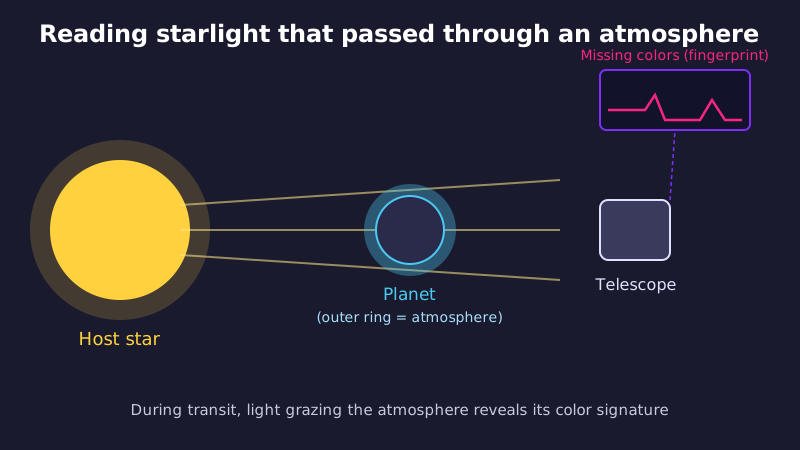
How can we tell whether a rocky planet dozens of light-years away has an atmosphere? For a few hours, as the planet crosses in front of its star, starlight grazes its air and comes out with a few colors missing. SORABUMI explains how transit spectroscopy reads that 'color fingerprint,' and why the clue shrinks to the thickness of an apple peel once you're talking about an Earth-sized world.

When Gravity Itself Becomes a Telescope: The 'Too-Early' Cluster 10.4 Billion Light-Years Away

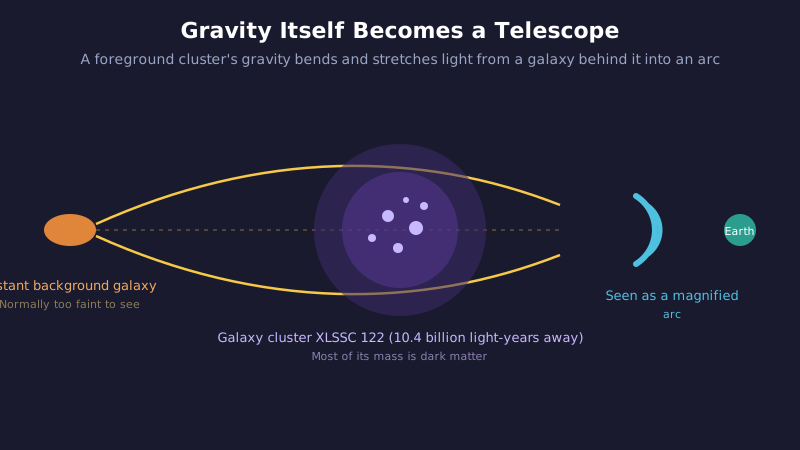
In 2026, JWST confirmed that the galaxy cluster XLSSC 122, some 10.4 billion light-years away, is producing powerful gravitational lensing. SORABUMI explains how a foreground cluster's gravity bends and magnifies light from behind it, and why this densely packed cluster shouldn't have existed so soon.

Being in the Habitable Zone Doesn't Guarantee Air: The 'Cosmic Shoreline' That Separates Planets

GJ 3378 b, a super-Earth found 25 light-years away, sits right in the middle of its habitable zone, soaking up about 90% as much starlight as Earth gets from the Sun. But the real test for finding life isn't distance — it's whether a planet can hold onto its atmosphere. SORABUMI explains the new yardstick astronomers call the cosmic shoreline.

A 250-Gram Toy-Tech Sphere Took the First Photo of a Fallen Moon Lander

The closest photo of Japan's SLIM lander lying face-down on the Moon was taken by SORA-Q, an 80mm, 250-gram sphere built with transforming-toy technology from Takara Tomy. At roughly 1/4000th the weight of NASA's Mars rover Perseverance, why did such a small, simple design hold up so well in a brutal environment? SORABUMI explains.