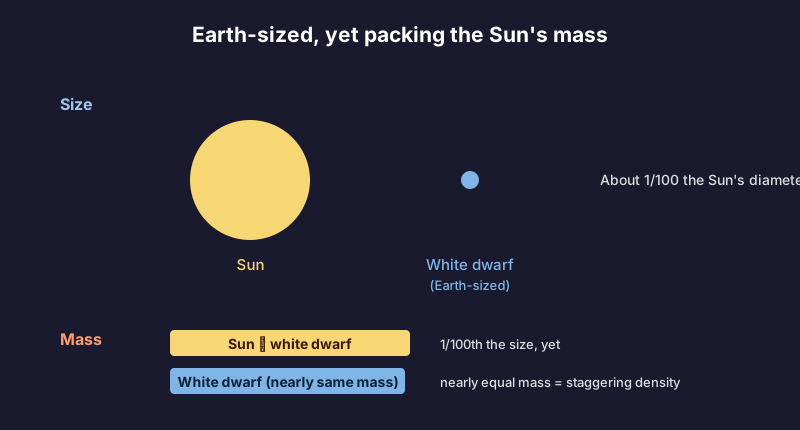
Just 25 light-years from the Sun — practically next door, in cosmic terms — sits the leftover ember of a star. A ball the size of Earth, packed with roughly the mass of the Sun.
We now know it as the ninth-closest white dwarf to our own star. Strangely, though, astronomers had sensed something was there for 27 years before they figured out what it was. A quarter century went by with the mystery unsolved.
It was close. There were hints it existed. And still, nobody could actually see it. Why?
Why a Next-Door Star Went Unseen
The answer is almost embarrassingly simple: its neighbor was too bright.
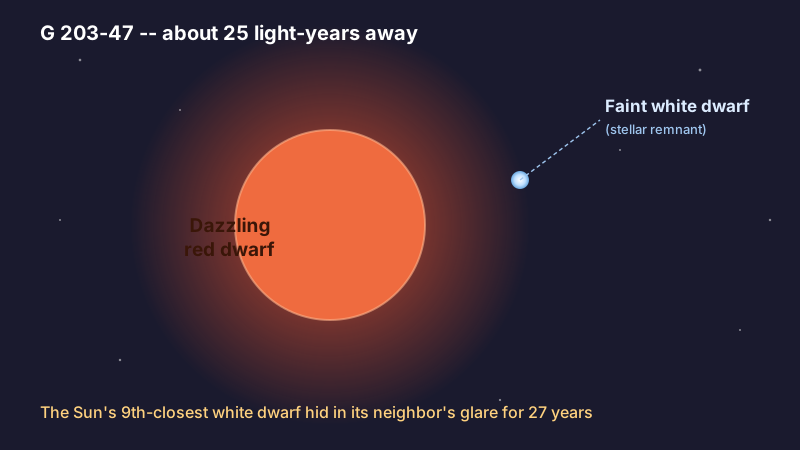
The white dwarf in question lives in a system called G 203-47, alongside a red dwarf — a small, dim, reddish star, cooler and fainter than the Sun. The two form a pair, orbiting each other.
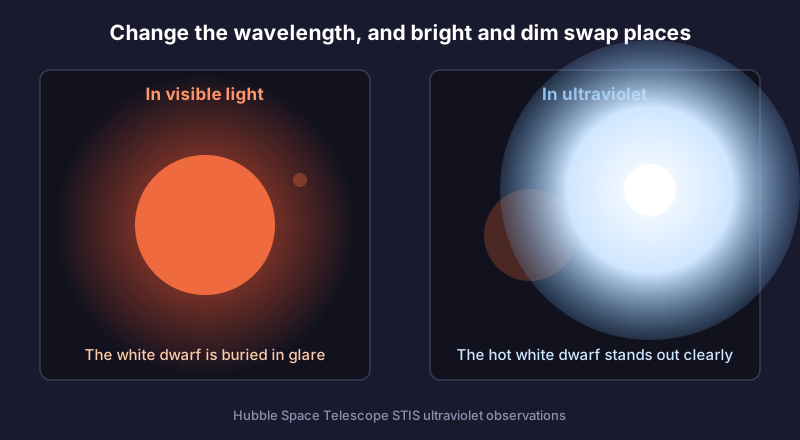
Red dwarfs may be dim by stellar standards, but they still outshine a burnt-out white dwarf by a wide margin. Look at the system in visible light, and the white dwarf simply disappears into its companion’s glow.
Picture standing directly under a bright streetlamp at night — you can’t make out anyone standing in the shadow at your feet. That’s essentially what was happening 25 light-years away. The faint white dwarf was swallowed by the glare of its ruddy neighbor.
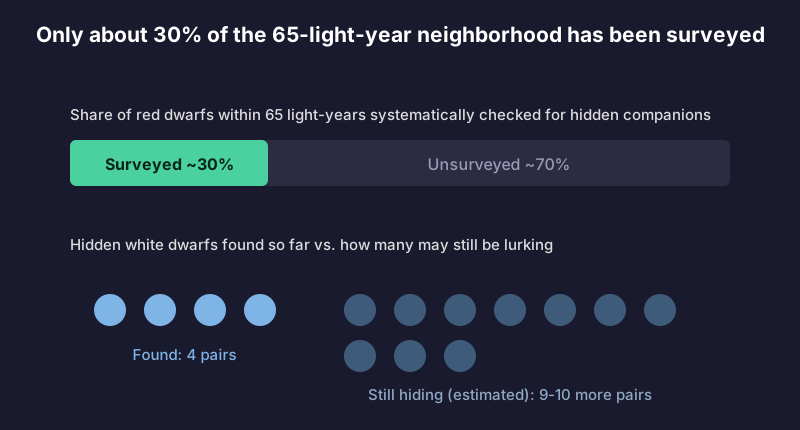
G 203-47 wasn’t the only case. Three other systems — GJ 207.1, LHS 1817, and Wolf 1130 — turned out to be hiding companions the same way. Four pairs in total, all within 65 light-years of Earth. On a cosmic scale, that’s practically our own backyard.
So if nobody could see these stars, how did anyone know they were there at all?
A Wobble Astronomers Had Known About for 27 Years
The clue was a tiny wobble.
When a star has a gravitational partner, that partner tugs it around, causing small periodic shifts. Seen from Earth, the star’s radial velocity — how fast it moves toward or away from us — oscillates in a regular rhythm. You can detect that rhythm even when the culprit itself stays invisible.
Astronomers watching the red dwarf in G 203-47 had picked up exactly this kind of wobble. Something with gravity was tugging on the star, rocking it back and forth. But whatever it was, it stayed out of sight.
It’s rare for astronomers to let a mystery sit unresolved for this long. In the case of G 203-47, 27 years passed between the first detection of the wobble and the confirmation of what caused it — long enough for a newborn to grow up and become a parent. The whole time, the records held nothing but the ghostly signature of an invisible companion.
Researchers suspected the wobble’s source was a dim white dwarf. All they needed was a way to dodge the glare and catch it directly. The question was how.
Dodging the Glare with Ultraviolet Light
This is where the color of light comes into play.
Red dwarfs earn their name from their reddish hue and relatively cool surfaces. White dwarfs, by contrast, are the freshly exposed cores of dead stars — still blazing hot. And hotter objects pump out more blue light and ultraviolet radiation, the invisible wavelengths shorter than violet.
Switch the wavelength you’re looking at, and the balance of power flips. A red dwarf that dominates in visible light fades into the background in ultraviolet. The white dwarf, meanwhile, comes into its own.
This is where it gets interesting. The research team turned to Hubble’s Space Telescope Imaging Spectrograph, or STIS. Once they looked in ultraviolet, the white dwarf’s light — previously buried behind its companion — popped clearly out of the data.
The work came from teams at the University of Warwick and the University of Colorado Boulder, published in July 2026 in Monthly Notices of the Royal Astronomical Society. The observations made one thing plain: a star lost in visible light can reveal itself entirely once you switch to ultraviolet.
Earth-Sized, Sun-Massive: What Exactly Is a White Dwarf?
So what is a white dwarf, anyway?
A star roughly as massive as the Sun spends its final act blowing off its outer layers, leaving behind only its core. That leftover core is the white dwarf — essentially the ember of a star that has burned through all its nuclear fuel.
What makes it strange is just how tightly packed that ember is. Despite being no bigger than Earth, it holds onto nearly all of the original star’s mass. Scoop out a sugar-cube-sized chunk of white dwarf material, and it would weigh about as much as a car. That’s a density Earth-bound intuition simply isn’t built to handle.
In G 203-47, the white dwarf completes one orbit around its red dwarf companion every 14.9 days, while the red dwarf itself spins on its axis roughly once every 100 days. Two stars, close together, keeping wildly different rhythms.
Imagine floating nearby: a dim, ruddy giant looms large while an Earth-sized white speck circles it in just over two weeks. Nothing flashy about it, but you wouldn’t be able to look away.
Naturally, that raises another question. Finding four of these hidden pairs so close to home — was that just luck?
Finding Four Wasn’t Luck at All
As it turns out, no — this wasn’t a lucky draw.
Theories of stellar birth and death let astronomers estimate how many close pairs like this should exist in our immediate neighborhood. The research team’s population models predicted somewhere between four and five such pairs.
They found exactly four.
It sounds odd to say, but when a prediction and an observation line up this precisely, it’s a strong vote of confidence in the underlying theory. This wasn’t a case of stumbling onto one hidden star by chance. It’s a case of hidden white dwarfs turning up in exactly the numbers theory said they should.
Flip that around, and it means something else too: the catalog of our stellar neighbors still has blank entries waiting to be filled.
The Neighborhood Census Is Only 30% Done
Worth pausing on this point.
Within 20 parsecs — about 65 light-years — of the Sun, there are plenty of red dwarfs. Only about 30% of them have been systematically checked for hidden companions. The other 70% remain completely unexamined.
The research team estimates that this local neighborhood could be hiding another nine or ten close pairs. Somewhere out there, dim embers may still be orbiting unnoticed, drowned in the glare of brighter red companions.
It’s easy to assume the catalog of our nearest stars is finished business — that a neighborhood this close to the Sun must have been thoroughly combed over by now.
But the truth is, even the ninth-closest white dwarf, sitting just 25 light-years away, had an empty entry on the books until very recently. The neighborhood census isn’t even halfway done.
Somewhere in tonight’s sky, an unnamed ember is still quietly circling, tucked into the glare of a brighter, redder star.