The universe is full of structures called galaxy clusters — vast collections of hundreds or thousands of galaxies bound together by gravity. But the galaxies inside them aren’t just floating peacefully. As they move, they warp, lose gas, and eventually run out of the fuel they need to make new stars.
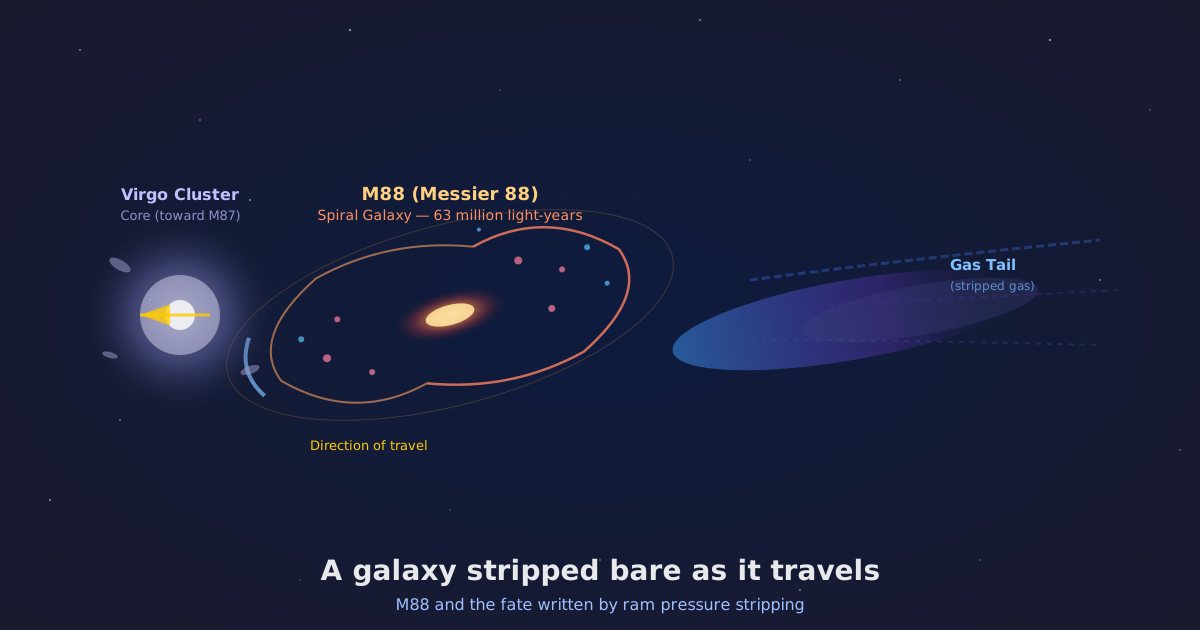
The Hubble Space Telescope, operated by NASA and ESA, recently captured exactly this process happening to M88 (Messier 88), a spiral galaxy traveling through the Virgo Cluster. Images released in 2026 show M88 at the moment it’s being “eaten away” by the cluster’s searingly hot gas.
What Kind of Galaxy Is M88?
M88 (NGC 4501) is a spiral galaxy sitting 63 million light-years from Earth, in the direction of the constellation Coma Berenices. It’s bright enough to spot with binoculars if you have decent skies.
At its center lurks a supermassive black hole with roughly 100 million times the mass of the Sun — and it’s an active one, pulling in gas while blasting some of it back outward. The spiral arms are peppered with pink and blue star clusters: this is a galaxy in full productive swing, churning out new stars at a healthy rate.
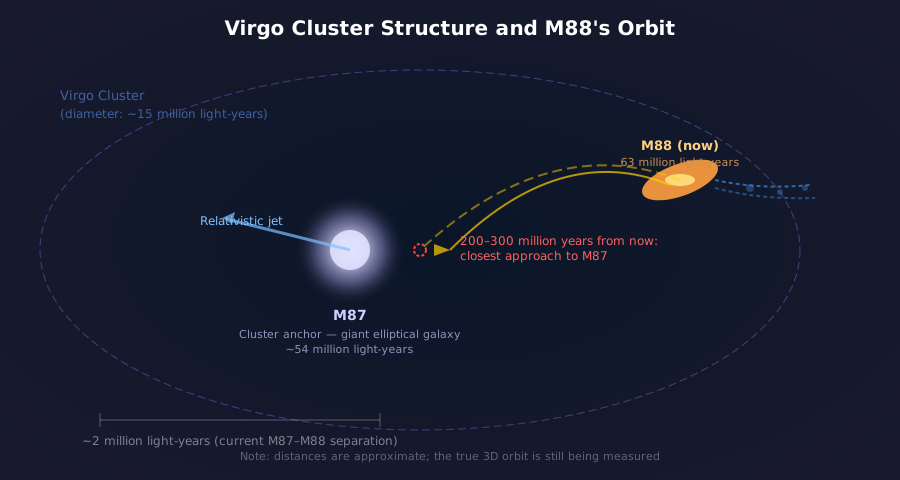
There’s a catch, though. M88 is a member of the Virgo Cluster, a gravitationally bound family of more than 1,300 galaxies. And as it keeps moving through that environment, something irreversible is quietly underway.
How the Stripping Works
The space between galaxies inside a cluster isn’t empty. It’s filled with thin but ferociously hot gas — plasma heated to over 100 million degrees. Normally this gas goes unnoticed, but when a galaxy rushes through it at high speed, the result is a powerful headwind.
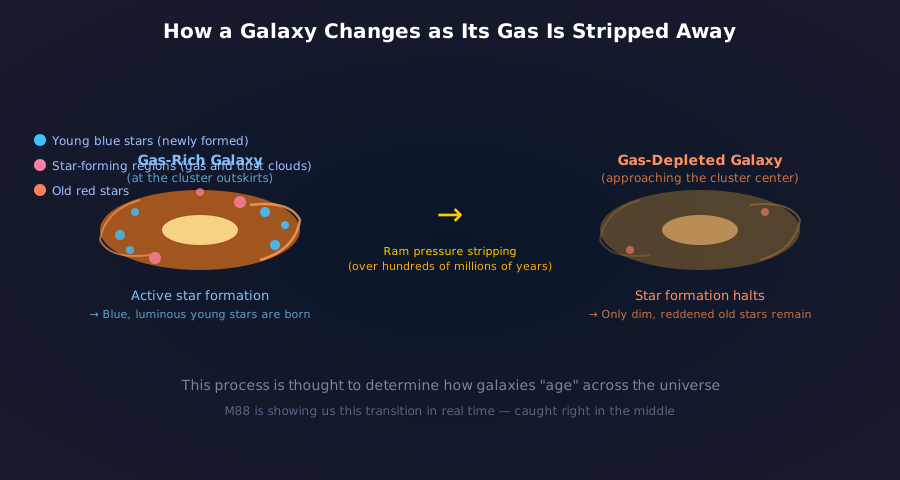
This is “ram pressure stripping.” The name sounds technical, but the idea is simple: the faster you push forward, the stronger the wind you feel coming back at you. Like cycling into a gale and watching your gear fly off the back, a galaxy racing through the cluster’s plasma loses its own gas — peeled off and swept behind it.
The ram pressure intensifies toward the cluster’s center. In the outer reaches it’s relatively gentle; as a galaxy approaches the core, the surrounding plasma gets denser and the “wind” grows fiercer. M88 is currently on a trajectory where that pressure is steadily rising.
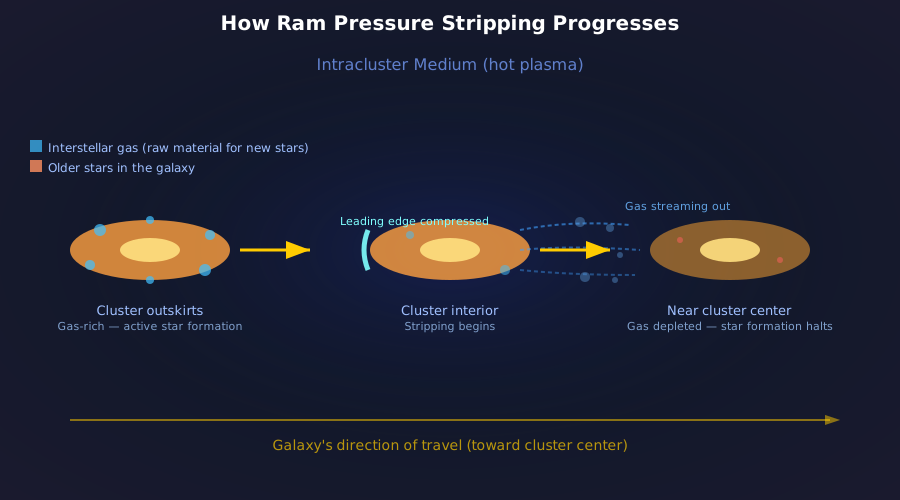
The key detail: what gets stripped isn’t stars themselves, but the cold gas that would have become new stars. Think of it like a factory where the machinery stays put but the raw materials keep disappearing. The outer, diffuse gas goes first; the denser gas deeper in the disk holds on longer. How far the stripping reaches — and how fast — depends on the galaxy’s mass and how quickly it’s moving through the cluster.
What Hubble Found at M88
Hubble’s observations confirmed several things at once.
On the galaxy’s leading edge — the side facing into the direction of travel — gas is being compressed and lit up brightly. That’s the signature of material being slammed and squeezed by the headwind. Behind the galaxy, there’s a trailing streamer of escaped gas extending like a tail.
The gas disk itself also appears truncated in places, and the amount of cold gas that should be there has dropped significantly. The raw material for star formation is already draining away.
According to the research team, M88 is currently falling toward the cluster’s center and is expected to make its closest approach to M87 — the dominant giant elliptical at the heart of the Virgo Cluster — within the next 200 to 300 million years. When that happens, the ram pressure will be far more intense than it is today. M87 is the galaxy famous for harboring the black hole that the Event Horizon Telescope imaged in 2019, the one with the glowing ring-shaped shadow. As cosmic neighbors go, M88 and M87 will share quite a dramatic moment a few hundred million years from now.
What makes the observation particularly interesting is that the gas isn’t torn away all at once. Different parts of the disk shed material at different rates and times. Lower-density regions go first; the dense core holds on. Hubble’s spatial resolution was sharp enough to map this uneven stripping in detail — something harder to do with a more distant cluster.
What Happens to M88 in 200–300 Million Years?
Bluntly: it loses almost all ability to form new stars.
The blue star clusters lighting up M88’s spiral arms today are young, hot, and short-lived. Once the gas supply cuts off and no new stars are born, those blue stars will fade within tens of millions of years. What’s left will be a population of older, dimmer, reddish stars — the slow-burning survivors.
The color of the galaxy changes. From a blue-tinged spiral to something resembling a red elliptical. The shape might look similar from afar, but the nature of the thing is completely different: a galaxy that can no longer give birth to stars.
Astronomers call this a “quenched galaxy” — one where star formation has shut down. The universe is full of them, but how exactly they got quenched remains one of the big open questions in extragalactic astronomy. Ram pressure stripping is considered one of the leading culprits.
Quenched galaxies broadly fall into two camps: those that ran out of star-forming gas on their own, and those stripped from the outside while passing through a cluster environment. In the first case, the prime suspects are internal processes — black holes or supernova explosions blasting gas out from within. In the second case, ram pressure stripping is the star of the show, and M88 is a textbook example. The more cases researchers can observe in detail, the better they can judge which pathway is responsible for more of the universe’s quenched population.
Why M88 Is Worth Paying Attention To
Ram pressure stripping isn’t rare — any galaxy living inside a cluster eventually experiences it. What makes M88 special is the timing: it’s being caught right in the act.
Galaxy evolution is glacially slow by any human measure. “Catching” a galaxy mid-stripping is a bit like stumbling across a time-lapse of a tree falling in a storm — except the storm lasts a few hundred million years. The fact that we can observe it happening at all is partly luck, partly the angular resolution that Hubble still delivers at this distance.
With M88, researchers can trace in real data which regions are losing gas first and how quickly the depletion is spreading. That lets them test theoretical models — essentially checking which combinations of parameters (galaxy mass, cluster speed, gas density profile) produce stripping at the rate and pattern they actually see. It’s a cosmic-scale laboratory experiment.
Distance matters too. M88 is close enough that Hubble can resolve the structure of the gas distribution in detail. Push the same cluster to twice the distance, and the fine-grained patchwork of uneven stripping becomes impossible to read.
A Galaxy’s Journey Writes Its Fate
What I find genuinely striking about this story is that a galaxy’s location and movement through space can fundamentally determine its entire future.
If M88 had never fallen into the Virgo Cluster, it would probably still be building stars today. But by becoming a cluster member and traveling through it, the galaxy has set itself on a course toward an irreversible loss. In the universe, where you belong and how you move through it can make the difference between continued life and slow extinction.
Put it in more everyday terms: it’s like moving to a new neighborhood that ends up reshaping who you are. M88 hasn’t done anything wrong. It’s simply traveling — and the act of traveling is costing it, piece by piece, the materials it needs to keep making stars.
The countless stars that would have been born from that lost gas will never exist. The blue clusters glowing in M88’s spiral arms today may be among the last generations this galaxy will ever produce. Seen that way, the bright compressed arc at the leading edge — that extra-luminous rim of squeezed gas — looks a little different.
No human will live to see what M88 looks like in 200 million years. But the data we have now is good enough to predict that scenario with real confidence. On a cosmic timescale, M88’s journey has barely begun.