For 40 years, Saturn’s rotation rate was, in a word, wrong.
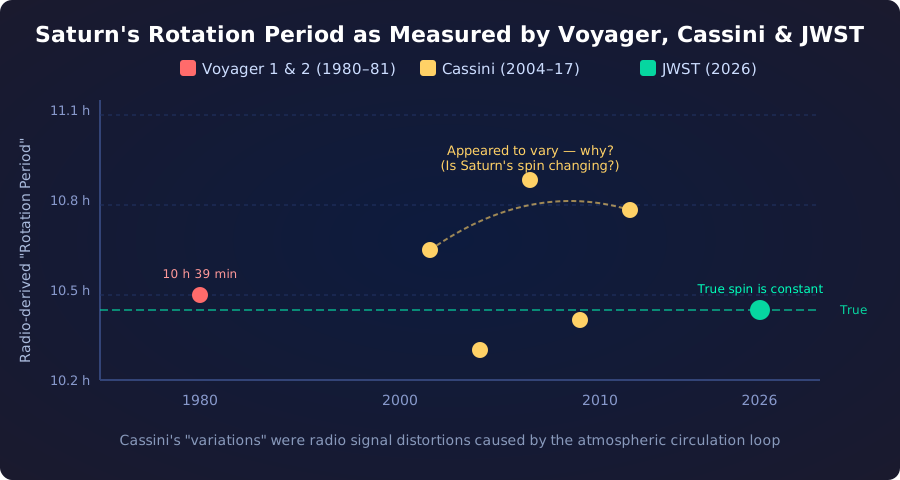
Voyager 1 clocked it at 10 hours, 39 minutes and 24 seconds back in 1980. Then subsequent observations started drifting — not by a tiny margin, but by measurable amounts that kept shifting. In astronomy, a planet can’t just decide to spin faster or slower. Yet every time researchers measured, the numbers refused to agree. Most of them didn’t believe the results at first, either.
In March 2026, the James Webb Space Telescope finally cracked the case. The culprit was the aurora.
Measuring a Planet With No Ground Was Already Hard
With a rocky world like Earth, you just track a mountain or a coastline and time how long it takes to come back around. Saturn doesn’t have that luxury. It’s made of gas and liquid — no surface, no landmarks, nothing to pin a marker to.
So astronomers turned to radio waves. Saturn’s powerful magnetic field emits radio pulses on a regular cycle. Measure that period, the thinking went, and you’ve got a proxy for how fast the planet’s interior is spinning.
The 10-hour-39-minute figure from Voyager was calculated this way, and for a while it sat in textbooks as Saturn’s “true” rotation rate.
Then NASA’s Cassini spacecraft arrived at Saturn in 2004 and began its continuous watch. Something strange happened almost immediately: the radio period started shifting. Worse, the northern and southern hemispheres were returning different values. Same planet, different numbers, different times.
“It can’t be that Saturn’s interior is actually changing. But if the radio signal is changing, something must be interfering with it, right?”
That question took more than 20 years to answer.
A Suspect Emerged in 2021
The first real breakthrough came in 2021. Tom Stallard and his team at Northumbria University found that powerful high-altitude atmospheric winds were generating electrical currents — and those currents were distorting the radio measurements.
In other words, the rotation rate itself hadn’t changed. The radio signal used to measure it was being nudged by current-carrying atmospheric winds.
But that opened a new question immediately: where were these winds getting their energy? What was driving them in the first place?
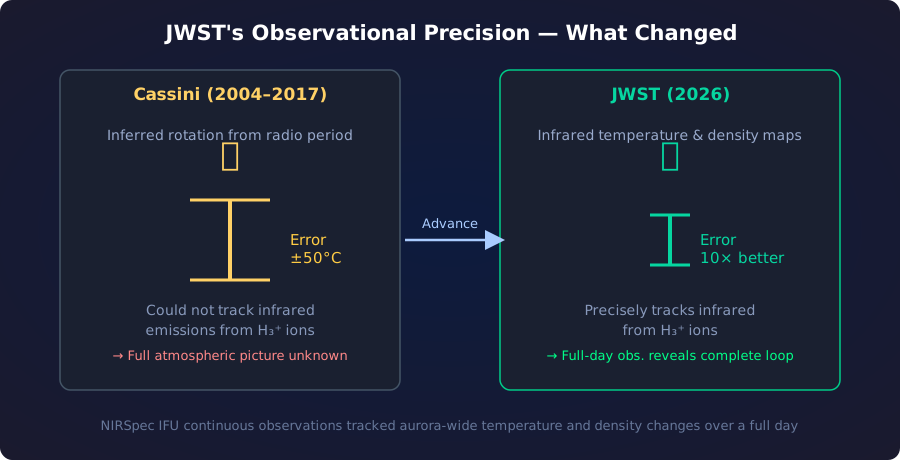
Cassini had run into a wall here. The instruments on board couldn’t precisely track the infrared emissions from a molecule called the trihydrogen cation (H₃⁺) in Saturn’s upper atmosphere. Without that, reconstructing the full picture of how the atmosphere was circulating was impossible.
JWST Stared at Saturn’s North Pole for an Entire Day
That’s where JWST came in. Its NIRSpec instrument — specifically the integral field unit — can track H₃⁺ infrared emissions with about ten times the precision of what Cassini could manage, where temperatures are now uncertain by only around 50°C compared to before.
Stallard assembled a team of 16 researchers and pointed JWST at Saturn’s north polar aurora region for a full continuous day. The goal was to track how temperature and density in that region shifted over time, hour by hour.
What they found, published in the Journal of Geophysical Research: Space Physics in March 2026, was more elegant than anyone expected.
A “Self-Sustaining Heat Pump” in Space
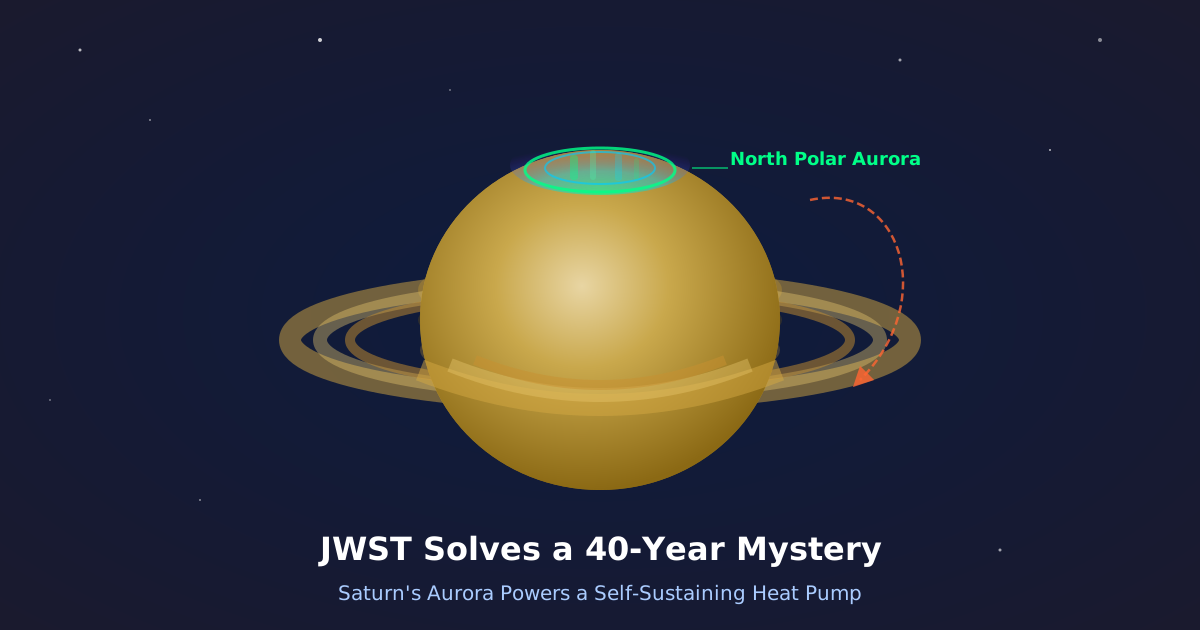
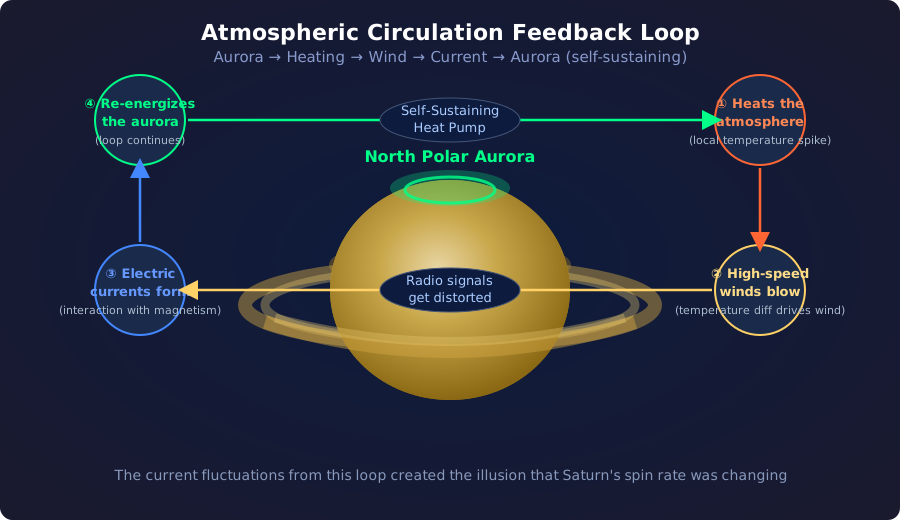
The team discovered a self-sustaining feedback loop centered on the aurora. Stallard described it as “effectively a planetary-scale heat pump.”
Walk through the steps: the aurora fires up at Saturn’s north pole. The atmosphere underneath gets locally superheated. That temperature difference drives powerful winds. The winds interact with the magnetic field to generate electric currents. Those currents pump energy back into the aurora, which heats the atmosphere again. Round and round it goes.
Once started, the loop feeds itself. It’s a Möbius strip of atmospheric physics, running continuously at Saturn’s north pole.
And the electric currents from that loop were bleeding into the radio measurements. Since the loop’s intensity shifts with season and hemisphere, it introduced what looked like genuine variation in the spin rate. The rotation was always the same. What changed was how much noise the loop injected into the signal.
Why Cassini Got the Right Data but Not the Right Answer
It’s worth being clear: Cassini was an extraordinary spacecraft. The radio measurements weren’t flawed. The problem was that nobody recognized the atmospheric circulation loop as the source of interference.
In hindsight, that makes sense. To spot it, you’d need to see the aurora, the atmospheric winds, the electric currents, and the magnetic field all interacting simultaneously — in motion. Cassini’s instruments couldn’t capture that full picture at once.
What JWST provided was a temperature-and-density time series across the entire aurora region. Not a snapshot, but a day-long continuous record at the molecular level. That combination of breadth and precision was the last missing piece.
This Probably Isn’t Just About Saturn
The most intriguing part of this discovery is that it may not stop at Saturn.
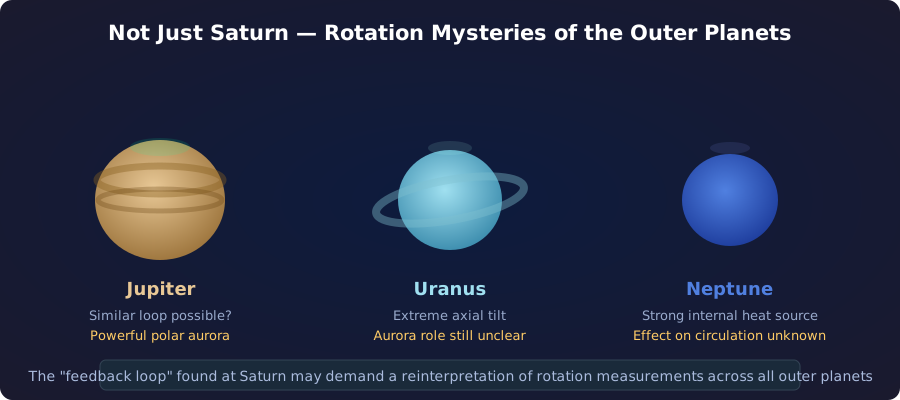
In their paper, the team suggests that the feedback structure they found — where the atmosphere drives the magnetosphere and the magnetosphere drives the atmosphere — could apply to the outer planets broadly.
Jupiter has ferocious polar auroras. Uranus has a rotation axis tilted almost 98 degrees, generating strange atmospheric dynamics. Neptune has an unusually strong internal heat source and some of the fastest winds in the solar system. Any of these planets could have had their apparent rotation rates skewed by the same kind of atmospheric interference.
“Does Jupiter’s spin rate need revising too?” That question hasn’t been answered yet, but it’s on the table — and the implications could reshape what we think we know about every gas giant in the solar system.
Why It Took 40 Years, and Why That’s Actually Fine
Some readers might find 40 years frustrating. But that’s really where the science lives.
The Voyager team wasn’t wrong to report what they measured. The Cassini team wasn’t wrong either. Researchers didn’t insist Saturn was changing — they kept confronting the inconsistency honestly, year after year, without a tidy explanation.
The problem was instrumental. To understand how atmospheric loops distort radio signals, you needed a way to watch those loops in real time, at scale, with molecular-level precision. JWST launched in 2021, began full science operations in 2022, and delivered this result in 2026.
The instrument had to exist first. That’s not a failure — it’s how science actually works. The mystery sat patiently, waiting for the right tool.
Saturn is still out there, turning at the same steady rate it always has, aurora glowing at its pole. Forty years after Voyager first tried to clock it, we finally have the real number.
Reference: Tom Stallard et al., “JWST observations of Saturn’s northern aurora reveal a self-sustaining feedback loop”, Journal of Geophysical Research: Space Physics, March 2026. Northumbria University newsroom