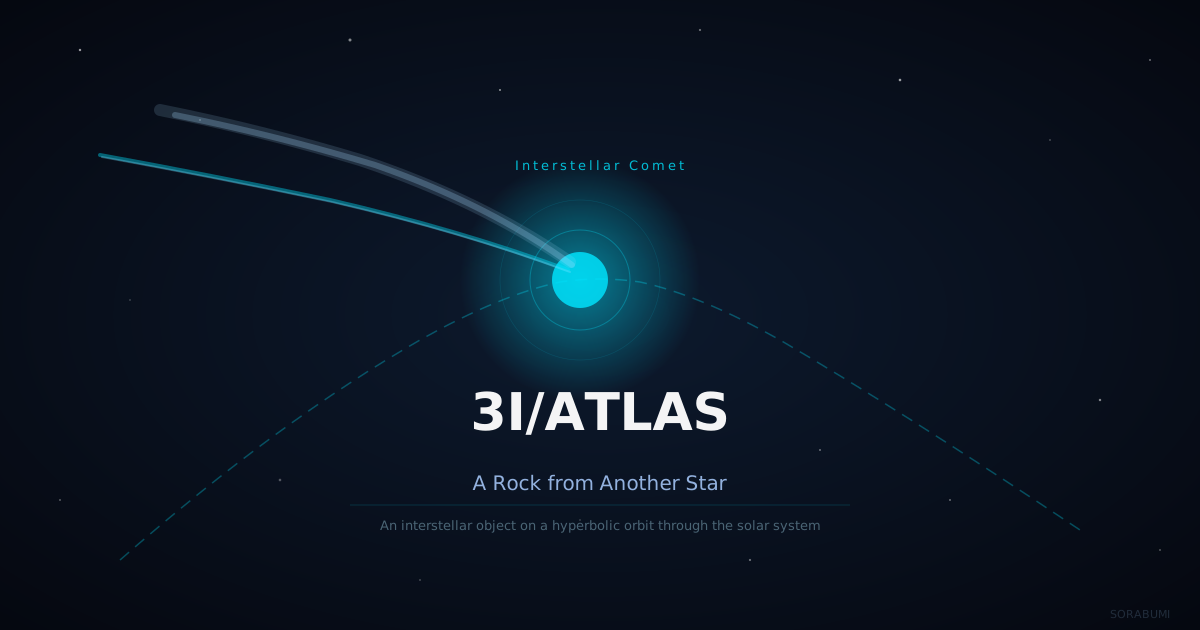
For the first time, humanity has directly read the ingredient label of an object born outside our solar system. The object in question is a single comet — one that formed around a distant star, got flung out of its home system, and wandered all the way here.
And the label looked nothing like what we expected.
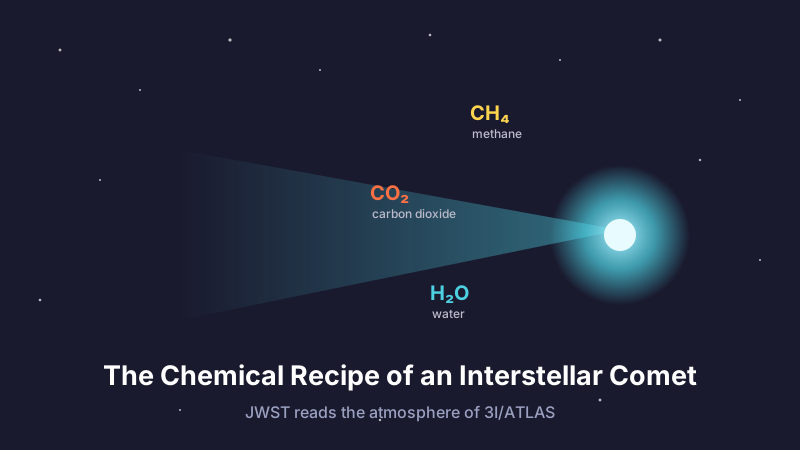
This is what the James Webb Space Telescope (JWST) found when it peered into the atmosphere of interstellar comet 3I/ATLAS: methane, and an extraordinary amount of carbon dioxide. Today I want to talk about this “recipe from another star” — and why it matters more than it might first seem.
What the “3I” in 3I/ATLAS Actually Means
Let’s start with the name. The “3I” prefix tells you everything about what this object is.
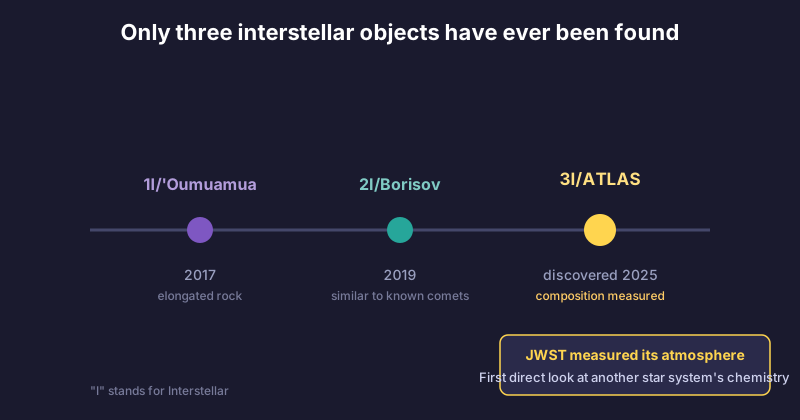
The “I” stands for Interstellar. These are objects that did not form in our solar system and are not gravitationally bound to the Sun. They were born around some other star, ejected from that system, and are simply passing through ours. Only two such objects had ever been confirmed before 3I/ATLAS: 1I/’Oumuamua in 2017, and 2I/Borisov in 2019. This one is the third.
Why does the third one matter so much more than the first two? The story is instructive.
‘Oumuamua was strange — elongated, rocky, barely outgassing. We couldn’t figure out what it was made of before it left. Borisov was more cooperative: it behaved like a normal comet and did release gas, but its composition turned out to be surprisingly similar to solar system comets. In other words, it came from somewhere else and looked like something we already knew.
3I/ATLAS is different. It is a comet, which means as it swings toward the Sun, internal ices warm and sublimate, venting gas into space. That gas carries the chemical fingerprint of wherever this thing was assembled. The comet, in effect, handed us its own ingredient label.
Pause for a moment on what that means. We have never sent a probe to another star system. Yet here we are, analyzing material that actually formed around one — because the delivery arrived on its own.
Three Molecules JWST Could Smell
So how do you read a comet’s chemical label from here? The tool is JWST’s MIRI instrument — the Mid-Infrared Instrument.
Different molecules absorb and emit infrared light at characteristic wavelengths. It works a bit like identifying food by its smell: each molecule has a unique “fingerprint” in the infrared, and MIRI is extraordinarily good at reading those fingerprints.
The observations took place on December 15–16 and again on December 27, 2025, while the comet was more than 300 million km from the Sun — more than twice the Earth-Sun distance, and well into cold-space territory.
MIRI picked out three molecules: water vapor, carbon dioxide, and methane.
The methane detection carries special weight. According to the research team, this is the first time methane gas has been directly detected in an interstellar object. For the first time, we can name a specific organic building block in material that originated around another star.
Water, carbon dioxide, and methane. On their own those names sound almost mundane. But here’s where things get interesting — and this is honestly my favorite part of the story. What really matters is not which molecules were there, but how much of each.
The Ratios Are Completely Different
In a typical solar system comet, water ice dominates. Carbon dioxide is present too, but usually in modest amounts relative to water.
3I/ATLAS broke that pattern. The carbon dioxide abundance was unusually high — the research team described it as a ratio rarely seen in solar system comets. The methane-to-water ratio also sits well outside the range of most comets we know from our own system.
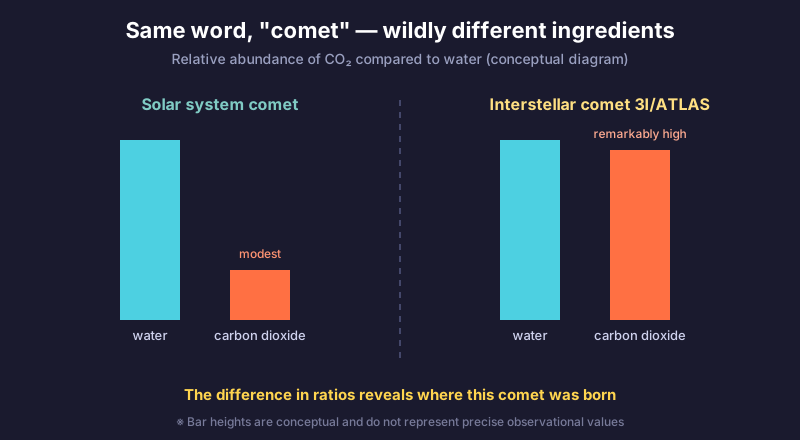
Why would the ratios be different? Comets are, in a sense, the leftover material from planet formation. The temperature, pressure, and available chemistry at the spot where a comet solidified all get locked into its ice composition. The ratios become a record — a recipe card — of the conditions where that object was made.
Think of it like home cooking. Two people can both make curry, but if one grew up in a kitchen where they always used twice as many spices, you can taste the difference. 3I/ATLAS’s recipe doesn’t match any kitchen in our solar system.
The high CO₂ content, for instance, could be a sign that this comet froze at a very cold location in its home system. Carbon dioxide freezes at a lower temperature than water. So the abundance of CO₂ is a clue about how far from its host star — and how cold — the place was where this object originally formed.
I’ll be honest: that single point made me genuinely pause. A different recipe means a different kitchen. We are reading the culinary style of a kitchen no one has ever visited, based entirely on what the ingredients tell us about themselves.
Methane That Came From Deep Inside
There’s a second layer to the methane story. It’s not just that methane was there — it’s about where it came from.
The research team’s interpretation is that this methane did not come from the comet’s surface. It welled up from ice buried deep in the interior.
Here’s the picture they propose: as the comet made its closest approach to the Sun, solar heat penetrated not just the surface crust but down into a deeper layer of methane-rich ice. That ice sublimated rapidly, and the resulting gas punched through to the outside. MIRI caught it in the act.
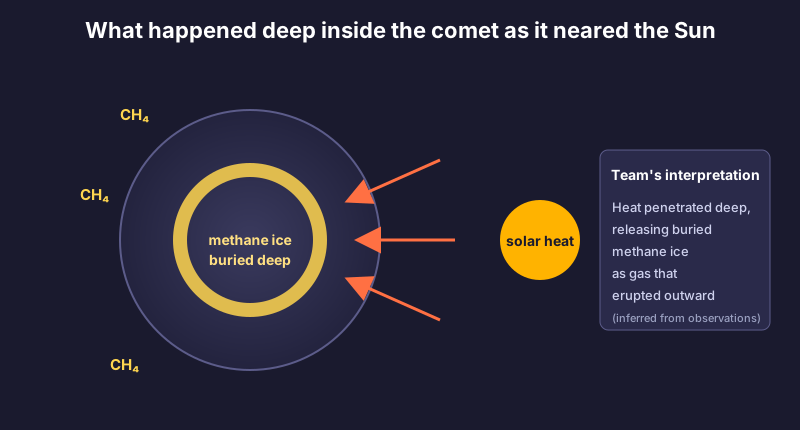
It’s worth being clear about what’s observation and what’s interpretation here. The detection of methane is observed fact. That it came from deep inside is the team’s best explanation for that fact — a well-reasoned inference, but an inference.
Even so, the picture it paints is vivid. Imagine floating next to that comet: the ground warming beneath you, ancient ice buried inside slowly vaporizing and seeping out, jets of gas that have been frozen in place for billions of years finally escaping into space. That gas carries the chemistry of a distant star system — and a telescope 300 million km away just named its molecules.
Entering the Era of Direct Chemical Measurements from Other Stars
The real significance of this result isn’t just that an interesting comet came along.
Until now, every method we had for learning about the chemistry of other star systems was indirect. We analyze the spectrum of starlight. We measure the tiny dimming as a planet crosses in front of its star and look at how the atmosphere filters the light. All of these are clever, and they’ve taught us an enormous amount — but they’re all ways of observing from a distance.
3I/ATLAS is different in kind. A solid object that actually formed around another star traveled to our solar system and vented its interior chemistry in front of our telescope. We didn’t infer the composition from light filtered through an atmosphere 100 light-years away. We measured the molecules directly.
The difference is significant. Reconstructing composition from a distant star’s light is a bit like trying to identify a dish by its aroma alone. With 3I/ATLAS, we got to ladle out a taste from the pot. Same general process called “analysis,” but a completely different level of confidence.
The results were published in an astronomy journal in April 2026. The lead author is Matthew Belyakov of Caltech, with co-authors including Ian Wong of the Space Telescope Science Institute, among others.
This was only the third interstellar object ever identified — and we were already able to go this deep. Which means the fourth and fifth, when they come, will add more pages to a recipe book we’re just beginning to compile. One recipe tells you very little. A dozen starts to reveal patterns. Enough, eventually, to say something about the range of kitchens the universe runs.
Somewhere out there right now, an unnamed interstellar object may already be crossing our sky, too faint to see yet. When it finally shows up, humanity will quietly pull another ingredient label off the shelf of a star system no one has ever visited.