Twenty-six thousand light-years from Earth, deep inside a cold cloud of gas and dust near the galactic center, astronomers have found a sugar made of four carbon atoms.
The molecule is called erythrulose — not a household name, but think of it as a smaller, simpler cousin of table sugar. What matters isn’t so much what it is, but where it turned up: in a lightless void where no stars or planets have yet formed, a molecule that could be a building block for life’s genetic machinery was already assembled and waiting.
Finding Organic Molecules in Space Isn’t the Surprise Anymore
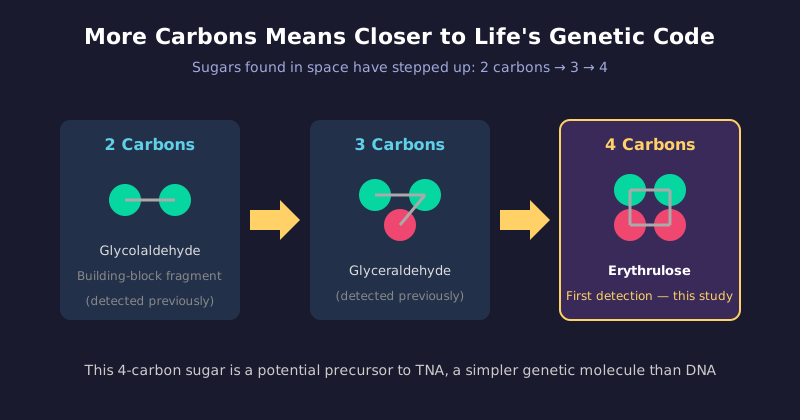
Let’s be honest: the headline “organic molecule detected in space” has become almost routine. Fragments of amino acids, precursors to DNA bases, sugars of various kinds — they keep turning up in star-forming clouds and comets. Simple sugars with two or three carbon atoms have been found before, so “sugar in space” alone wouldn’t rate much excitement.
The interesting part here is the carbon count.
The backbone of DNA and RNA — the molecules life uses to store genetic information right now — relies on a 5-carbon sugar. Until this discovery, the most complex sugars spotted in space had only two or three carbons. This detection of a 4-carbon sugar in a molecular cloud is a step up. Think of it as climbing one more landing on a long staircase toward life.
A team led by Izaskun Jiménez-Serra of the Centro de Astrobiología (CAB) in Spain published these results as a preprint in June 2026. They made the observations using the Yebes 40m telescope in Spain and the IRAM 30m telescope in France, reading the radio-wave “fingerprints” that molecules leave in the spectrum to identify exactly what’s out there.
So What Exactly Is Erythrulose?
Bear with me for a moment of chemistry. It pays off later.
When most people hear “sugar,” they picture something sweet. In chemistry, the word covers a much broader family: any molecule where carbon, hydrogen, and oxygen link up in a particular pattern. Erythrulose is a member of that family called a ketose, with four carbon atoms strung together.
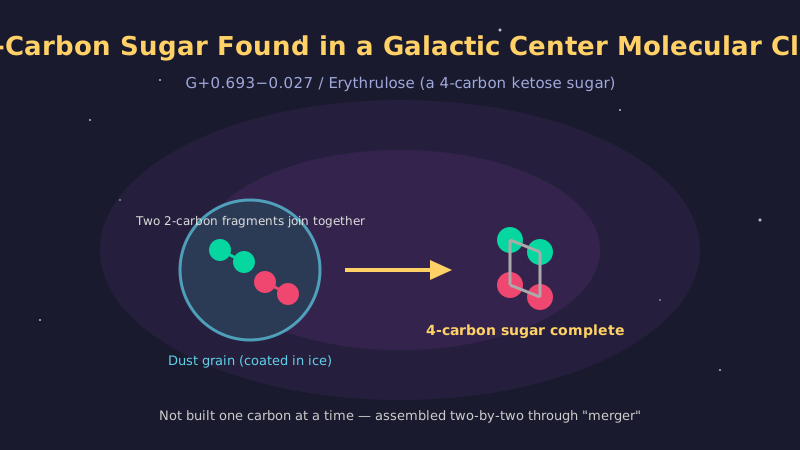
The cloud where it was found has the cryptic designation G+0.693−0.027 — a dense region of dust and gas close to the Milky Way’s center. Astronomers have long treated it as a molecular treasure chest; unusual molecules keep showing up there.
The detection itself is solid. The probability that the observed radio signal appeared by random chance is just 0.2 percent — about two times in a thousand. The team is confident this is a genuine detection of erythrulose.
A brief sense-of-scale note: “26,000 light-years” means the radio waves now reaching our telescopes left that cloud when humans were still living in Ice Age caves. We’re receiving a very old message.
The Real Surprise Was How the Sugar Forms
This is the part I find most compelling.
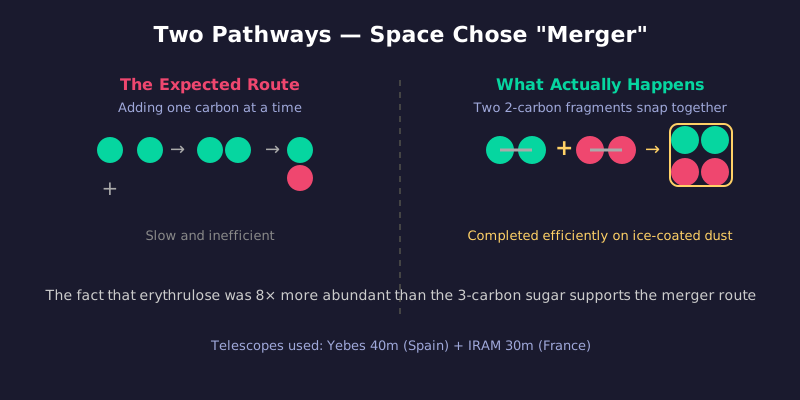
If you want to build a larger sugar by adding carbons, the obvious way is to do it one atom at a time — like climbing a ladder rung by rung. Many chemists assumed that’s how it worked in space too.
But the observed abundances didn’t fit that picture. Erythrulose (4 carbons) was at least eight times more plentiful than glyceraldehyde (3 carbons). If you were adding carbons one at a time, each step up the ladder should produce less of the product, not more. Something was off.
The team’s alternative explanation: instead of adding carbons one by one, the cloud is joining two 2-carbon fragments in a single step. Molecules like glycolaldehyde and ethylene glycol — both 2-carbon species — meet on the ice-coated surfaces of tiny dust grains and lock together, producing a 4-carbon sugar in one shot.
It’s the difference between stacking blocks one at a time and snapping two pre-made pairs together. This “merger” pathway naturally explains why the 4-carbon sugar is more abundant than the 3-carbon one.
The venue for that reaction — ice on microscopic dust grains drifting through interstellar space — is remarkable in its own right. Cosmic rays and hydrogen atoms bombard the ice, creating reactive conditions. What looks from the outside like an inert, frozen cloud is, at the grain scale, a tiny chemical factory running continuously.
TNA: A Genetic Molecule Simpler Than DNA
Now for the life-of-life connection.
Today’s organisms store genetic information in DNA and RNA, but those are enormously complex structures. Most researchers don’t think something that sophisticated sprang into existence fully formed. There must have been simpler precursors — earlier versions that could carry information without all the biochemical machinery we have now.
One strong candidate is TNA, short for threose nucleic acid. Its backbone is simpler than DNA or RNA, yet it can still form chains capable of storing and transmitting information. The hypothesis is that the very first self-replicating molecules may have been TNA-like, before life eventually upgraded to the more capable DNA system.
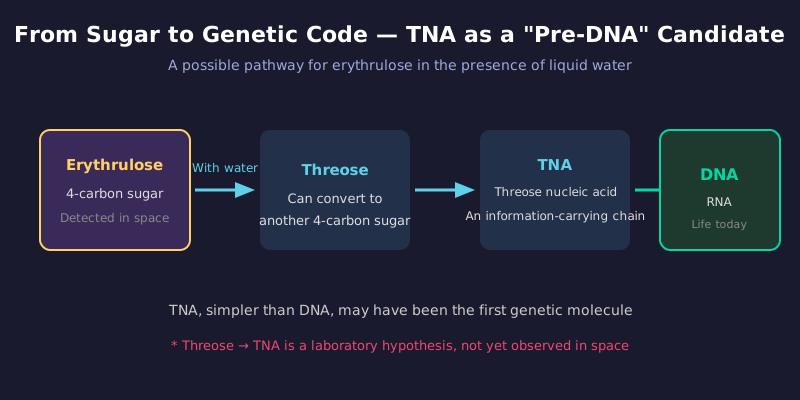
Here’s where erythrulose fits in. According to the research team, erythrulose can convert to threose — another 4-carbon sugar — when liquid water is present. And threose is exactly the structural backbone that TNA is built from.
The chain of possibilities, then, runs like this: erythrulose forms in interstellar space, gets delivered to a young planet, converts to threose in the presence of water, and threose polymerizes into TNA — a first-generation information molecule. The path to heredity may trace all the way back to a dark molecular cloud.
A word of caution, though. The step from threose to TNA is a laboratory hypothesis, demonstrated in chemistry experiments. There is no observational evidence that it happens in space. What this study confirmed is that a 4-carbon sugar exists in a molecular cloud. Everything beyond that is a plausible story that researchers are working to test. It’s worth keeping observation and speculation in clearly separate buckets.
What This Discovery Actually Changes
So what’s different now?
One shift is in how we think about the supply chain for life’s ingredients. You might imagine that the molecules needed for biology were synthesized on Earth after the planet formed. But if 4-carbon sugars already existed in the molecular cloud that predated the solar system, the picture changes. The raw materials may have been delivered ready-made, carried aboard the dust and ice that eventually clumped together into Earth.
Try this thought experiment: picture the early solar system from outside, 4.6 billion years ago. Earth was still a whirling cloud of debris. Inside that cloud, sugar molecules were already present. Life’s building blocks didn’t wait for a planet to exist — they had a head start.
The other shift is in the recipe. Seeing a “merger” of 2-carbon fragments rather than a step-by-step addition gives researchers a new handle on how increasingly complex molecules assemble in space. Sugars with 5 or 6 carbons may not be far off from being detected.
Look at the night sky on a clear evening. Those dark patches in the Milky Way — the stretches where stars seem to be missing — aren’t empty. They’re dense clouds where, right now, on the surfaces of grains smaller than a grain of sand, molecules are quietly clicking together. The next time you see that dark band overhead, somewhere in it, a small sugar is being born.