Every time I look at photos of Mars, something nags at me. Why are the north and south so dramatically different? The northern hemisphere is a broad, smooth lowland; the south is cratered ancient highlands. That asymmetry has puzzled Mars researchers for decades.
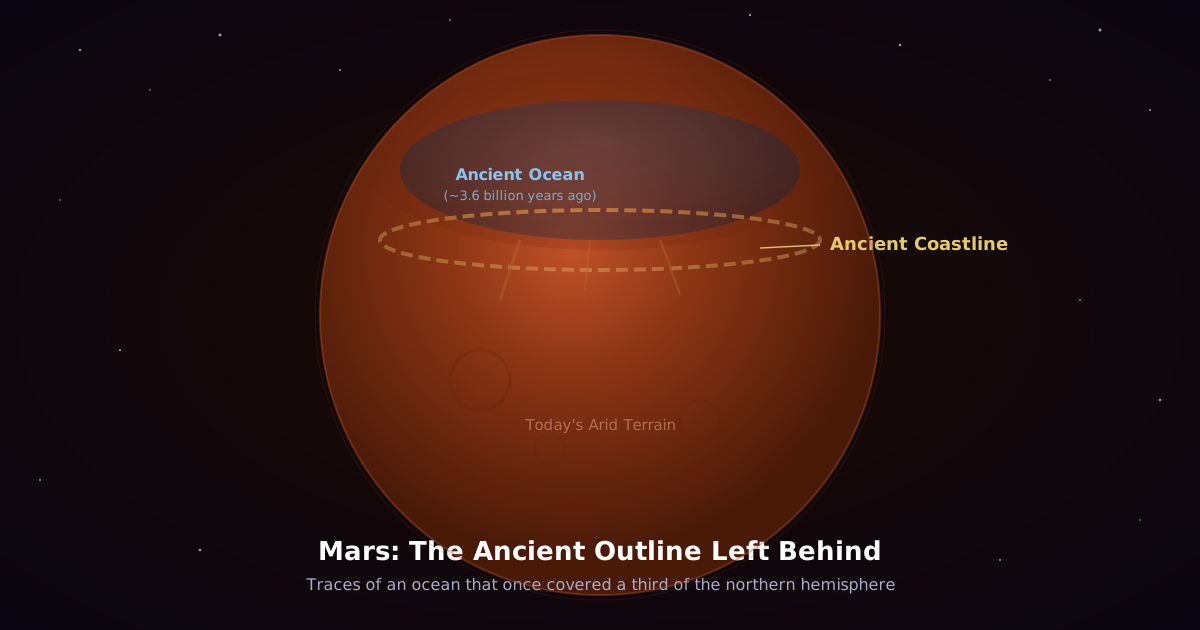
In April 2026, a study published in Nature by researchers at Caltech offered one of the most compelling answers yet. The northern hemisphere, they argue, was once home to a vast ocean covering roughly a third of the planet — and the evidence is literally ringed into the landscape.
What Is a “Bathtub Ring”?
The research team, led by Abdallah Zaki and Michael Lamb, zeroed in on a feature that looks a lot like a continental shelf.
On Earth, a continental shelf is the shallow, flat seafloor extending from the edge of a continent — typically down to about 200 meters depth. Sediment accumulates there over millions of years under the ocean’s weight. Finding one is essentially a receipt: it proves an ocean was parked there, long-term.
The colloquial name for this kind of feature — “bathtub ring” — is almost too apt. It’s the ring of grime left on the inside of a tub after the water drains. When a sea dries up, it leaves behind a similar topographic trace along its old shoreline.
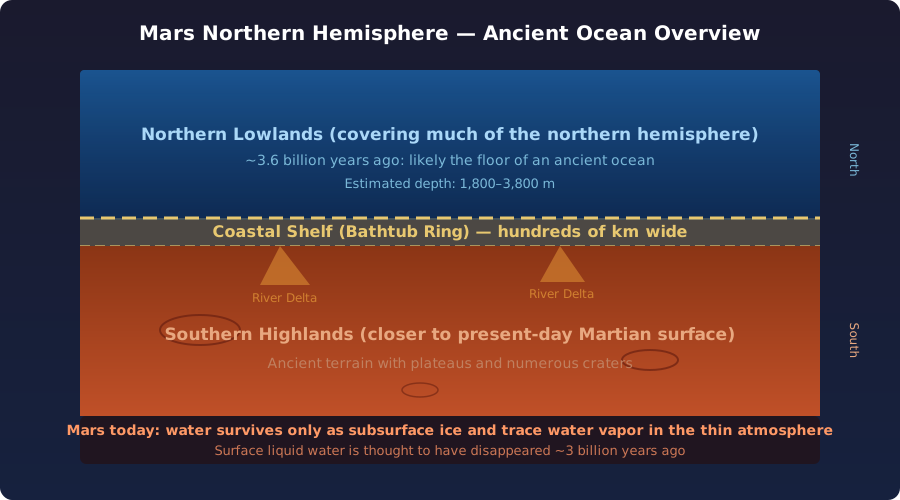
When Zaki and colleagues analyzed Martian terrain data, they found exactly this kind of flat shelf running along the margin of the northern lowlands. Some sections stretch hundreds of kilometers wide. The shelf sits roughly 1,800 to 3,800 meters below Mars’s theoretical reference surface — and crucially, the locations of ancient river deltas line up with it almost perfectly. River deltas only form where rivers meet the sea. Rows of ancient deltas lining up along a shelf is a strong argument that this was once a real coastline.
Haven’t We Heard This Before?
Fair question. The idea of liquid water on ancient Mars is hardly new. The surface is covered with erosion channels, mineral analyses point to prolonged water exposure, and since the 2001 Mars Odyssey mission we’ve known there’s an enormous volume of ice buried underground.
The sticking point has always been: was that water temporary or sustained? Earlier evidence couldn’t rule out a scenario where heavy rains created short-lived ponds, then vanished. Brief wet seasons don’t build continental shelves. A shelf requires water to persist for millions of years, with sediment slowly piling up layer by layer. That makes the shelf a different class of evidence — not circumstantial traces of water that once flowed, but direct topographic proof that a stable shoreline existed.
Researchers are calling it “the most compelling evidence yet” for an ancient Martian ocean.
Why a Shelf Is Hard to Fake
It’s worth dwelling on why shelf topography carries so much weight as evidence.
A shoreline by itself is actually a weak argument. Sea level can fluctuate by tens to hundreds of meters due to climate shifts and tectonic activity, so a single preserved shoreline might reflect nothing more than a temporary water spike.
A continental shelf is different. It builds through patient, relentless deposition — sediment settling under shallow water over millions of years, accompanied by chemical weathering of the underlying rock. You can’t make one in a storm or a flood. The formation process encodes the long presence of water in the structure itself.
The shelf features Zaki’s team identified are far too extensive and too coherent to be explained by transient water. Their shape and scale are consistent with Earth’s own continental shelves. And there’s one more thing worth noting: the fact that these features are still recognizable after billions of years of volcanism and wind erosion means they were large enough to survive. That alone says something about the scale of what was once there.
Where Did the Ocean Go?
If an ocean covered a third of the northern hemisphere, what happened to it?
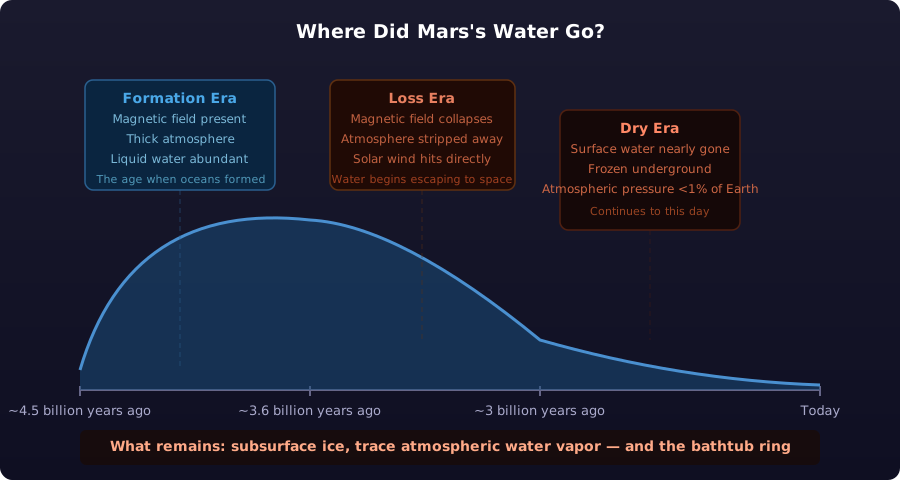
The answer involves several compounding factors.
First: the collapse of the magnetic field. Around 4 billion years ago, Mars’s internal activity slowed and its global magnetic field faded. On Earth, the magnetic field acts as a shield, deflecting the solar wind — the stream of charged particles that constantly blows out from the Sun. Without that shield, the solar wind began stripping away Mars’s atmosphere.
As the atmosphere thinned, air pressure dropped. Lower pressure means water boils at a lower temperature, so evaporation accelerated. Water vapor rising into the upper atmosphere was split apart by ultraviolet radiation and the hydrogen bled off into space.
Today, Mars’s surface pressure is about 0.6% of Earth’s. Liquid water simply can’t exist at the surface under those conditions. Most of the ancient ocean escaped to space; the rest froze underground. A faint trace remains as water vapor in the thin atmosphere.
The whole process took hundreds of millions of years. The bathtub ring is estimated to have formed around 3.6 billion years ago — right in the window when the magnetic field was already gone and Mars was drying out fast.
A Map for the Search for Life
The most significant implication of this discovery may be what it means for where to look next.
On Earth, the sediment layers most likely to yield fossils and organic material are those that were once near a coastline. Shorelines concentrate nutrients; microbial life thrives there. River deltas — where organic-rich sediment washes into the sea — are especially productive hunting grounds.
On Mars, the places where the bathtub ring overlaps with ancient delta deposits are precisely the analogs to those fossil-rich environments.
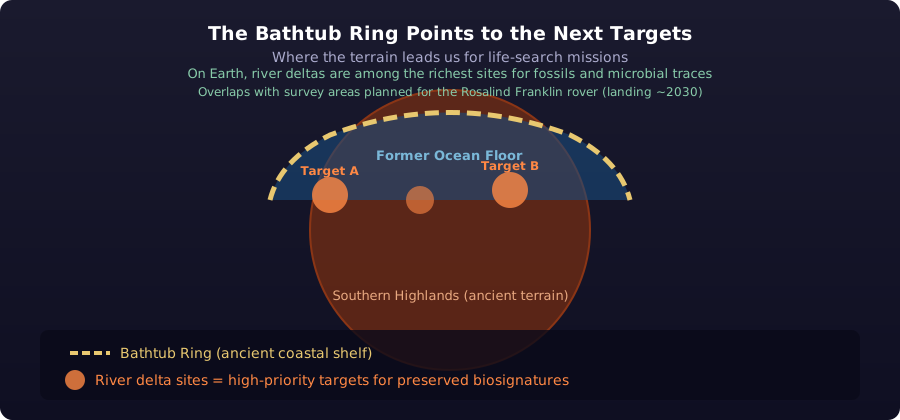
ESA’s Rosalind Franklin rover, set to launch in late 2028 and land on Mars in 2030, carries a drill capable of sampling rock down to two meters below the surface — deep enough to reach material sheltered from radiation. The landing zone candidates being considered overlap significantly with the northern lowland margin where the bathtub ring sits. That’s not a coincidence.
NASA’s Curiosity and China’s Zhurong have similarly prioritized zones that were once wet. This latest finding sharpens those targeting decisions with a much clearer geological rationale.
As It Once Was on Earth
Take a moment to imagine Mars 3.6 billion years ago, viewed from above. The northern hemisphere is mostly blue ocean. River mouths fan out into deltas where the water meets the land. Sandy shallows line the shore. And under the water, maybe, microbial colonies spread across submerged rock surfaces.
All of that is now desiccated rust-red stone. But the outline of where the water stopped — that much is still there, etched into the terrain.
The same thing happened on Earth, in a different era. Ancient seafloor sediments now exposed at rocky shorelines have given us fossils, and from those fossils we’ve read the history of life on this planet.
The bathtub ring on Mars might be doing the same thing: preserving whatever was there, waiting to be read. Reading it requires rock samples. That’s why the rovers are heading that way.
Researchers have been looking for this kind of evidence for a long time. Or maybe it’s the other way around — the evidence was always there, written into the landscape, waiting for us to notice.