Rocky or Gassy — What If It’s Neither?
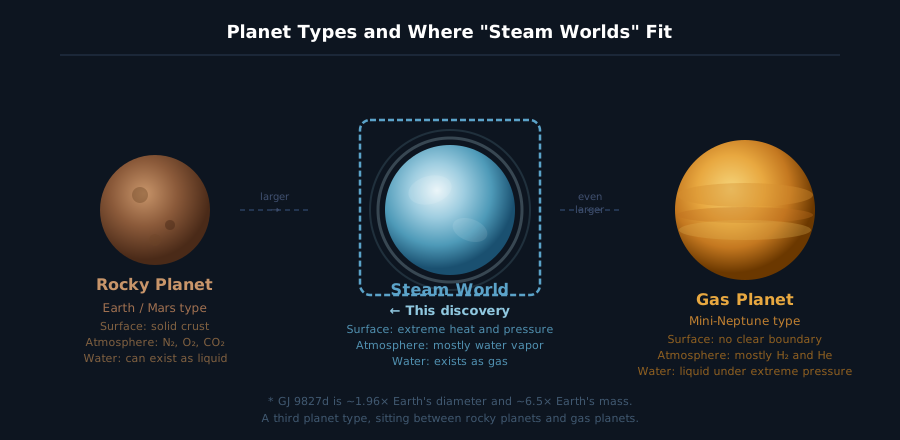
The universe is overflowing with planets. We’ve confirmed more than 5,000 of them, and new ones keep turning up every year. With that many examples in hand, researchers have gotten comfortable sorting planets into two broad buckets.
The first is the rocky planet — worlds like Earth and Mars with solid crusts you could stand on. The second is the gas planet (or its smaller cousin, the “mini-Neptune”) — worlds like Jupiter and Neptune swaddled in thick layers of hydrogen and helium.
Then in 2023, JWST — the James Webb Space Telescope — confirmed a planet that fits neither description.
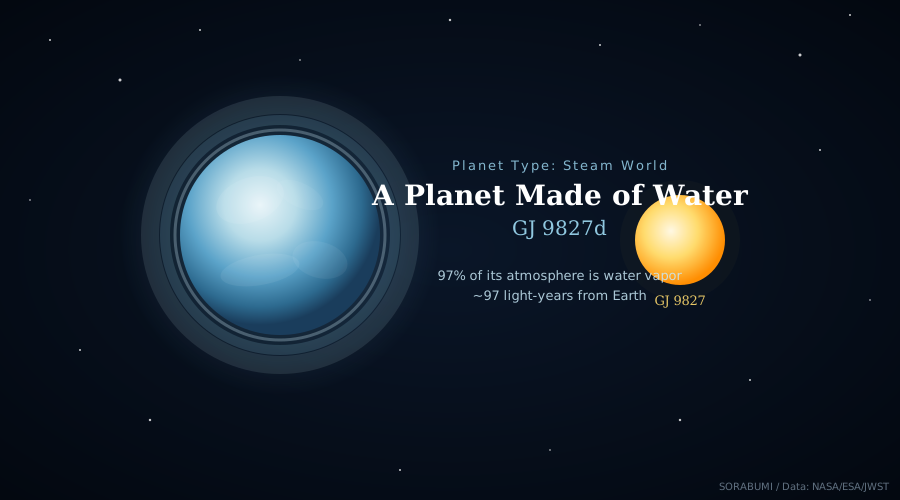
Meet GJ 9827d. It sits 97 light-years away in the direction of the constellation Hydra. Its diameter is roughly 1.96 times Earth’s, its mass about 6.5 times ours. Size-wise, you might guess it’s a slightly oversized rocky planet or a smallish gas world. But when JWST analyzed its atmosphere, the answer was something else entirely.
Almost the entire atmosphere is water vapor.
Not nitrogen. Not oxygen. Not carbon dioxide. Water. Water vapor accounting for more than 97% of the atmosphere. Researchers are calling this a “steam world.”
Why Scientists Use the Word “Confirmed”
To be precise about it: the idea that steam worlds could exist had been theorized for years. But predicting something and actually observing it are two different things. Nobody had managed to take a spectrum of an exoplanet atmosphere and say, with confidence, “this is a water vapor world” — not until now.
GJ 9827d is the planet where JWST pulled off that first confirmed detection. The Hubble Space Telescope had already hinted at water in its spectrum, but the signal was too close to the noise level to be definitive. It took JWST’s sharper eyes to cross the line from “maybe” to “yes.”
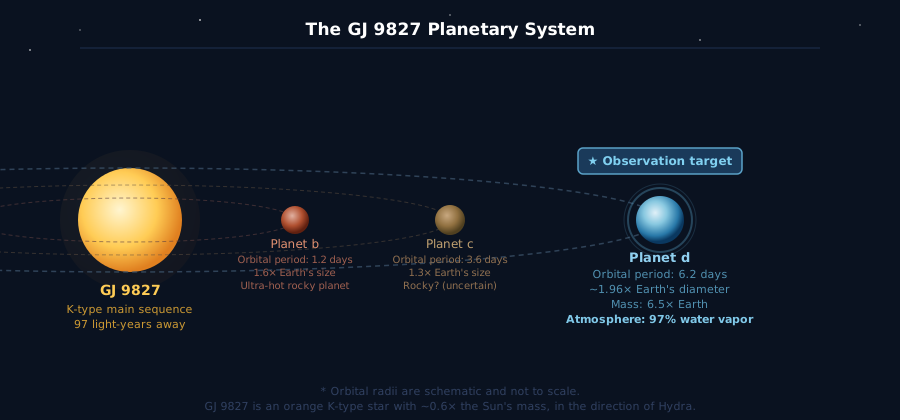
The host star, GJ 9827, is an orange K-type star slightly smaller and dimmer than our sun. Three planets orbit it — b, c, and d, in order from the inside out. Planet d, the outermost, is the one drawing all the attention. Its orbital period is 6.2 days — a full year in just over six days.
And yet “outermost” is relative. Planets b and c orbit so close to the star that they complete a lap in about a day. Planet d just looks roomy by comparison. In absolute terms, it’s still much closer to its star than any planet in our solar system, and its surface temperature is estimated to exceed 400°C. Liquid water has no chance of surviving there.
Reading an Atmosphere 97 Light-Years Away
You might wonder how this is even possible. Can we really measure the composition of an atmosphere from here?
As it turns out, yes — through a technique called transit spectroscopy.
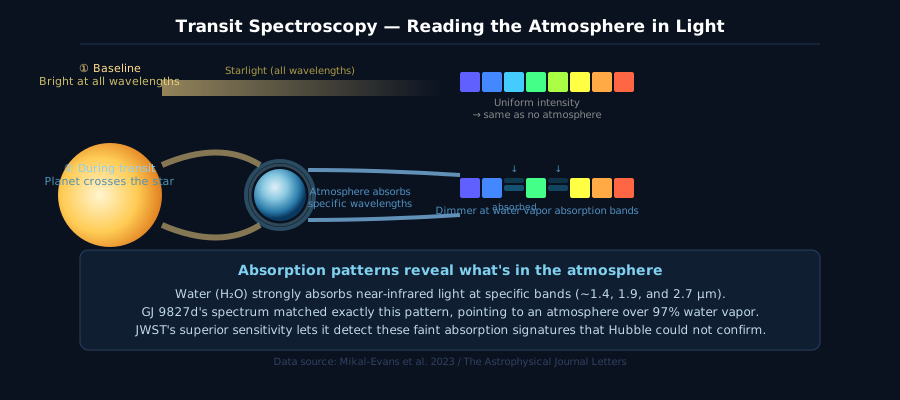
Here’s how it works. When a planet crosses in front of its star, some of the starlight passes through the planet’s atmosphere on its way to our telescopes. Different molecules absorb different wavelengths of that light — water (H₂O) in particular soaks up specific bands in the near-infrared. By looking at which wavelengths are missing from the transmitted spectrum, scientists can figure out what the atmosphere is made of.
GJ 9827d’s spectrum showed the water vapor absorption pattern clearly — and not just faintly. The signal was strong enough to suggest that nitrogen, hydrogen, and other potential atmospheric gases weren’t diluting the water at all. Water vapor dominated completely.
JWST stacked data from more than 30 separate transits to build up that result. Painstaking observation, accumulated over time, produced a historic finding.
”Water World” — So Does That Mean Life?
The obvious question: if there’s that much water, could something be living there?
Honestly, the odds are not good.
Temperature is the first problem. GJ 9827d’s atmosphere is estimated at over 400°C, and the planet sits in an environment bathed in intense stellar radiation. It’s well outside the “habitable zone” where liquid water can stably exist. The water is plentiful, but every last bit of it is boiling into gas.
Then there’s everything else life requires. Energy budgets. Sources of organic molecules. Interfaces between liquid and solid phases where chemistry can happen. Time. There’s no evidence GJ 9827d checks any of those boxes.
That said, this discovery matters for astrobiology in an indirect way. Now that we know steam worlds are real, they expand our map of planetary diversity. How do water-rich planets form? Where does all that water come from? What kinds of intermediate structures exist between rocky planets and gas giants? This is one solid foothold for answering those questions.
And if water-heavy planets like this can form at all, it raises the possibility that the same type of world might exist at a cooler distance from its star — somewhere water could stay liquid. GJ 9827d may be a sweltering dead end itself, but it points toward what could be an interesting family of worlds.
How Does a Steam World Come to Be?
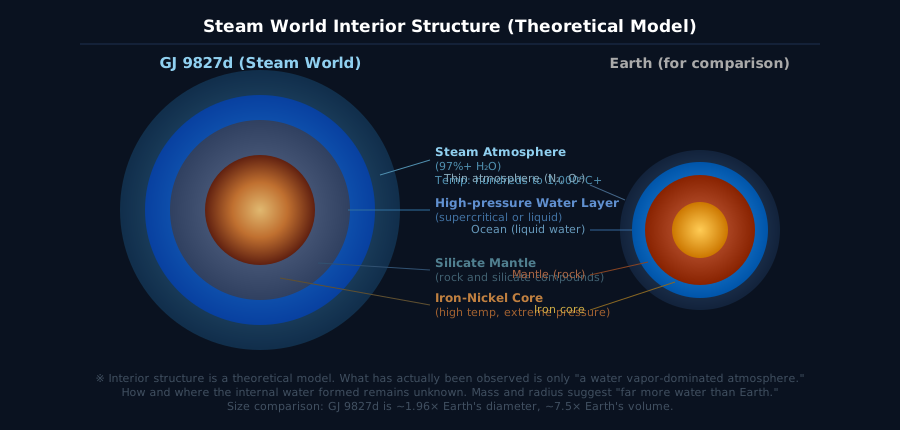
Two competing hypotheses are trying to explain how GJ 9827d got this way.
The first is the “water-rich formation” scenario. The planet formed far from its star, beyond the snowline where water ice was abundant. Rocky and icy material clumped together to build the planet, which later migrated inward. As it crept toward the star, the heat gradually evaporated the ice into the water-vapor atmosphere we see today.
The second is the “stripped mini-Neptune” scenario. GJ 9827d started out as a mini-Neptune with a hydrogen-helium envelope. The star’s intense X-ray and ultraviolet radiation then blasted the lighter gases away over billions of years, leaving behind only the heavier water vapor.
Which story is right? That will take more work — precise density measurements, comparisons against planet formation simulations. Both scenarios are still in play.
JWST and the New Age of Exoplanet Atmospheres
None of this happens without JWST. Since the telescope began operations in 2022, exoplanet science has shifted into a higher gear.
Hubble could probe atmospheres, but its sensitivity and wavelength range had real limits. JWST covers a broad swath from near-infrared to mid-infrared, and it can detect signatures of water, methane, and carbon dioxide with far better precision. The steam world confirmation is just one entry on a growing list: around the same period, JWST also detected carbon dioxide in another exoplanet’s atmosphere and identified sulfuric acid clouds elsewhere. What used to be “perhaps” is now “here’s what it’s made of.”
Ninety-seven light-years sounds far. On the scale of the Milky Way, it’s practically next door. And right there in our own neighborhood, a planet wrapped entirely in water vapor has been quietly orbiting its star all along. The old “rocky or gassy” binary never quite captured what the universe was doing.
A Steam World Rewrites the Planetary Rulebook
Understanding planetary diversity is really about understanding why Earth — with its rocky surface, liquid water oceans, and thin atmosphere — turned out the way it did.
Earth is one specific solution to a very large problem. Every new type of planet we confirm adds a data point to the picture, helping us see how common or how rare our own particular solution might be.
The steam world adds a new page to that catalog.
A world wrapped in water vapor, 97 light-years away, is real. We don’t know yet whether anything could live there. But knowing it exists — that’s enough to make you see the sky a little differently.