6,000 Planets — and Zero Earths
As of 2026, humanity has confirmed more than 6,000 exoplanets. Gas giants the size of Jupiter, icy worlds rivaling Neptune, hot Jupiters screaming around their stars in a matter of days. All kinds of worlds are out there.
And yet, not a single one is genuinely Earth-like.
To be precise, there are about 70 candidates that might resemble Earth in some way. But “similar” and “identical” are very different things. A planet that matches Earth’s size, temperature, liquid water, and atmospheric composition — all at once — doesn’t exist in our confirmed catalog. Not one.
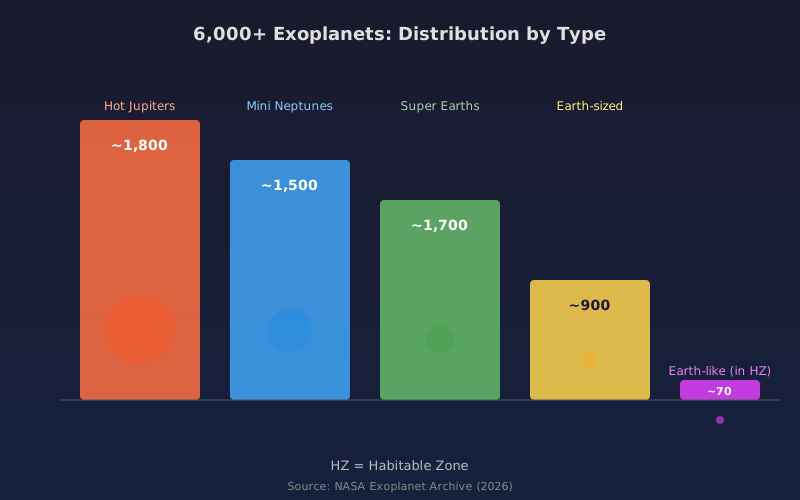
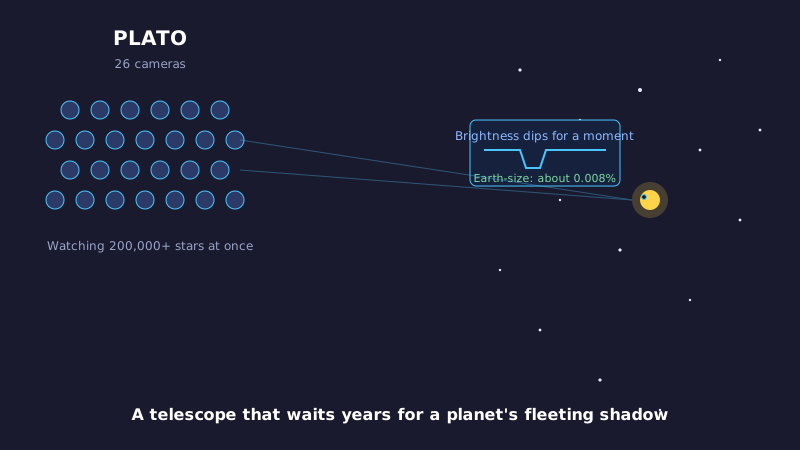
Why haven’t we found one? The short answer: we can’t see them yet. Earth-sized planets are small. When one crosses in front of a distant star, the signal it produces is barely a whisper. Analyzing the atmosphere requires even greater precision. So the absence of a confirmed Earth twin doesn’t mean one doesn’t exist — it means we haven’t been able to look hard enough.
The “Habitable Zone” and Why It’s So Easily Misunderstood
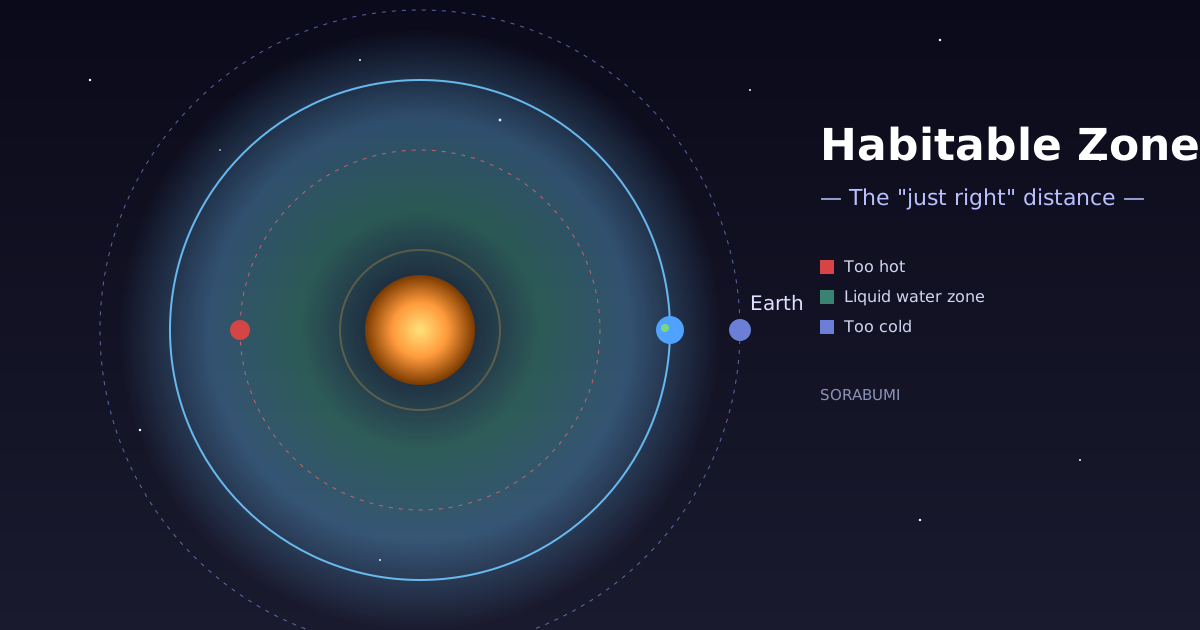
Any conversation about exoplanets inevitably brings up the habitable zone — the range of distances from a star where liquid water could theoretically exist on a planet’s surface.
In our own solar system, the habitable zone spans roughly from Venus’s orbit to Mars’s orbit, with Earth sitting comfortably in the middle.
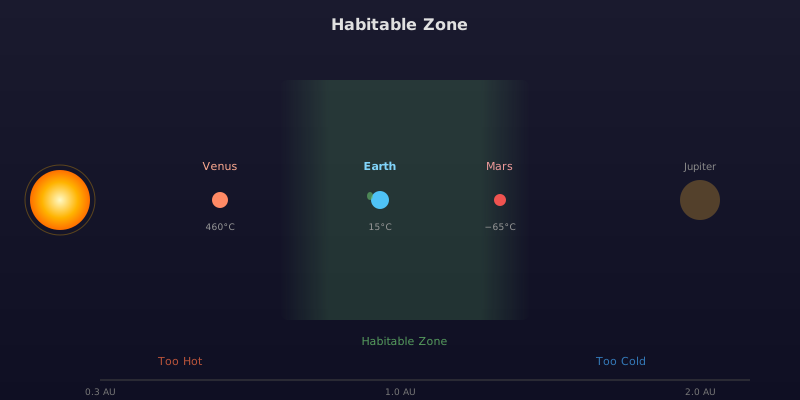
But the term is deceptively optimistic. “In the habitable zone” does not mean “habitable.” Venus sits right at the inner edge, and its surface temperature hits 460°C — a sulfuric acid-laced inferno. Mars barely scrapes the outer edge, but its thin atmosphere can’t hold liquid water in place.
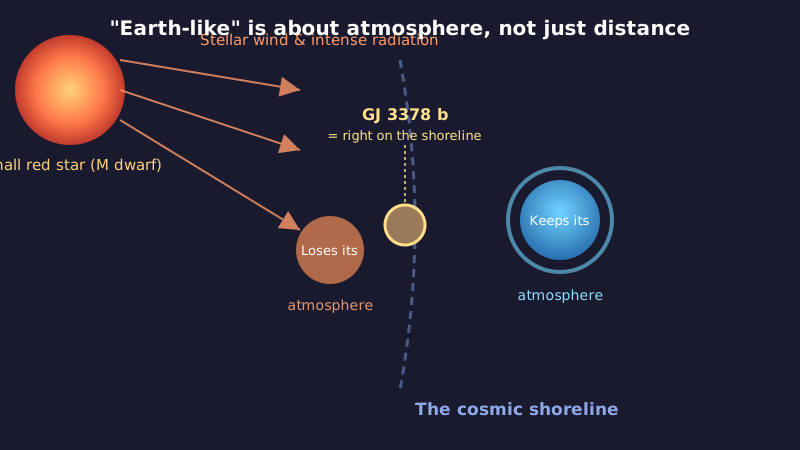
In the end, the habitable zone only tells you that the possibility of liquid water isn’t zero. Atmospheric thickness, composition, magnetic field strength, volcanic activity — every one of these factors has to align before water can stay liquid. Without them, a planet in the habitable zone is still just a rock.
The reason scientists keep using the metric anyway is pragmatic: distance from a star is easy to calculate. Atmospheric properties are extraordinarily hard to measure from light-years away. So “filter by distance first” is the best available starting strategy.
How Earth-Like Is Earth-Like? The ESI Explained
There’s a more precise metric for measuring planetary similarity: the Earth Similarity Index, or ESI. It combines four parameters — radius, bulk density, escape velocity, and surface temperature — into a single value between 0 and 1, where 1 is a perfect match for Earth.
The highest-ESI exoplanets we know of today include TRAPPIST-1e and Kepler-442b, both scoring around 0.85. That sounds encouraging — until you think about what 0.85 actually means in practice.
TRAPPIST-1e, for instance, is slightly smaller than Earth and orbits a red dwarf — a dim, cool star. Its year lasts just six days. It’s almost certainly tidally locked, meaning one face permanently bakes in starlight while the other sits in permanent frozen darkness.
And JWST observations of the TRAPPIST-1 system suggest that TRAPPIST-1d may have no atmosphere at all. The entire system is battered by intense stellar flares that could be stripping planetary atmospheres away entirely.
An ESI of 0.85 doesn’t tell you much about what it’s like to stand on that surface — or whether standing there is even conceivable.
A New Way to Look — The Nancy Grace Roman Space Telescope
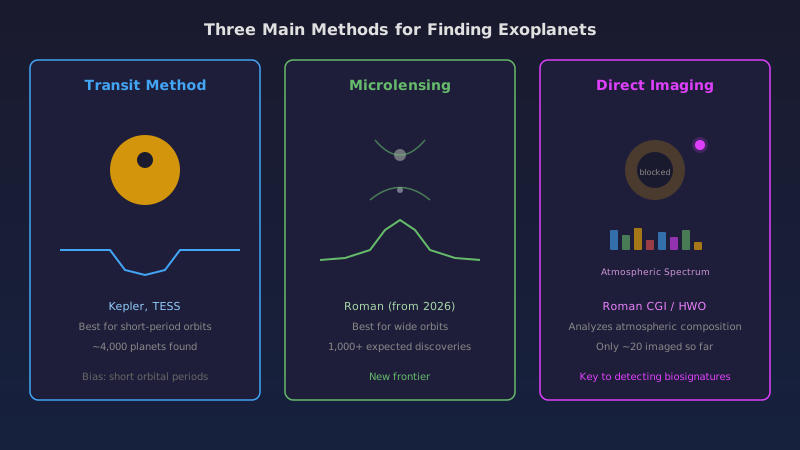
Exoplanet discovery has been dominated by the transit method: detecting the faint dimming that occurs when a planet crosses in front of its star. Kepler found more than 2,700 planets this way.
But the transit method has a built-in bias. Planets in tight orbits — close to their stars — are far easier to spot than those in wider, Earth-like orbits. The sample we’ve collected is skewed.
Enter the Nancy Grace Roman Space Telescope, targeting launch in fall 2026. Assembly was completed in late 2025, and the spacecraft is currently in final testing. It will ride a SpaceX Falcon Heavy to the L2 Lagrange point, 1.5 million kilometers from Earth.
Roman’s key tool is gravitational microlensing — a technique that uses the gravity of a foreground object to bend and amplify the light of a background star. Because it doesn’t rely on a planet passing in front of its own host star, microlensing is uniquely capable of detecting planets in wide, distant orbits.
Over a five-year mission observing 100 million stars, Roman is expected to find more than 2,500 new exoplanets, including many rocky, Earth-sized worlds. Microlensing alone could yield over 1,000 planet detections — more than five times the total number found by that method to date.
Roman also carries a coronagraph, a device that blocks starlight to reveal the planets orbiting around it. Direct imaging of exoplanets has produced only a handful of confirmed cases so far. A working coronagraph opens up the possibility of directly analyzing planetary atmospheres in ways that were previously out of reach.
PLATO’s Specific Target: An Earth Around a Sun-Like Star
Almost simultaneously, ESA’s PLATO mission is ramping up. Equipped with 26 cameras, PLATO will monitor more than 150,000 bright stars simultaneously.
Its goal is sharply defined: find Earth-sized planets in the habitable zones of Sun-like stars. Where Kepler cast a wide net over faint, distant stars, PLATO focuses on nearby, bright ones. The logic is straightforward — planets around nearby stars can be followed up by JWST and next-generation observatories, making it possible to study their atmospheres in detail.
That follow-up step is crucial. Finding a planet is only the beginning. Determining whether it has an atmosphere, liquid water, or any sign of life requires sustained, high-resolution observation after the initial discovery. PLATO is, in a real sense, a machine for identifying the best candidates for further investigation.
Research published in 2025 adds another wrinkle: even rocky, Earth-mass planets can retain helium-dominated primordial atmospheres under the right conditions. The assumption that rocky equals thin-atmosphere may be too simple. Planetary diversity keeps surprising us.
Rethinking What “Earth-Like” Even Means
If you’ve been reading carefully, you may have noticed something. The whole framework of “Earth-like” is, when you step back, deeply Earth-centric.
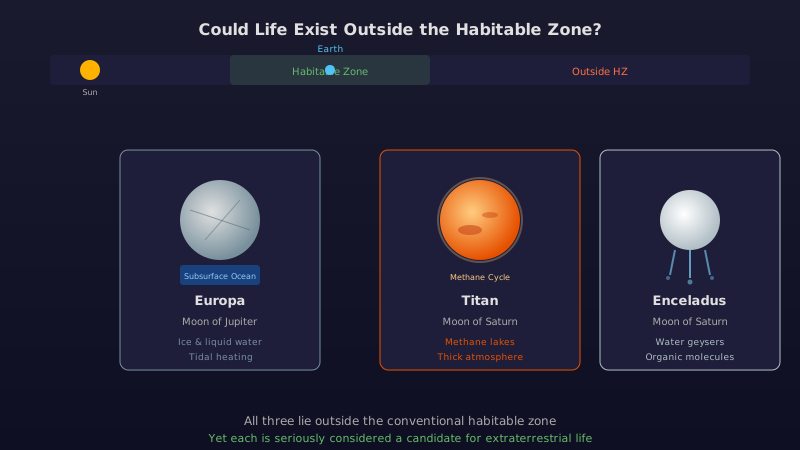
Assuming liquid water is a prerequisite for life is a conclusion drawn entirely from studying life on Earth. If organisms could use ammonia or methane as a solvent instead, the definition of the habitable zone would have to be rewritten from scratch. Saturn’s moon Titan has lakes of liquid methane. Jupiter’s moon Europa harbors a liquid ocean beneath its ice shell. Neither sits inside the conventional habitable zone. Yet both are serious candidates in the search for life.
We may also be too fixated on planets specifically. Moons could host life just as well. There’s no rigorous reason to rule out microbial life in small bodies elsewhere.
The more we learn about exoplanets, the clearer it becomes that “search for something Earth-like” is a strategy with built-in limits. What we actually need is to keep revising the question itself: what are the conditions under which life can exist at all?
What the Next Decade Will Show Us
From 2026 into the 2030s, exoplanet science is set to accelerate sharply.
Roman will harvest planets in wide, distant orbits that no previous telescope could reach. PLATO will narrow down the best Earth-like candidates around Sun-like stars. JWST will analyze their atmospheres. Three telescopes, each with a distinct role, building a fuller picture together.
And further out on the horizon: NASA’s proposed Habitable Worlds Observatory (HWO), a large dedicated space telescope designed to directly image Earth-like exoplanets and search for biosignatures — oxygen, methane, and other atmospheric signs of life.
“No Earth-like planet has been found” can sound discouraging. But what it actually means is that we lacked the tools. Those tools are now being built and launched.
Six thousand confirmed exoplanets are a scratch on the surface of the galaxy, which holds hundreds of billions of stars — most of them orbited by planets. Statistically, a world with conditions resembling Earth’s would be the strange exception if it didn’t exist somewhere.
The question is no longer whether such a place is out there. It’s when we’ll have the means to confirm it. That answer, in all likelihood, is closer than we think.