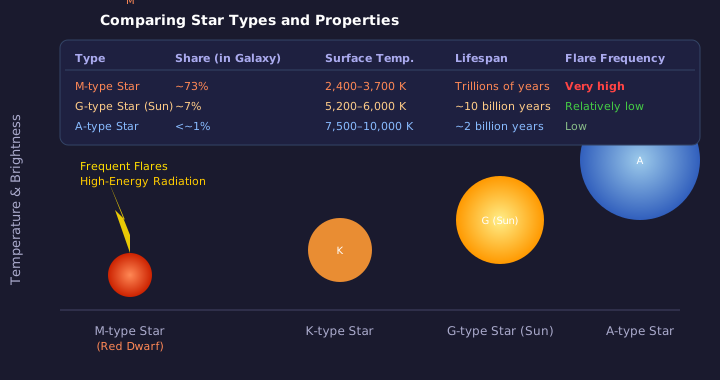
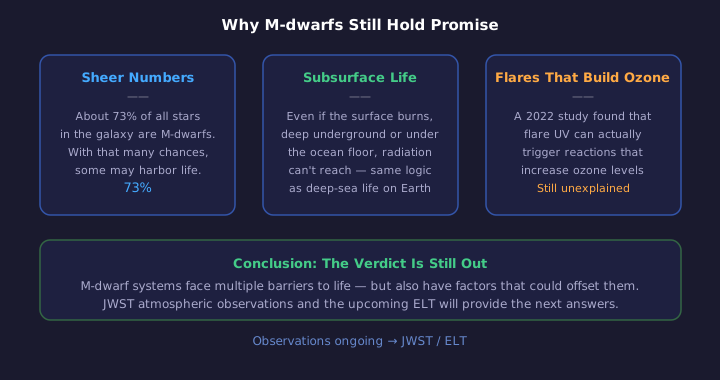
Count up the stars in the Milky Way and roughly 73% of them turn out to be M-type stars — red dwarfs. K-type stars come in second at about 14%, while our Sun’s class, G-type, accounts for a mere 7%. The vast majority of stars in the universe, in other words, are small, dim, and red.
Recent observations have added an interesting wrinkle: M-dwarfs host plenty of rocky, Earth-sized planets. On paper, that means the galaxy is teeming with potentially habitable worlds.
But the picture is more complicated than that. M-dwarfs may be small, but they can be ferociously violent.
What Is a Stellar Flare?
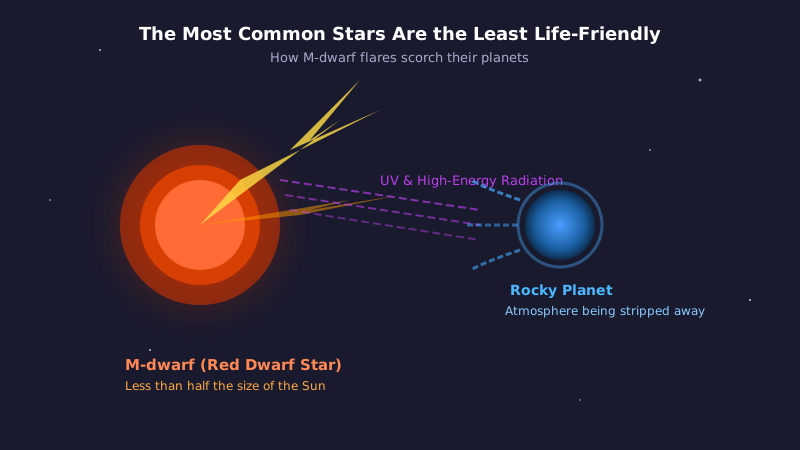
A stellar flare is an explosion triggered by the sudden release of a star’s magnetic energy. The Sun produces a few per month, but M-dwarf flares can dwarf those in both scale and frequency.
The benchmark for solar flares is the Carrington Event of 1859 — the most powerful flare in recorded history. A direct hit of that magnitude today would cripple power grids and communications infrastructure worldwide. M-dwarfs can produce flares that make the Carrington Event look modest, sometimes several times a week.
The energy comes from magnetism. M-dwarfs have convection — the churning mix of hot plasma — running throughout their entire volume, not just an outer layer. That generates strong, tangled magnetic fields. When those fields collide and snap apart, the stored energy blasts outward in a torrent of X-rays and ultraviolet radiation lasting anywhere from minutes to hours.
Some data suggest that young, active M-dwarfs can release the equivalent of years’ worth of solar energy in a single hour. And since M-dwarfs can live for trillions of years — far longer than the current age of the universe — their hyperactive youth stretches on for timescales that dwarf human civilization many times over.
The Habitable Zone Is Too Close
Here’s where proximity becomes a problem.
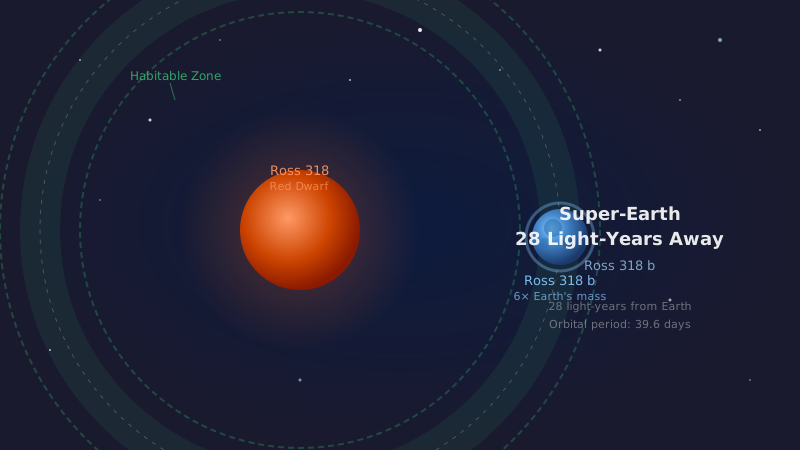
The habitable zone is the orbital range where a planet could maintain liquid water on its surface. M-dwarfs are so cool — surface temperatures of 2,400 to 3,700 K, compared to the Sun’s ~5,800 K — that their habitable zones huddle right up against the star.
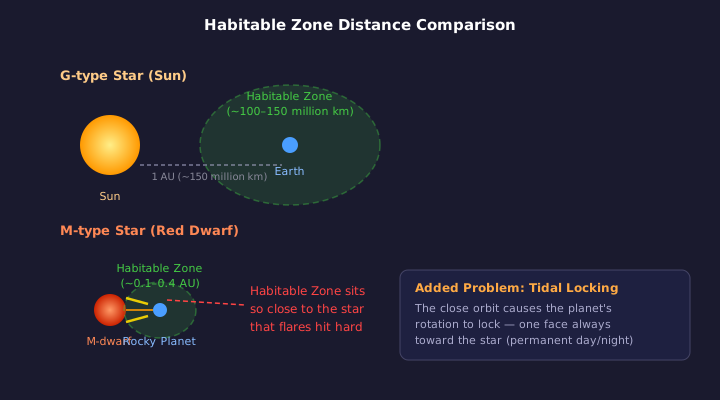
In our solar system, the habitable zone spans roughly 0.95 to 1.37 AU (1 AU is the average Earth–Sun distance, about 150 million km). Earth sits comfortably near the middle.
An M-dwarf’s habitable zone is less than one-tenth that distance: around 0.1 to 0.4 AU. Any planet in that zone is orbiting several times closer to its star than Earth orbits the Sun. That proximity creates two compounding problems.
First, it means taking a direct hit from flares. Radiation intensity scales with the inverse square of distance — halve the distance, quadruple the dose. A planet orbiting at one-third the distance receives nine times the radiation.
Second, that close orbit leads to tidal locking. Just as the Moon always shows Earth the same face, gravity gradually locks nearby planets so one hemisphere permanently faces the star. Permanent noon on one side, permanent midnight on the other — a situation that complicates atmospheric circulation and magnetic field formation in ways that aren’t fully understood yet.
The Shield Gets Eaten Away
Atmosphere is non-negotiable for life. Without air pressure, surface water evaporates. Without an ozone layer, UV radiation hits the ground unfiltered.
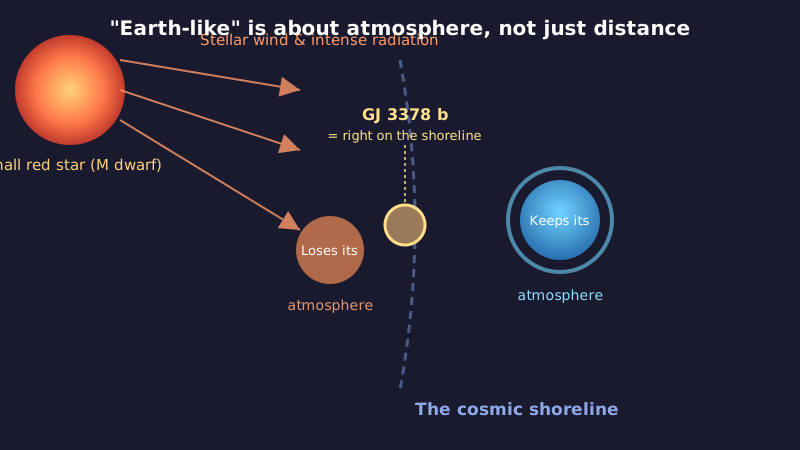
M-dwarf flares threaten both. High-energy particles slammed into a planet’s upper atmosphere can knock gas molecules into space — a process called atmospheric escape. Over millions or billions of years, even a thick atmosphere can be ground down to nearly nothing.
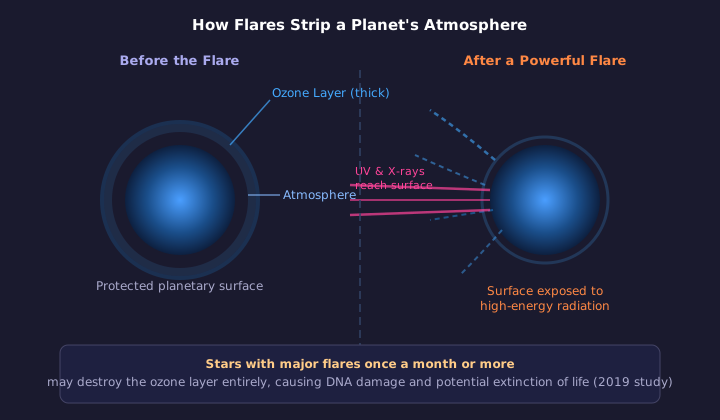
A 2019 study found that planets orbiting M-dwarfs prone to major flares at least once a month could have their ozone layers completely destroyed. Without ozone, UV radiation reaches the surface unimpeded. DNA — the molecule that carries genetic information — is extremely sensitive to UV damage, making surface life essentially impossible under those conditions.
Mars is an instructive cautionary tale. It once had a thicker atmosphere and flowing liquid water, but after losing its magnetic field and being battered by the solar wind for eons, it ended up thin and dry. A planet orbiting an active M-dwarf, with weak magnetic shielding and relentless flare bombardment, could lose its atmosphere even faster.
On the magnetic field question, tidal locking may make things worse. A planet’s magnetic field is generated by its rotating, churning iron core — the dynamo effect. Slow down the rotation, and that dynamo weakens. Atmosphere and magnetic field, the planet’s two main shields, may both thin out at once.
Why the Possibility Hasn’t Gone Away
As bleak as that sounds, the story isn’t over. A few potential counterarguments remain.
One is pure probability. M-dwarfs dominate the galaxy, and their lifespans stretch into the trillions of years. Our Sun will last about 10 billion years; the smallest M-dwarfs can outlive the current age of the universe. With that many stars running for that long, some combination of star, planet, and conditions might beat the odds.
Another is the possibility of life underground or under the ocean. On Earth, microbes thrive in deep-sea hydrothermal vents and rock layers kilometers below the surface. Flare radiation punches through the atmosphere but stops dead after a few meters of rock or water. Below the surface, the environment could stay stable regardless of what’s happening up top.
A 2022 study added an unexpected twist. Flare UV can trigger photochemical reactions in a planet’s atmosphere that actually produce ozone rather than destroying it. Whether the net effect is gain or loss depends on the planet’s atmospheric composition and the star’s particular flare patterns. “More flares equals no atmosphere” is too simple a conclusion.
Honestly, as of 2026, there is no definitive answer. Whether M-dwarf planets can support life remains one of the hottest debates at the frontier of astronomy.
JWST Is Watching Atmospheres in Real Time
The breakthrough tool is the James Webb Space Telescope. When a planet passes in front of its star — a transit — JWST can capture how starlight filters through the planet’s atmosphere. Different molecules absorb different wavelengths, so the telescope can read the chemical fingerprint of what’s up there.
In 2025, hints of atmospheric composition were detected around a planet orbiting K2-18, a star cooler than the Sun and close to M-dwarf territory, with its planet sitting inside the habitable zone. Detailed measurements of whether such planets retain their atmospheres would tell us a lot about the real-world impact of flares.
Later in the 2020s, the Extremely Large Telescope (ELT, with a mirror roughly 39 meters across) is scheduled to come online, enabling direct atmospheric measurements of M-dwarf planets nearby. It will be the best instrument yet for hunting the molecular signatures of life — oxygen, water, methane.
The central question driving all this can be put simply: can M-dwarf planets hold onto their atmospheres? The day that question gets a clear answer, the broader debate about life on exoplanets will leap forward.
Summary
M-type dwarf stars are the most common stars in the galaxy, and they host plenty of rocky planets. But frequent, powerful flares combined with tidal locking — a consequence of the habitable zone sitting so close to the star — may strip those planets of the atmospheres they need to support life.
That said, the odds aren’t zero. Life could find refuge underground or under the ocean. Flares might, under the right conditions, actually help build ozone rather than destroy it. And there are simply so many M-dwarfs in the galaxy that some favorable combination must exist somewhere.
JWST and the telescopes coming after it will turn this debate into data. The question of whether the galaxy’s most abundant stars harbor life is, in a real sense, a question about how common life is in the universe. Nobody knows the answer yet — and it’s being measured right now.