Earth exists because, 4.6 billion years ago, countless specks of dust drifting through space happened to come together.
The Moon, Mars, Jupiter — trace any of them back far enough and they all started in the same place: the dust of open space. That dust clumped, collided, and over an almost incomprehensible stretch of time, became worlds. How exactly? Thanks to decades of observation, we now have a pretty good picture.
It All Starts with a Cloud of Gas and Dust
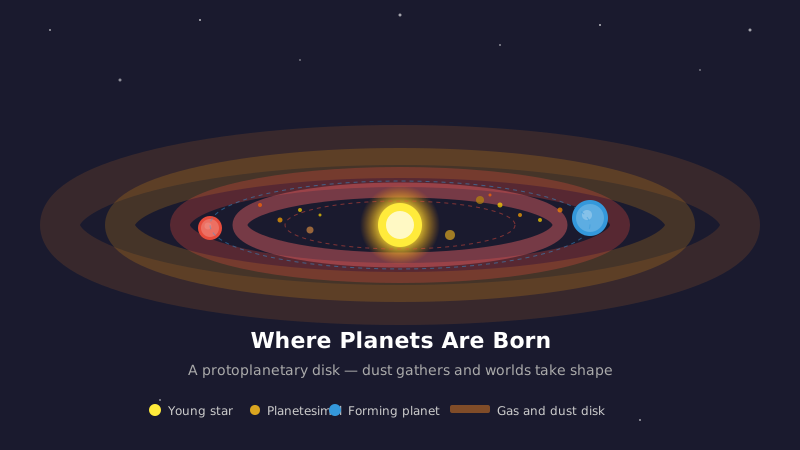
Planets are born inside what astronomers call a molecular cloud — an enormous, diffuse mass of mostly hydrogen and helium. These clouds dot the spiral arms of galaxies, and they are vast. The portion of a molecular cloud that gave rise to our solar system is thought to have spanned more than 100 light-years across.
When something disturbs such a cloud — the shockwave from a nearby supernova, for instance — it can become gravitationally unstable and begin collapsing under its own weight. As it contracts, the cloud spins faster and flattens into a thin disk. Think of a figure skater pulling in their arms: angular momentum is conserved, so the rotation speeds up.
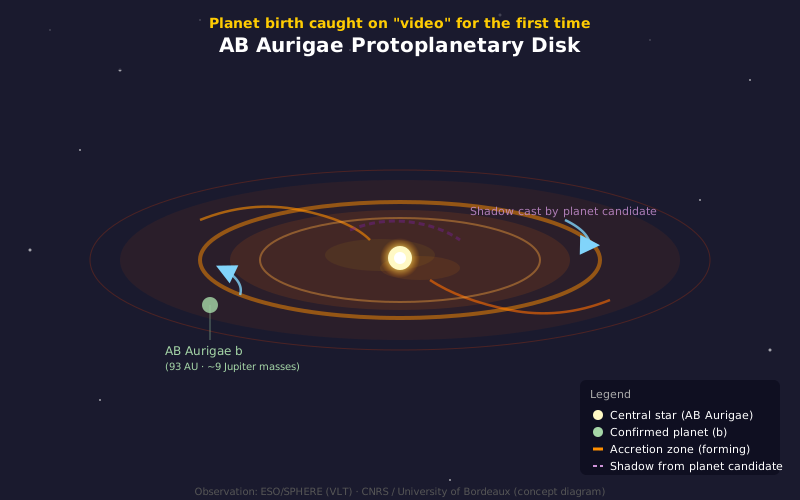
The result is a protoplanetary disk: a young star forming at the center, surrounded by a swirling pancake of gas and dust. Everything that will eventually become a planet is somewhere inside that disk.

From Static Cling to Gravity: How Dust Becomes a Planet
The first step in planet-building is almost comically small-scale.
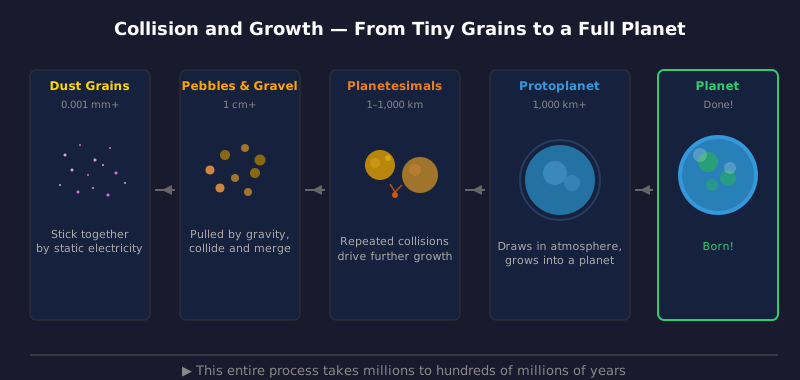
Dust grains in a protoplanetary disk measure about 0.001 mm across. In the low-velocity environment of the disk, they drift into each other and stick together by static electricity, first forming pebble-sized clumps, then chunks a few centimeters across. Collisions at this stage are gentle enough that material tends to stick rather than shatter.
Things get tricky once a rock reaches about a meter in diameter. At that size, interactions with the surrounding gas start dragging the rock inward toward the central star — a problem researchers call radial drift. It’s a real obstacle, and we don’t fully understand how nature gets around it.
One popular theory involves turbulent eddies inside the disk. Rocky fragments accumulate at the cores of these vortices and rapidly grow into kilometer-scale bodies called planetesimals. Once you have planetesimals, gravity takes over. Larger bodies pull in smaller ones, and the process snowballs — bigger objects have stronger gravity, so they collect material faster. This phase of explosive growth is aptly called runaway accretion.
Why Some Planets Are Rocky and Others Are Enormous Balls of Gas
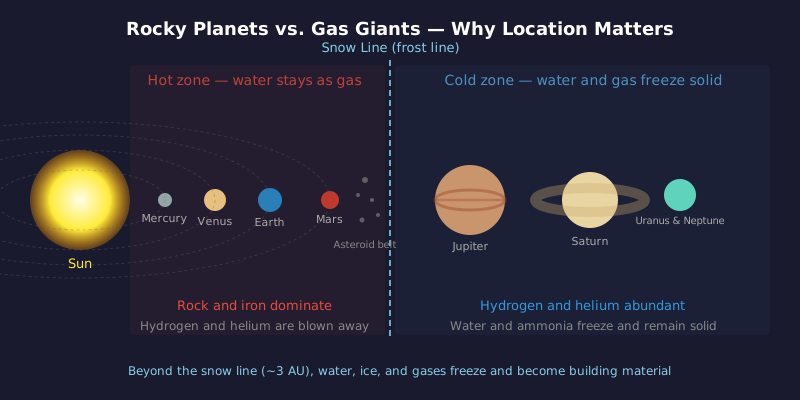
Look at our solar system: small, rocky planets close to the Sun (Mercury, Venus, Earth, Mars), then huge gas giants farther out (Jupiter, Saturn), and ice giants beyond those (Uranus, Neptune). What draws that dividing line?
The key is a boundary called the snow line. At roughly 3 AU from the Sun (where 1 AU is the average Earth-Sun distance of about 150 million km), temperatures drop low enough for water to exist as ice rather than vapor. Inside the snow line, water and ammonia remain gaseous — and gases don’t make good building material. Rocky, metallic solids are all that’s left, so only rocky planets form there.
Beyond the snow line, water, various ices, and other volatiles freeze solid, dramatically increasing the amount of raw material available. Protoplanets can grow much larger out here. Once a growing core crosses a critical mass threshold, it starts pulling in the surrounding hydrogen and helium gas by gravity and rapidly balloons into a giant. Jupiter almost certainly formed this way: a solid rock-and-ice core that eventually accumulated a massive gaseous envelope.
The details are still debated — planetary science is messier than any clean model suggests — but the broad picture, that the snow line divides rocky planets from gas giants, holds up across many observed exoplanet systems.
Planet Formation Doesn’t End Cleanly — The Late Heavy Bombardment
Even after planets were mostly assembled, the early solar system was far from calm. Sometime around 4.1 billion years ago — roughly 500 million years after the solar system formed — there appears to have been a period of intense bombardment. Researchers call it the Late Heavy Bombardment.
The leading explanation involves Jupiter and Saturn. As those giant planets gradually settled into their current orbits, their gravity scrambled the paths of smaller objects in the inner solar system, sending a torrent of asteroids and comets raining down on the terrestrial planets. Much of the cratering you can see on the Moon today dates to this period. Earth took heavy hits too.
Interestingly, that same chaotic bombardment may have delivered water to Earth. The idea that comets and asteroids carried much of our oceans here — the exogenous water hypothesis — remains a serious contender among origin-of-water theories.
Seen from this angle, “planet formation” wasn’t a single event but a prolonged, violent process stretching across hundreds of millions of years.
Exoplanets Changed Everything We Thought We Knew
For a long time, our solar system was treated as the template for planetary formation. Then, starting in the 1990s, the hunt for exoplanets began dismantling that assumption piece by piece.
As the Hubble Space Telescope gave way to JWST and ground-based surveys, thousands of exoplanets turned up — and many of them look nothing like what our solar system would predict.
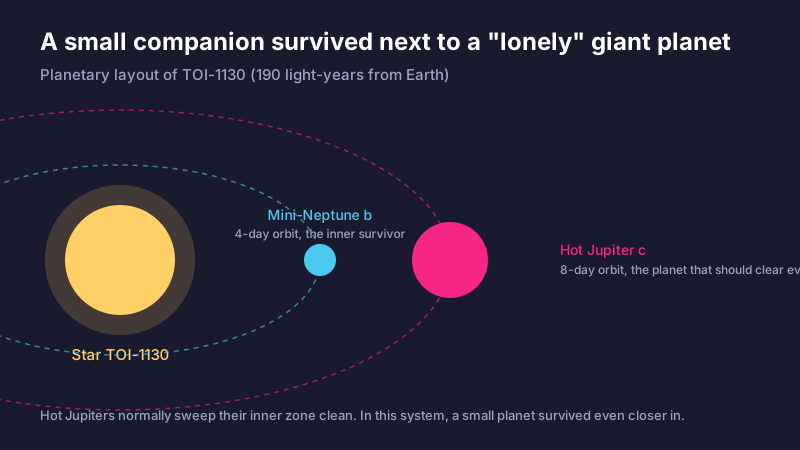
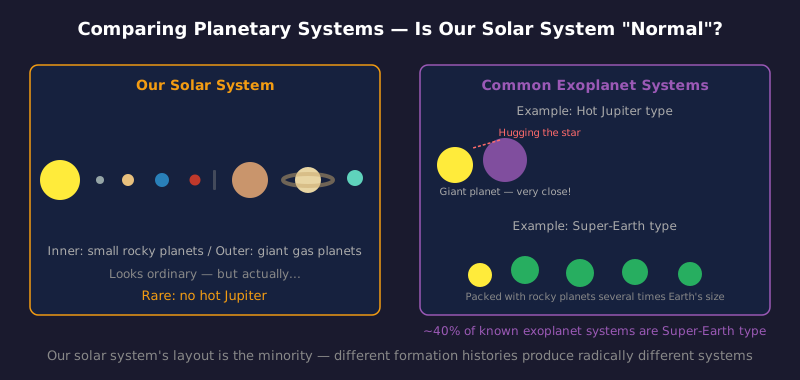
Hot Jupiters were among the first surprises. These are gas giants the size of Jupiter orbiting so close to their stars that a “year” lasts only a few days — tighter orbits than Mercury’s. Nothing in traditional planet formation theory anticipated them forming where they’re found. The best explanation is that they formed farther out and then migrated inward as they interacted with the remnants of the gas disk.
Super-Earths are equally striking. Rocky planets two to ten times Earth’s mass show up in a large fraction of exoplanet systems — yet our solar system has none. In this light, our system starts to look unusual, not typical.
Some researchers think Jupiter is the reason. A hypothesis called the Grand Tack proposes that Jupiter migrated inward early in the solar system’s history, sweeping much of the rocky material out of the inner disk before reversing course and heading outward again. If that’s right, the modest size of Earth and the other inner planets is a direct consequence of Jupiter’s orbital wandering.
What JWST Is Revealing About Planetary Diversity
Since JWST began science operations, exoplanet research has reached a new depth. Characterizing the atmospheres of planets around other stars was once extremely difficult; JWST’s spectroscopic capabilities have opened that door wide.
The findings keep defying expectations. There are steam worlds — planets where the oceans have entirely evaporated into a thick, water-vapor atmosphere. There are lava worlds that somehow retain a thin atmospheric layer. There are Jupiter-like planets with water-ice clouds rather than the ammonia clouds theory predicted. Every new observation adds another data point to what is becoming a remarkably diverse zoo of planetary types.
All of this variety traces back to the conditions during formation: how far from the star a planet coalesced, how long the gas disk persisted, what type of star is at the center, whether a nearby giant planet stirred things up. Small differences in those early conditions cascade into wildly different final results.
Our solar system is one particular outcome among an enormous range of possibilities.
What It Actually Means That Dust Became a World
Boiled down to its essentials, planet formation is the story of a 0.001 mm grain of dust becoming a rocky sphere 6,000 km in radius over 4.6 billion years. The numbers are hard to hold in your head, but the underlying process is a surprisingly short chain of principles: grains stick together by static electricity, rocks attract each other by gravity, collisions build mass, and eventually an atmosphere falls into place. That’s basically it.
That same chain is playing out right now around young stars scattered across the galaxy. ALMA telescope images of protoplanetary disks around nearby young stars show concentric ring-shaped gaps — the signatures of infant planets already sweeping their orbital paths clear of material.
The exact same thing was happening in our solar system 4.6 billion years ago. Which makes the ground under your feet feel a little less like solid bedrock and a little more like the settled end of a very long, very dusty story.