Pick up any exoplanet headline and you’ll almost certainly see the phrase “habitable zone.”
It means the band of distances from a star where liquid water can exist on a planet’s surface. Not too close, not too far — the Goldilocks region. The logic follows neatly: liquid water, maybe life. It’s a clean, satisfying concept.
But the term gets used a little loosely. Sometimes it sounds like “habitable zone” = “planet with life.” As if location is destiny.
Is it really that simple? Does sitting in the right orbital lane mean creatures can actually thrive there?
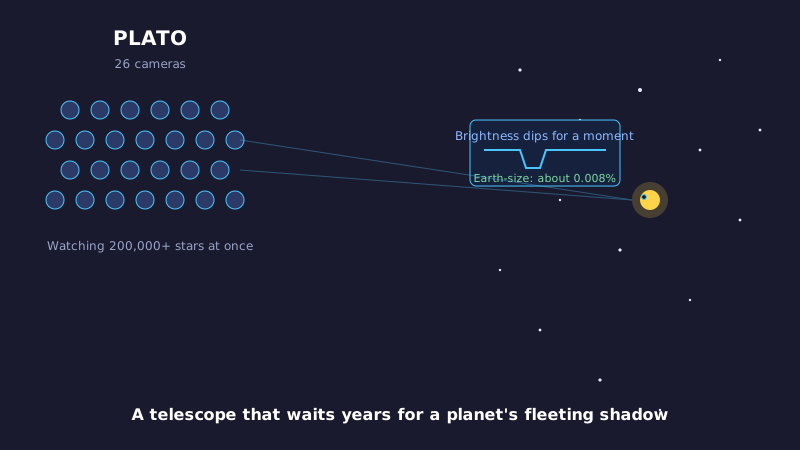
In the second half of 2026, the European Space Agency (ESA) plans to launch PLATO, a flagship space telescope carrying 26 cameras that will stare at tens of thousands of stars looking for Earth-like planets. With that mission approaching, it’s worth unpacking what “habitable zone” actually means — and what it leaves out.
The “Just Right” Distance Shifts Depending on the Star
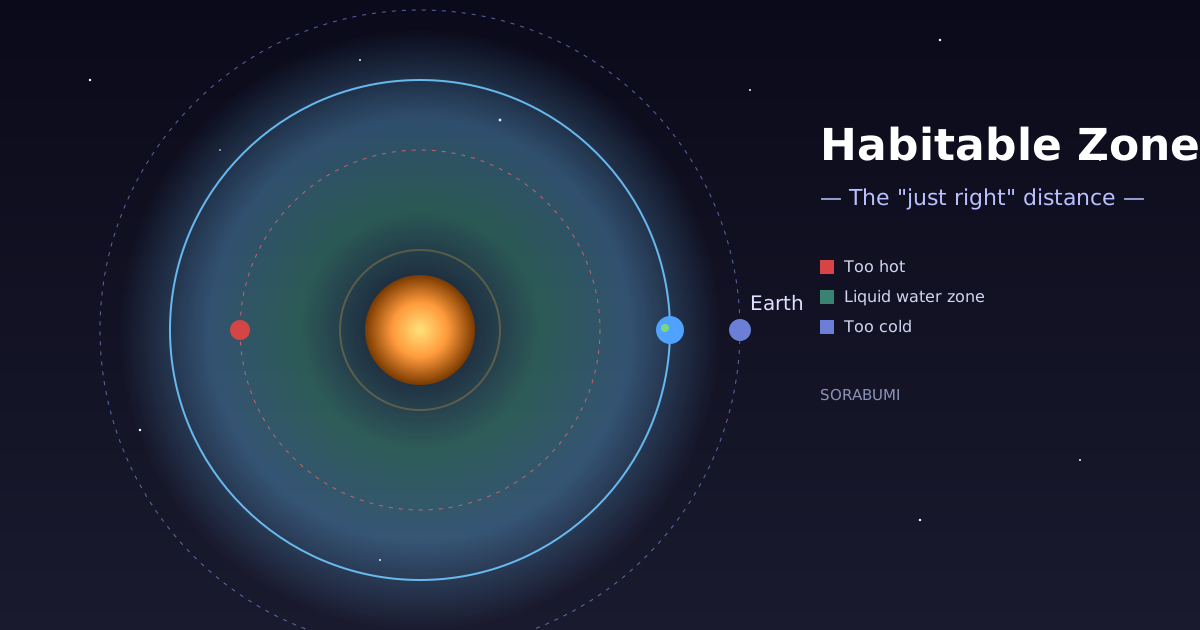
Start with the basics. The habitable zone is defined by distance from a star.
For our Sun, the zone runs roughly from just outside Venus’s orbit to around Mars’s orbit — with Earth sitting comfortably near the middle. Venus is too close and too hot; Mars is too far and too cold; Earth lands in the sweet spot.
The important thing to realize is that this sweet spot moves entirely depending on the star. The solar system makes it look like there’s only one habitable zone in the universe. But stars come in wildly different flavors.
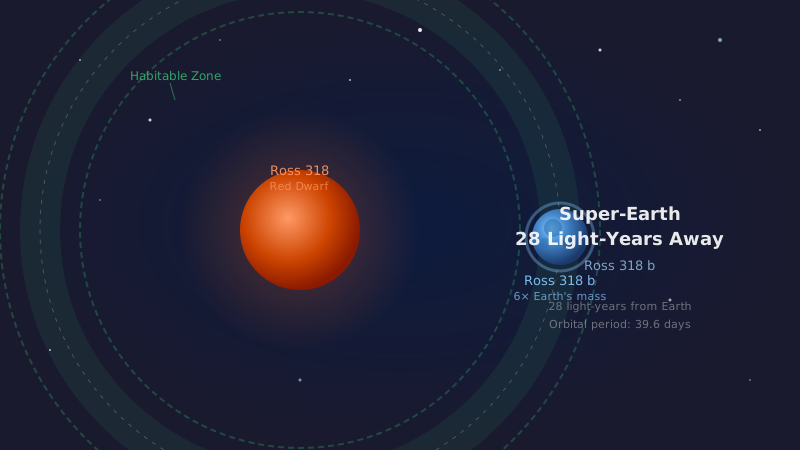
Take red dwarfs — cool, dim stars with surface temperatures around 3,000°C. Because they put out much less light than the Sun, a planet needs to orbit close just to get warm. The habitable zone hugs right up against the star.
At the other end, F-type stars burn hotter, around 6,500°C. A planet in their system would need to orbit much farther out to avoid being scorched. Their habitable zone is wide and distant.

All of that is just the distance story.
The Right Distance — but No Water
Here’s where things get complicated. Being at the right distance doesn’t guarantee liquid water. Not even close.
Venus is the clearest example. It sits near the inner edge of our solar system’s habitable zone — in or out depending on how generously you define it. Yet its surface temperature reaches 460°C, hot enough to melt lead. The terrain looks scorched. Water is nowhere.
Why? Venus accumulated a thick carbon dioxide atmosphere that traps heat with brutal efficiency. The greenhouse effect sent temperatures soaring far beyond what its distance from the Sun would predict.
Mars tells the opposite story. It sits near the outer edge of the habitable zone — a bit on the cold side. Evidence of ancient river channels suggests Mars once had liquid water flowing across its surface. Today it’s a freeze-dried red desert.
What happened? Mars lost its magnetic field. Without the protective bubble that Earth’s magnetosphere provides, the solar wind gradually stripped away the Martian atmosphere. As the atmosphere thinned, pressure dropped, and any surface water evaporated into space.
Same habitable zone. Completely different outcomes.
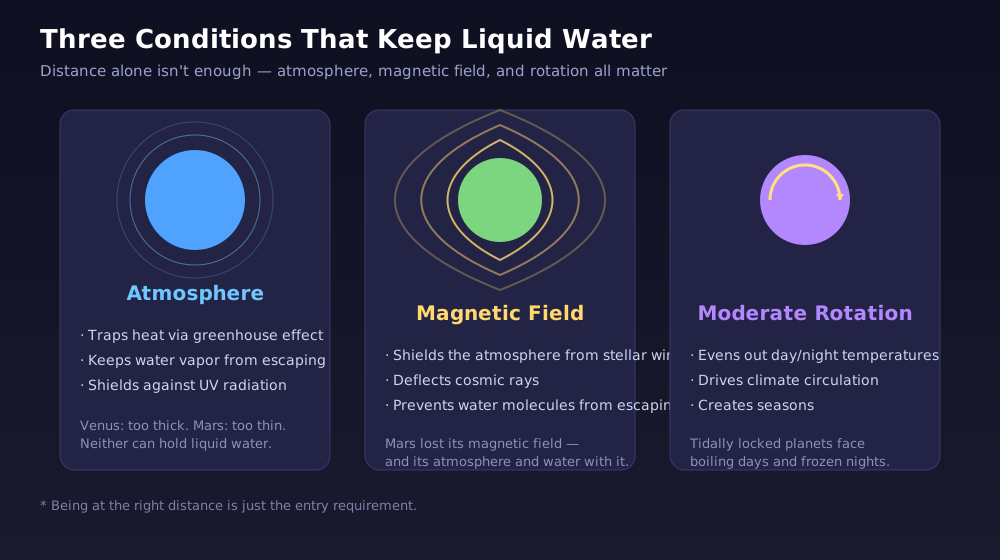
Atmosphere, Magnetic Field, Rotation — Three Hidden Requirements
Keeping water on a planet’s surface requires more than distance. At minimum, three other conditions have to line up.
The first is atmosphere. Think of it as a blanket — not too thick, not too thin. Without one, the temperature swings between day and night become extreme. A functioning atmosphere is what actually allows liquid water to persist; getting the distance right is necessary but not sufficient.
The second is a magnetic field. When molten metal churns inside a planet’s core, it generates a magnetic field. That field deflects the charged particles streaming out from the host star — what we call stellar wind. Without it, the atmosphere erodes slowly but surely. Mars is the case study.
The third is rotation rate. If a planet spins at a reasonable pace, day and night alternate regularly, temperatures stay averaged out, and atmospheric and oceanic circulation can develop.
But some planets become tidally locked — permanently facing their star on one side, turned away on the other. The dayside roasts and water evaporates; the nightside freezes solid. The region where liquid water could exist shrinks to a sliver, if it exists at all. This is a real problem for planets in red dwarf habitable zones, which sit so close to their stars that tidal locking is common.
Water Worlds Beyond the Zone
Here’s where it gets genuinely interesting.
The habitable zone concept was built around a specific scenario: sunlight warms a planet’s surface enough that water stays liquid. That framing makes sense. But our own solar system has already shown us liquid water existing somewhere we didn’t expect.
Europa, a moon of Jupiter. Enceladus, a moon of Saturn. Both sit far outside the Sun’s habitable zone — their surfaces sit around −170°C, locked under thick ice shells.
And yet, both almost certainly harbor oceans of liquid water beneath that ice. Enceladus goes further: geysers of water vapor erupt through cracks in the ice. The Cassini spacecraft flew through those plumes and detected organic molecules.
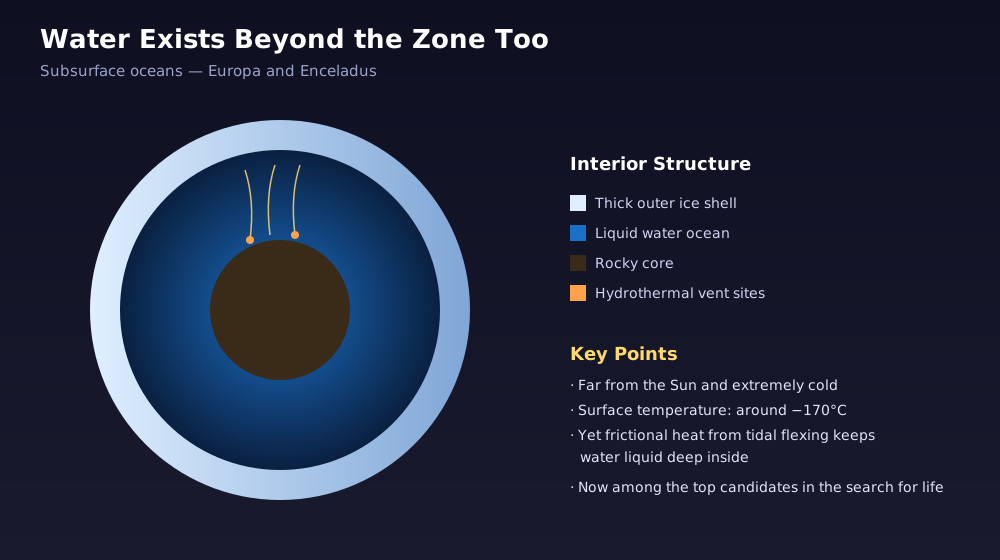
How does this work? The heat source isn’t the Sun. These moons are squeezed by the immense gravity of Jupiter and Saturn, causing their rocky interiors to flex and deform. That tidal friction generates enough heat to melt ice from the inside out.
The implication is striking: liquid water doesn’t require a warm surface. Internal heat can do the job just fine.
If you accept that, the habitable zone starts to look less like a fundamental rule and more like a convenient shortcut — one built for the most obvious case. The places in the universe where life might exist could be far more numerous, and stranger, than the zone suggests.
What PLATO Is Actually Hunting For
Back to exoplanets. What exactly is PLATO looking for?
The starting point is still the habitable zone — specifically, rocky planets within it. But the mission goes well beyond simply flagging planets at the right distance.
One priority is density. PLATO measures how much a planet dims its star as it passes in front of it — that gives you size. It also tracks how the star wobbles under the planet’s gravity — that gives you mass. Combine the two and you get density. Density tells you whether you’re looking at a rock, a gas ball, or something in between.
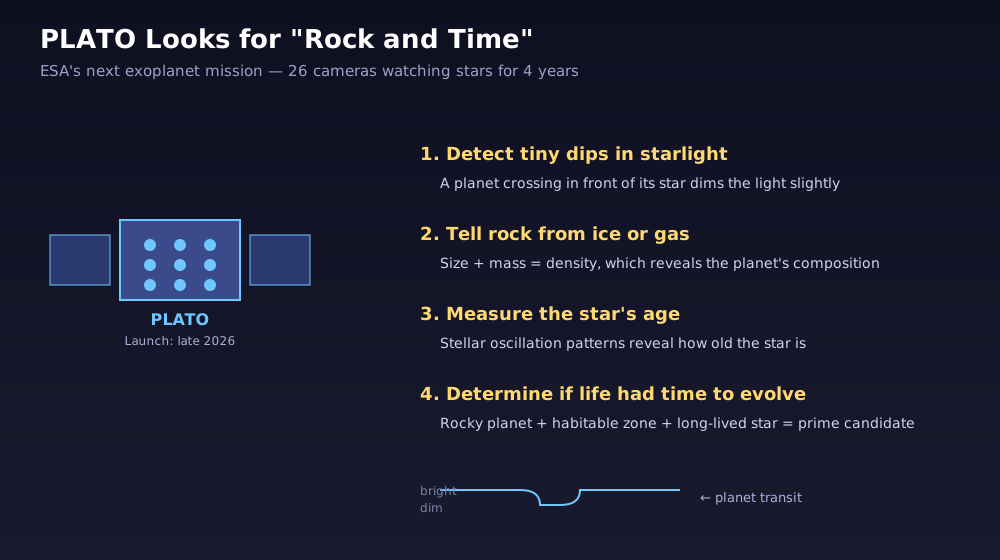
The other major capability is stellar age. Stars oscillate — tiny vibrations run through their interiors, and the pattern of those oscillations encodes the star’s age. This technique, called asteroseismology, is something PLATO is especially good at.
Age matters because evolution takes time. It took more than three billion years on Earth for single-celled life to eventually produce something as complex as us. A young star probably means a planet still cooling from its violent formation. A star near the end of its life means the environment is about to change dramatically. A planet needs its star to be stable long enough for life to not just arise, but to develop.
PLATO’s goal is to find candidates that check all three boxes: rocky, orbiting in the water zone, and circling a star old enough to have given life a real shot. After that, future observatories would examine those planets’ atmospheres directly — looking for biosignatures.
The Bar for “Habitable” Keeps Moving
Looking back over all of this, the habitable zone concept has become much more layered than it once was.
The original definition was clean: the band of distances where surface water can exist in liquid form. That definition still holds, and it’s still the most useful first filter for exoplanet searches.
But the actual requirements pile up fast. Atmosphere — the right kind, at the right thickness. Magnetic field. Rotation rate. And if you’re willing to look beyond the surface, the zone’s outer boundary disappears entirely. Europa and Enceladus are sitting out in the cold, technically disqualified, with liquid oceans underneath.
Personally, the subsurface ocean scenario is the one that captures my imagination most. Dark water under ice, far from any star. If something is alive down there, what is it eating? Chemical energy from hydrothermal vents seems like the best guess — the same way life clusters around deep-sea vents on Earth where sunlight never reaches.
The map we’ve been using to define “habitable” turns out to have been drawn from a pretty narrow human perspective. The real distribution of liquid water in the universe — and whatever might be living in it — could look very different.
PLATO launches in late 2026, and the era of direct atmospheric analysis follows. The moment we can say “this isn’t the only inhabited planet” feels closer than it did even a few years ago.
When that day comes, “habitable zone” will probably mean something broader than it does right now. Not just a narrow band around a star, but a scattered network of water-bearing worlds across the universe — inside ice moons, beneath alien oceans, lit by chemistry instead of stars.
With that thought in mind, the stars out there at night look a little different.