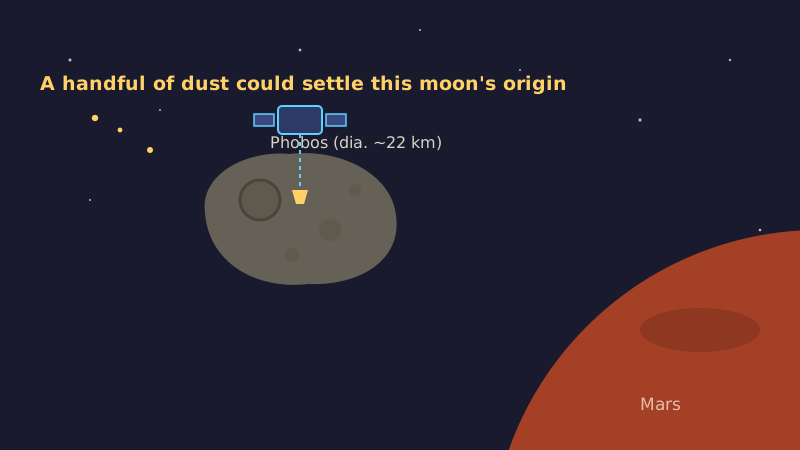
Mars has two moons. One of them is a lumpy, potato-shaped chunk of rock about 22 kilometers across.
This little moon crosses the Martian sky three times a day. And it rises in the west and sets in the east.
Its name is Phobos. In October 2026, a Japanese spacecraft will set off to visit this strange little world — with one goal: grab a handful of its sand and bring it home.
A Moon That Circles Mars Three Times a Day, Rising in the West
Earth’s moon takes almost a full day to cross the sky, rising slowly in the east and setting in the west — the rhythm we all take for granted. Phobos breaks every rule in that book.
According to NASA, Phobos orbits Mars three times a day. While Mars spins once on its axis, this little moon laps it three times over. So from the Martian surface, Phobos rises in the west and sets in the east just a few hours later.
The first time I read that number, I assumed it was a typo. A moon overtaking its own planet just isn’t something Earth prepares you to expect.
How does it pull this off? Simple: Phobos orbits absurdly close to Mars. The closer the orbit, the faster it moves — and Phobos hugs its planet tighter than any other moon in the solar system hugs its own.
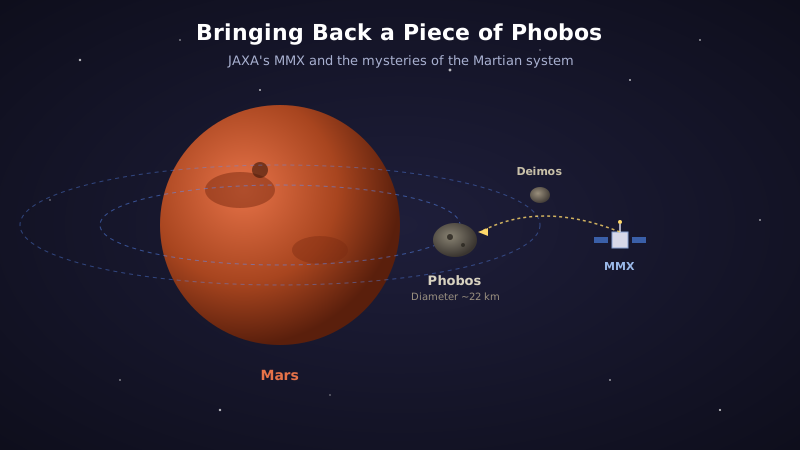
Its shape is just as odd. Phobos isn’t round. At 22 kilometers across, it’s roughly the size of a small city — you could fit the entire loop of Tokyo’s Yamanote train line inside it. On its surface sits a massive crater called Stickney, about 9.7 kilometers wide — nearly half the moon’s own diameter.
A rock carrying a scar that big, one wrong hit away from shattering entirely, is racing around Mars at close range right now. So where did this odd little moon actually come from?
Captured Asteroid, or Impact Debris?
This is where the story gets genuinely interesting. Researchers are split right down the middle on where Phobos was born.
One camp favors the “capture theory”: an asteroid from the outer solar system wandered too close to Mars and got snared by its gravity. The dark, reddish look of Phobos’s surface resembles distant asteroids, which is the main evidence behind this idea.
The other camp backs the “giant impact theory”: long ago, something large slammed into Mars, and the debris that scattered into orbit clumped together to form Phobos. Earth’s own moon is thought to have formed the same way — so why not Mars’s moon too?
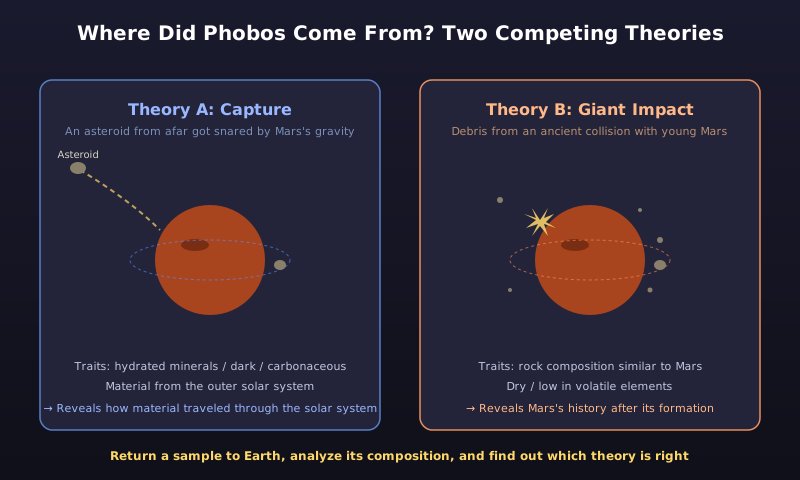
Both stories sound plausible. The frustrating part is that, from a distance, there’s no way to tell which one is true. The same dark rock could mean a foreign visitor or a fragment of Mars itself — and those two answers couldn’t be more different.
It’s a bit like being shown a single photograph and asked, “Are these two people related?” The resemblance might be there. But if you really want to know, a photo won’t cut it — you need to examine the cells themselves.
A Photograph Can’t Tell You How Something Tastes
So why hasn’t this been settled already? Spacecraft and telescopes have photographed Phobos plenty of times by now.
The problem is that color and shape can only tell you so much. The light reflecting off Phobos’s surface could belong to a distant asteroid or to Martian rock — it reads as either. Researchers believe this ambiguity simply won’t clear up until they get their hands on the real thing.
I’ll admit it: for a long time, I assumed that with so many spacecraft visits already logged, we’d basically know what Phobos is made of by now. Turns out there’s a massive gap between measuring reflected light from afar and breaking down actual grains of sand in a lab.
The ratio of elements in a rock — especially “isotopes” (versions of the same element with slightly different weights) like those of oxygen — works like a fingerprint unique to each body in the solar system. But you can only read that fingerprint by bringing the material back to Earth and running it through precision instruments.
You can stare at a photo of a dish all day and never learn what it tastes like. One bite tells you everything. Bringing home Phobos sand is exactly that: going to get the bite.
So who’s making the trip, and how?
MMX: A Spacecraft That Splits Into Three
That job falls to JAXA’s Martian Moons eXploration probe, or MMX. It’s scheduled to launch on an H3 rocket from Tanegashima Space Center on October 20, 2026.
MMX is built in three main sections: a propulsion module that carries it to Mars, an exploration module that studies Phobos and collects the sand, and a return module that carries the sample back to Earth. Each finished section gets jettisoned as the mission moves to its next stage.
The plan calls for arrival at Mars in 2027. Over roughly the next three years, MMX will study both Phobos and Deimos (the other Martian moon), then land on Phobos to collect at least 10 grams of sand. It’s set to leave Mars in 2030 and return to Earth in fiscal year 2031, with the sample capsule landing in Australia.
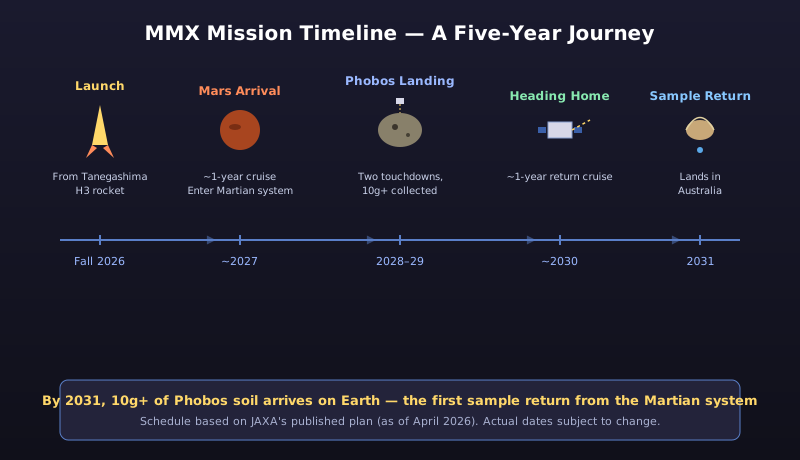
Ten grams might sound underwhelming — about two teaspoons, small enough to sit in your palm. But that single handful is enough to answer a question that’s stumped researchers for decades. It was never about quantity. It’s about getting the real thing.
Japan has done this before. Hayabusa and Hayabusa2 already brought back samples from the asteroids Itokawa and Ryugu — reaching a distant small body, grabbing a fragment, and bringing it home. MMX builds directly on that experience, this time aimed at a moon of Mars. NASA, ESA (the European Space Agency), and others are contributing to the mission, including a small rover named Idefix that will help scout the landing site.
Still, “landing” on Phobos is nowhere near as simple as it sounds.
Touching Down on a World With Almost No Gravity
Phobos is so small that it has almost no gravity — just a sliver of what you’d feel on Earth.
If you stood on its surface, a light kick off the ground could send you floating several meters up, and you’d stay airborne for a long while before drifting back down. Throw a ball with any real force and it might sail clean off into space. The rock beneath your feet feels less like something to stand on and more like something to gently lean against.
So this isn’t really a “landing” in the usual sense. It’s more like nudging up alongside a rock that’s spinning at high speed and carefully making contact without drifting away. That’s exactly why Idefix will scout the surface first, hunting for a safe spot to approach.
Picture it: standing on a rock you can’t even push off from, and looking up to see Mars, red and enormous, filling half the sky — far bigger and closer than Earth ever looks from our own moon.
Here’s where it gets even more interesting. There’s another reason to rush to Phobos right now. This moon won’t be around forever.
Scooping Sand From a Moon That’s Disappearing
Phobos is slowly spiraling inward toward Mars. According to NASA, it’s closing the distance by about 1.8 meters every century, pulled in by the same kind of tidal force that drives ocean tides here on Earth.
At this rate, Phobos is expected to either crash into Mars or be torn apart by tidal forces roughly 50 million years from now, scattering into a ring around the planet. Mars might one day wear a ring, much like Saturn’s.
Which means MMX isn’t just visiting a moon — it’s documenting the identity of a world destined to vanish. It’s a rare chance to get the record straight before it’s too late.
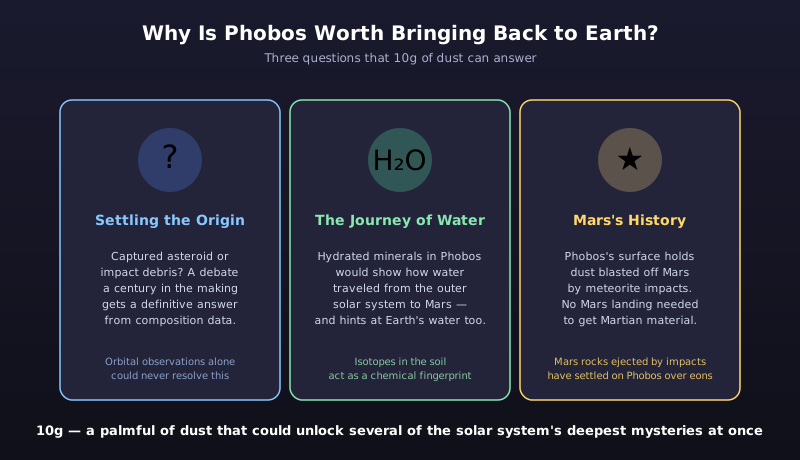
The sand itself holds the answer. If Phobos is a captured asteroid, its chemical fingerprint will look foreign, unlike anything on Mars. If it’s impact debris, that fingerprint will closely resemble the Red Planet’s own. Either way, the answer feeds into a bigger story: what kind of collisions shaped Mars in its distant past.
In fiscal year 2031, a capsule will drift down onto the Australian desert. The handful of sand inside will likely outlast Phobos itself — a moon destined to crumble into a ring — sitting quietly on a laboratory shelf back on Earth.