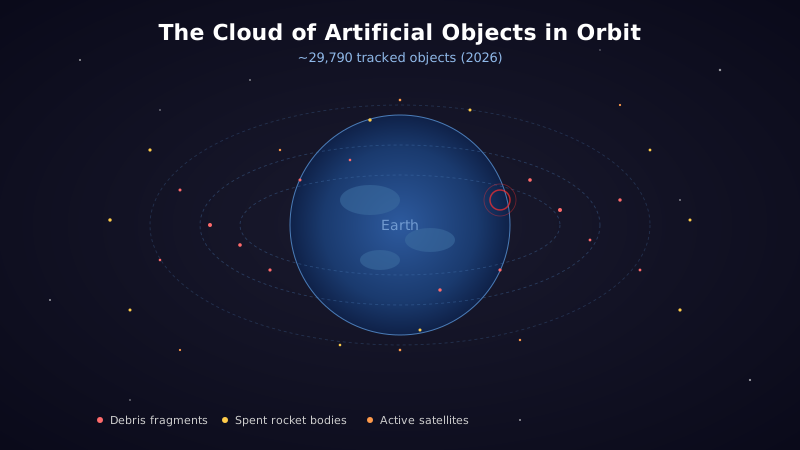
Humanity has been launching things into space for barely 70 years. In that short window, we’ve managed to litter Earth’s surroundings with nearly 30,000 pieces of broken machinery.
This isn’t a metaphor. The U.S. military tracks every object, assigns each one a number, and maintains a running catalog. As of February 2026, ground-based radar networks are following 29,790 artificial objects. A decade ago the count was around 23,000 — so things have gotten noticeably more crowded.
And that’s only the objects larger than about 10 centimeters. Include smaller fragments and the total jumps past 100 million.
This article gets into why space debris is genuinely dangerous, and what the term “Kessler syndrome” actually means — as precisely as possible.
What Does It Even Mean for Junk to “Pile Up” in Orbit?
Start with the basics. Every artificial object circling Earth is traveling at extraordinary speed.
Satellites in low Earth orbit (roughly 400 to 2,000 km altitude) move at about 7 to 8 km per second. A shinkansen bullet train moves at around 80 meters per second — so these objects are traveling roughly 100 times faster. At those speeds, a single loose screw hits with the force of a bullet fired into a car.
The International Space Station (ISS) at 400 km altitude has had its windows chipped by flakes of paint less than a centimeter across. Paint chips. That’s the scale we’re dealing with.
Space debris is nothing like garbage on the ground. It keeps moving indefinitely, it doesn’t fall for decades, and the relative velocities involved are on a completely different order of magnitude.
With that context, let’s look at why the debris count keeps climbing.
Dead Satellites Stay Exactly Where They Are
Every satellite launched eventually stops working. Fuel runs out. Instruments fail. The day comes when it no longer responds.
Here’s the problem: a dead satellite typically stays in its orbit.
At lower altitudes, traces of atmosphere create just enough drag to gradually pull objects back down — most satellites in the 400 km range reenter and burn up within years to decades. But above about 1,000 km, the atmosphere is essentially gone. Objects there can float for hundreds or even thousands of years.
Spent rocket upper stages, satellites shattered when their batteries exploded, military satellites blasted apart in weapons tests — all of it accumulates. That’s how you get to 30,000 objects.
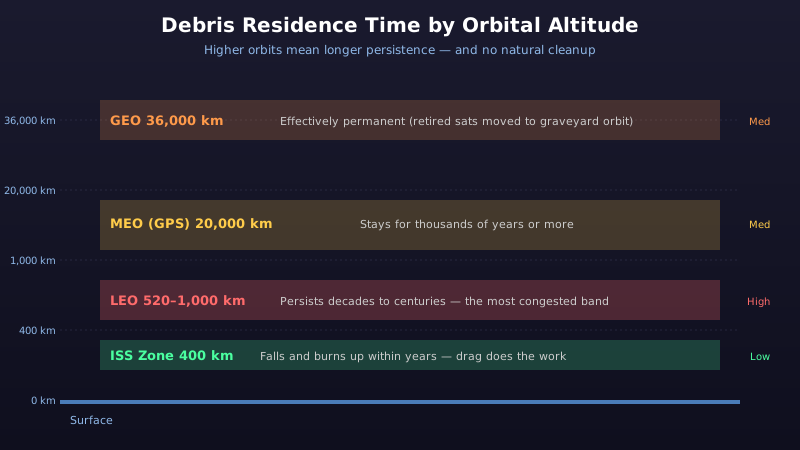
Two events alone account for a huge chunk of today’s tracked debris: China’s anti-satellite missile test in 2007 and the accidental collision between an American Iridium satellite and a defunct Russian Cosmos satellite in 2009. Together, those two incidents added several thousand new trackable fragments to the catalog.
Two events. Thousands of new pieces.
What Kessler Syndrome Actually Is
Now for the core of it. In 1978, NASA researcher Donald Kessler published a paper with an unsettling thesis.
The argument is simple: if the density of objects in orbit gets high enough, a collision produces fragments that go on to hit other objects, creating more fragments, which hit still more objects — and the process doesn’t stop.
It’s a chain reaction. The same structure as nuclear fission. Collisions breed collisions, fragments breed fragments, until a particular orbital band becomes so saturated with debris that it’s effectively unusable.
This is the Kessler syndrome.
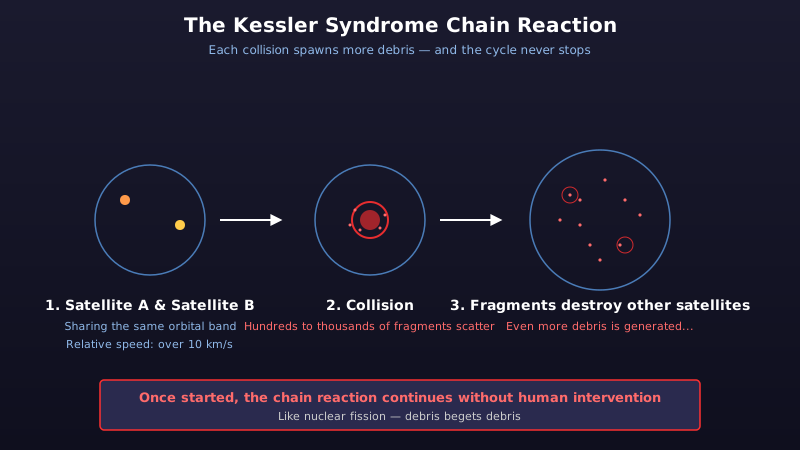
The critical detail: once the threshold is crossed, the cascade continues even if humanity never launches another satellite. Ground litter rots away; orbital debris self-multiplies.
The opening scene of the film Gravity — where a single satellite destruction sets off a spreading cloud of fragments that overwhelms everything in its path — is a dramatized version of the same idea. Heavily exaggerated, but mechanistically correct.
Are We Already in the Cascade?
So where does Earth stand right now on that spectrum?
Experts genuinely disagree. Some argue we haven’t yet reached the entry threshold. Others believe we’re already in the early stages, at least in certain altitude bands.
What’s harder to dismiss is a cluster of papers published after 2024 that reached fairly pointed conclusions: the band between roughly 520 km and 1,000 km altitude may already have exceeded the critical density for runaway cascading.
That altitude range is exactly where Earth observation satellites, weather satellites, and communications constellations like Starlink are concentrated. It’s the band that underpins most of the orbital infrastructure humanity depends on.
“Exceeded the threshold” doesn’t mean everything falls apart tomorrow. The prevailing view is that the cascade, if it’s already beginning, will unfold over decades to centuries — a slow deterioration, not a sudden catastrophe. But the emerging consensus in the field is that certain orbital bands have a real deadline, and that deadline is sooner than comfortable.
800 Near-Misses in a Single Day
The abstract threat becomes vivid when you look at the actual numbers.
According to the orbital monitoring service OrbVeil, on February 9, 2026 alone, tracked satellites came within 50 km of each other more than 800 times. Even after filtering for only the genuinely high-risk cases, there were 441 close approaches in a single day.
In the context of orbital mechanics, 50 km is essentially the same location. At the relative velocities involved, that distance closes in seconds.
The closest tracked pair was predicted to have its next near-miss within 5.5 days.
Satellite operators receive alerts like this every day: “Your satellite will have a close approach with a piece of debris in 5.5 days — do you want to maneuver?” Written out like that, it sounds almost mundane. For the person running the satellite, it absolutely is not.
Is Cleanup Technology Actually Keeping Up?
There are real efforts underway — but let’s be honest about the scale.
On the prevention side, international guidelines have long required satellites in low Earth orbit to deorbit within 25 years of mission end. In 2023, the FCC tightened that to 5 years for new U.S.-licensed satellites.
On the removal side, Japan’s Astroscale has successfully demonstrated a mission where a chaser satellite tracked, approached, and rendezvoused with a debris target. ESA’s ClearSpace-1 mission is working toward capturing a spent rocket stage and dragging it down to burn up.
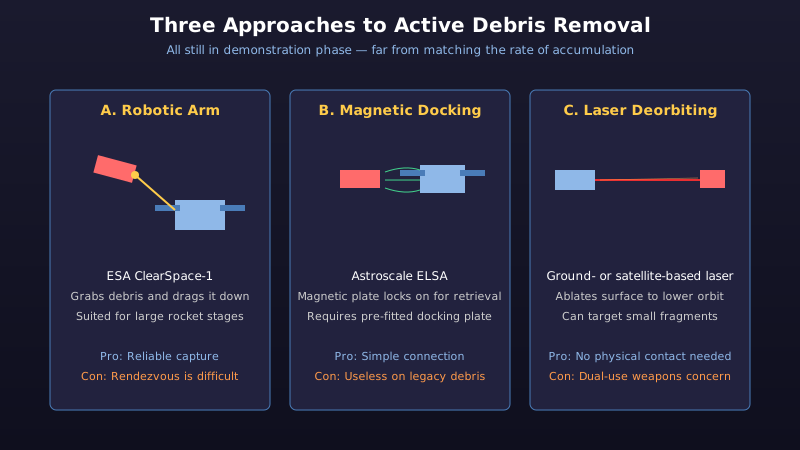
The catch: the pace is nowhere close to sufficient. The catalog grows by thousands of objects per year. Removal missions are demonstrating proof-of-concept on one or two objects at a time. The math doesn’t work.
Prevention remains far cheaper than removal. One philosophy gaining traction in satellite design is “Design for Demise” — building spacecraft specifically to burn up completely on reentry, so that even if deorbit takes longer than planned, nothing survives to become long-term debris.
This Is Not Just a Space Problem
One thing worth being direct about before wrapping up.
Space debris isn’t a niche concern for aerospace engineers. GPS, television, smartphone location services, weather forecasting, agricultural monitoring — all of it depends on satellites. Lose a critical orbital band and the consequences on the ground are not comparable to a power outage. They’re closer to losing the internet, global timing infrastructure, and disaster-response capabilities simultaneously.
The fear with Kessler syndrome is not just that future launches become harder. It’s that a cascade, once underway, could render a given altitude band unusable for generations. The time scale for recovery isn’t years — it’s centuries.
Seventy years ago, nothing human-made was in orbit. Today there are 30,000 tracked fragments up there, with tens of millions more too small to follow. How we manage that shared space is no longer purely a technical question. It’s a question about what kind of access to space we want to leave intact — for ourselves and for whoever comes after us.
Next time you look up at a dark sky, it’s worth remembering that just beyond the blue-black dark, a cloud of fast-moving debris is circling the planet, right now, in silence.