Someone decided to call an asteroid “Torifune.”
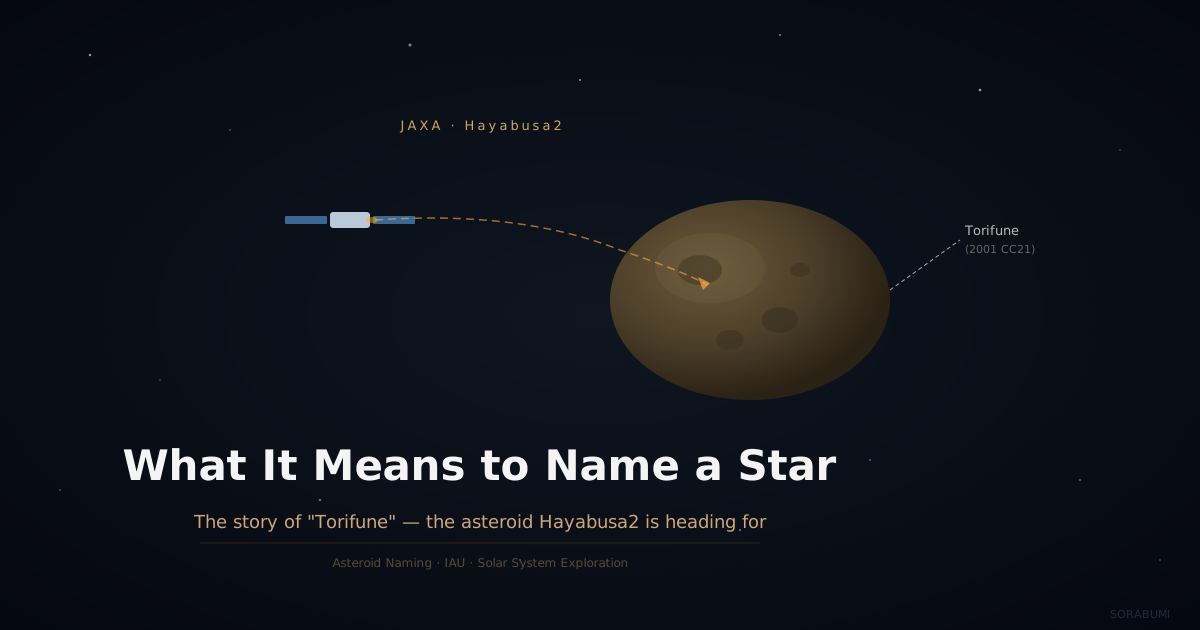
In July 2026, Hayabusa2 will close in on it. The spacecraft will streak past at 18,000 km/h, cameras running, capturing whatever it can of the surface in a few hours of frantic observation. The whole encounter is brief. But getting there has taken years — and once you learn why it’s called Torifune, this quiet little flyby starts to look like something more.
The Destination and a Name Worth Asking About
Hayabusa2’s extended mission began the moment it delivered its prize. After dropping a capsule packed with samples from asteroid Ryugu back to Earth in 2020, the spacecraft itself kept going. It still had fuel. Its instruments still worked. Ditching it would have been a waste.
So JAXA plotted a new course: visit two more asteroids. First, a flyby of 2001 CC21 (Torifune) in July 2026, then a long cruise to reach 1998 KY26 in 2031.
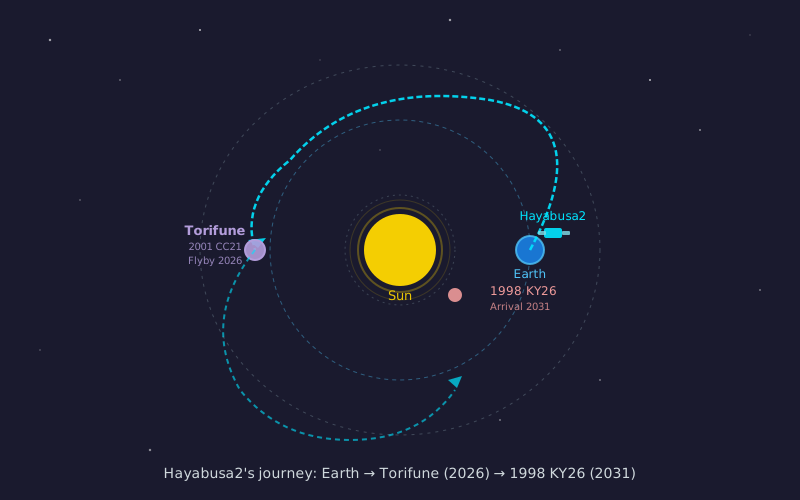
The designation “2001 CC21” is purely bureaucratic — it just encodes the year of discovery and a letter sequence indicating the order it was found. The official name “Torifune” carries a very different kind of weight. That difference is worth pulling on.
Who Names Rocks in Space — and How
There are over a million confirmed asteroids in the solar system, between Earth and the main belt between Mars and Jupiter. Each one gets a number. Some get a name.
The International Astronomical Union — the IAU, founded in 1919 — runs the whole show. It’s the body that standardizes everything in astronomy, from constellation boundaries to the definition of “planet” (yes, the same committee that demoted Pluto in 2006). Official asteroid names go through them.
The process works like this: an observer spots a new object and reports it to the Minor Planet Center (MPC). The MPC assigns a provisional designation. After enough follow-up observations pin down the orbit, the object gets a permanent number. Only then can the discoverer or mission team propose an actual name.
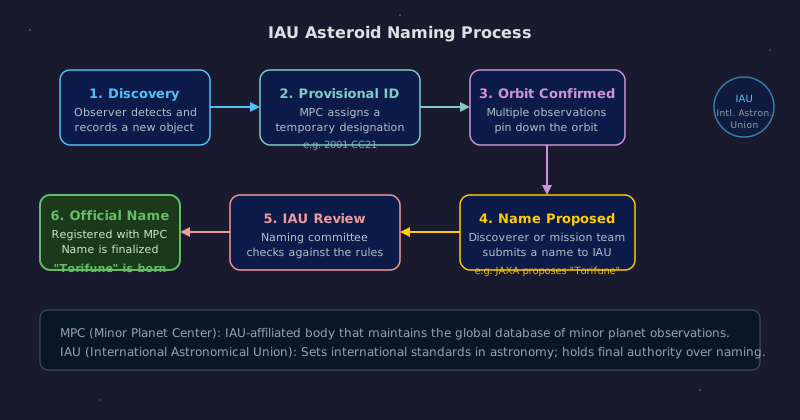
The IAU’s naming committee vets every proposal against a fairly long rulebook. Names must be under 16 characters, pronounceable, clearly distinct from existing names, and free of commercial or ideological overtones. Politicians and military figures must have been dead for at least 100 years. Mythology, science, art, geography, and mission-related names are all fair game. Asteroids around the world often reflect the culture of whoever found them. Japanese asteroids include names like Wakayama, Yamagata, Soichi Noguchi, and Yasunari Kawabata.
Japanese Mythology Hits Orbit — The Story Behind “Torifune”
Torifune comes from Japanese mythology. It’s the sacred vessel said to carry the deity Amenotorifune-no-mikoto — a divine ship that flies through the sky like a bird. The name appears in both the Kojiki and the Nihon Shoki, the oldest chronicles of Japan.
JAXA’s mission team submitted “Torifune” to the IAU, and it was approved. Given that Hayabusa itself means “falcon” — a bird — there’s a satisfying thread running through it all. A spacecraft named after a bird of prey, flying out to meet an asteroid named after a divine bird-ship. A human-made machine going to keep an appointment with a mythological one.
This choice has nothing to do with the science directly. But naming a rock among hundreds of thousands of identical numbers matters for a reason that’s harder to quantify. Numbers don’t stick in memory. Names give a thing a story.
There’s something almost ceremonial about naming an asteroid. A specific rock discovered in 2001 gets a name in 2024, and a spacecraft arrives in 2026. That sequence carries something inside it — the desire to know, and the desire to remember.
What It Actually Means to Fly Past Something at 18,000 km/h
A flyby is exactly what it sounds like: the spacecraft doesn’t land, doesn’t orbit, just passes close by and observes as much as it can. Hayabusa2’s closest approach to Torifune will last only a few hours. In that window, it has to point its cameras accurately, collect data, and beam everything back to Earth.
18,000 km/h works out to about 5 km per second — fast enough to cross Japan in roughly a minute. At that kind of speed, precision pointing isn’t trivial.
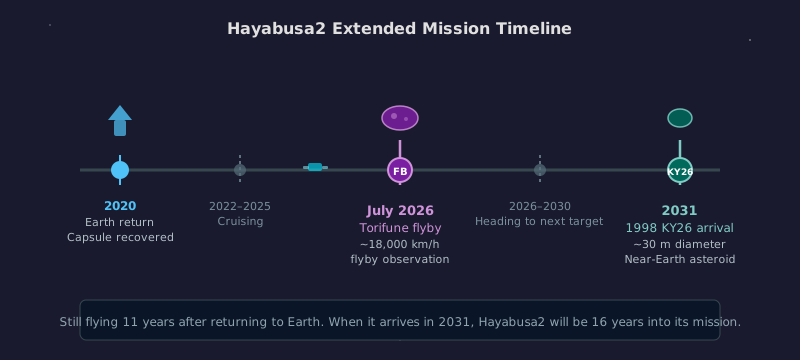
Torifune is estimated to be somewhere between 700 meters and 1 kilometer across. We don’t know much else about it yet. What shape is it? Are there craters? What color is the surface, and how reflective is it? The flyby images and spectral data will be the first real look anyone gets at this rock.
The flyby has real limits. There’s one shot at this, and small errors in the trajectory affect image quality. But “just passing through” is also the point — Hayabusa2 can conserve fuel for the next leg of the journey. Torifune is a waypoint. The main event is still ahead.
Planetary Defense — Why This Particular Rock Matters
Hayabusa2’s final destination, 1998 KY26, is tiny: about 30 meters across, roughly the height of a large building. At cosmic scales, that’s barely a speck of dust.
So why send a spacecraft to something so small? The answer is planetary defense.
1998 KY26 is classified as a near-Earth object, or NEO — an asteroid whose orbit brings it close to Earth’s path. At 30 meters, it’s large enough to destroy a city if it hit. That’s not a theoretical concern.
Planetary defense is the project of tracking these objects, characterizing them, and — when necessary — developing the technology to nudge them off course. In 2022, NASA’s DART mission did exactly that: it deliberately slammed a spacecraft into the asteroid Dimorphos and successfully changed its orbit. It was the first time humanity had intentionally moved a celestial body.
But changing an orbit requires knowing what you’re dealing with. What kind of rock? How dense? How does it hold together? Gathering that basic data is one of the core goals of the 1998 KY26 mission.
Torifune feeds into this, too. Its shape and composition will add to the growing picture of what near-Earth asteroids actually look like in practice — and that diversity of data improves the precision of any future deflection plan. Studying one rock now makes the math better for rocks that might matter later.
Naming as a Form of Attention
Space is full of rocks without names. Most are just numbers — catalogued, tracked, and otherwise ignored. The ones that have names got them because someone paid attention: a discoverer with a personal attachment, a spacecraft’s target, something scientifically significant enough to warrant it.
In Torifune, Japanese mythology and space exploration meet in an odd and quietly beautiful way. A divine vessel from an ancient text, now lending its name to a real rock that a real machine is flying to visit. The rock itself doesn’t change — it just keeps moving through the void. But something accumulates on the human side.
Naming is an act of declared interest. There are over a million asteroids out there, and only a few thousand have names. To join that small group is to be written into the record of human exploration.
In July 2026, Hayabusa2 will pass close to Torifune. For a few hours, two flying things will share the same patch of space. The images that come back will be the first portrait this named rock has ever had.