A 570-kilogram spacecraft. A collision speed of 6.6 km per second. A chunk of rock floating 11 million kilometers from Earth. That was all it took to change history.
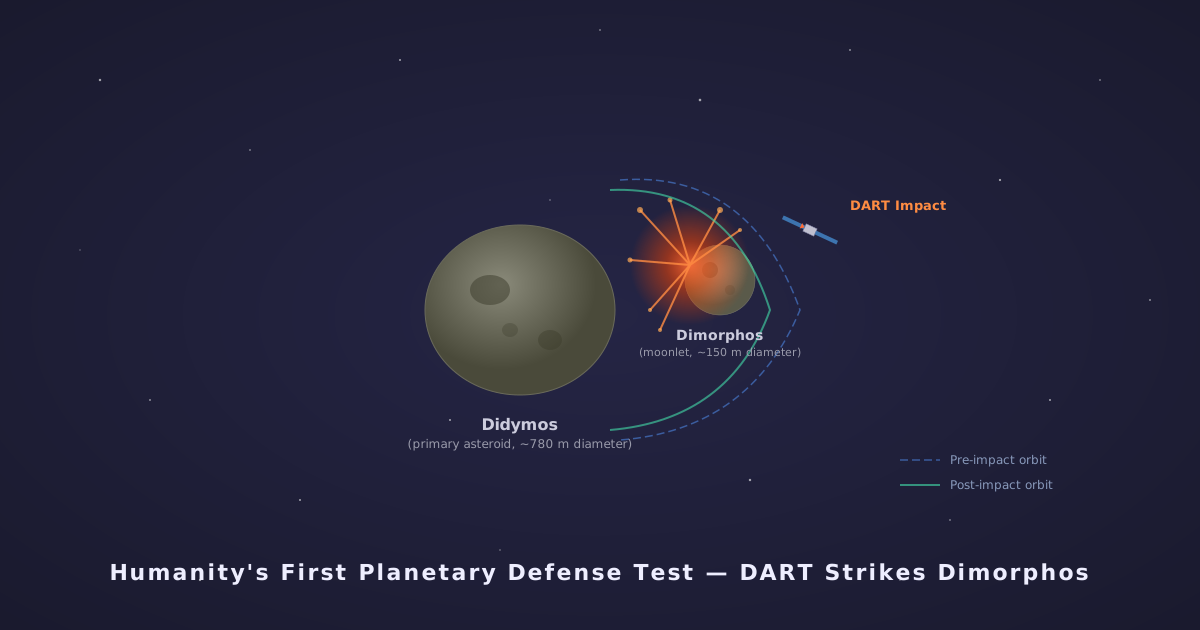
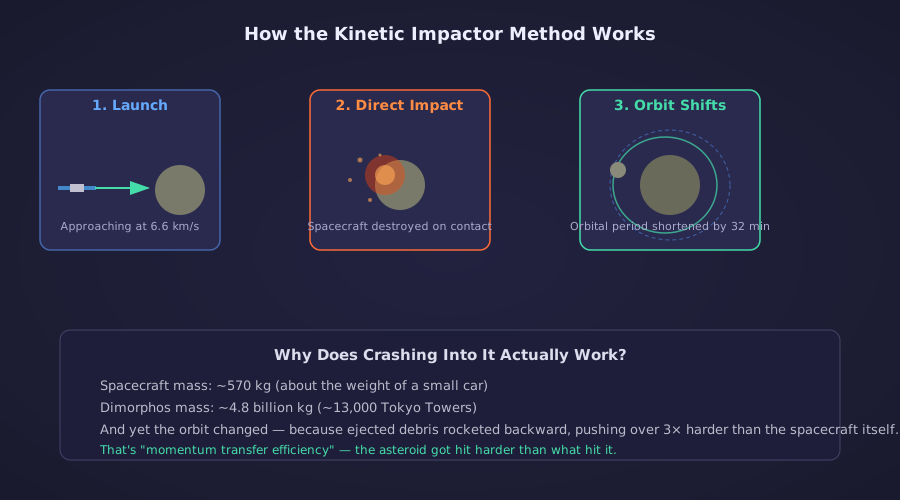
On September 26, 2022, NASA’s DART spacecraft — Double Asteroid Redirection Test — slammed head-on into the asteroid Dimorphos. The result: Dimorphos’s orbital period shrank by 32 minutes. For the first time ever, humanity had intentionally moved a space rock.
“Just Crashing Into It” — Why That Was Revolutionary
Let’s be honest. Strip away the context and what happened is simple: we hit something. Technically, it was a self-guided projectile thrown at a rock. But that simplicity was exactly the point.
Over the years, scientists had floated plenty of ideas for nudging an asteroid off course — nuclear detonation, ablating the surface with lasers, a “gravity tractor” spacecraft that hovers alongside and pulls gravitationally. All theoretically viable. None ever tested. DART demonstrated the most straightforward approach — ram it with a spacecraft and transfer momentum — in an actual, live test.
The twist? The effect was far bigger than the spacecraft’s own mass would suggest. When DART hit, it blasted out a plume of rocky debris that shot backward like rocket exhaust, pushing Dimorphos with 3.6 times the force of the spacecraft itself. A 570-kg impactor did the work of a 2-tonne shove.
That figure — the “momentum transfer efficiency” — surprised even the researchers. Until you actually do it, you just don’t know.
Dimorphos: An Asteroid With Its Own Moon
Time to talk about the target. Dimorphos is roughly 150 meters across, and it doesn’t travel alone. It orbits Didymos, a larger asteroid about 780 meters in diameter — making Dimorphos essentially a moonlet.
The binary setup wasn’t coincidental. It made measurement straightforward: compare how long Dimorphos takes to complete one orbit around Didymos before and after impact, and you have a direct readout of how much the orbit changed. With a solo asteroid, you’d have to track a tiny shift in a years-long solar orbit — painfully slow and imprecise.
Before impact, Dimorphos’s orbital period was 11 hours 55 minutes. After? 11 hours 23 minutes. A 32-minute reduction. NASA had set the success threshold at 73 seconds. The actual result was more than 25 times that. When I first read that number, my honest reaction was something between a laugh and disbelief — like preparing to jump a 5-step vault and clearing 8.
Why Hera Is Going Back to “Check the Homework”
DART was a triumph. But one critical question remains: if a genuinely threatening asteroid were heading toward Earth, could we actually pull this off?
We know the orbit shifted by 32 minutes. What we don’t know is why it shifted by exactly that much. The internal structure of Dimorphos is still uncertain — is it solid rock, a loose gravel pile, a rubble heap barely held together by its own gravity? That matters enormously, because the structure determines how efficiently a spacecraft’s momentum transfers into orbital change.
Hit solid rock and you get relatively little ejecta. Hit a loose aggregate and you get a much larger debris plume, amplifying the push. Whether DART’s result was a lucky coincidence or something repeatable depends on knowing what Dimorphos is actually made of inside.
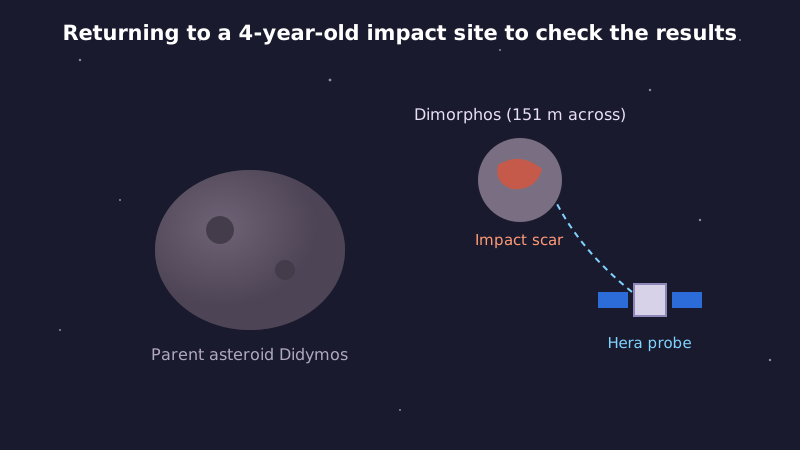
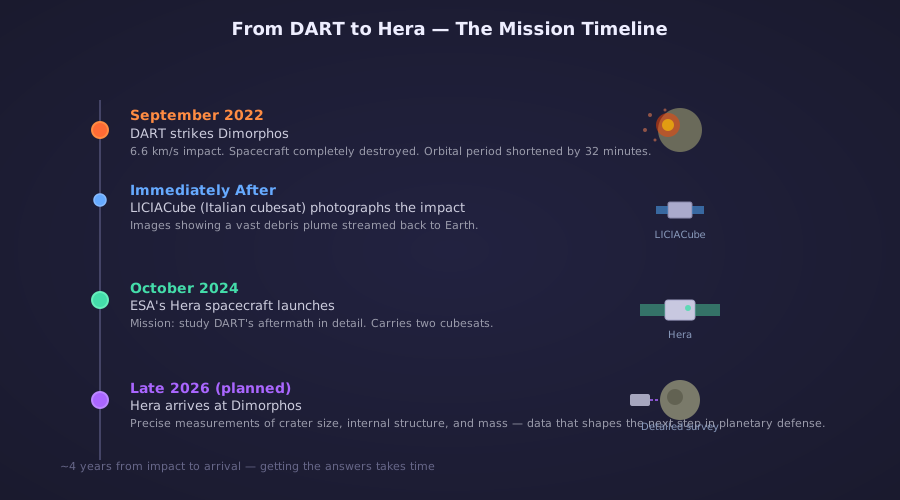
That’s where ESA’s Hera spacecraft comes in. Launched in October 2024, Hera is scheduled to arrive at Dimorphos in late 2026. It will map the crater DART left behind, measure Dimorphos’s mass and internal structure in detail. DART collected data on the impactor. Hera will collect data on what got hit. Together, they complete the planetary defense equation.
Hera’s Small Companions
Hera isn’t flying alone. It’s bringing two cubesats — Milani and Juventas — each roughly the size of a shoebox.
Milani is tasked with close-range surface photography, documenting the precise shape and dimensions of DART’s crater. Juventas goes deeper: it will use radar to peer inside Dimorphos, much like ground-penetrating radar used in geological surveys. The goal is a picture of what the asteroid looks like beneath the surface.
That “look inside” capability turns out to be critical for planetary defense. Every asteroid is different. Some are metal-rich, some icy, some fragile carbonaceous rubble. The next dangerous asteroid to approach Earth might be completely unlike Dimorphos. Knowing how internal structure affects deflection efficiency gives mission planners the constants they need to calculate how hard — and fast — a future impactor would need to hit.
A Disaster Drill You Actually Run
Think of earthquake preparedness. Your manual says: get under the desk, put on your helmet, move toward the exit. Sounds clear. But run an actual drill and surprises emerge — not enough room under the desks, nobody knows where the helmets are stored. Those gaps are invisible until you practice.
DART and Hera are that drill. DART was the live test. Hera is the after-action report. Smashing into an asteroid is cinematic; analyzing what happened afterward is decidedly less glamorous. But you can’t improve what you don’t measure.
There’s a larger point here too. DART’s success established something that hadn’t been true before: humanity is no longer helpless against asteroids. Sixty-six million years ago, the dinosaurs had no answer to a 10-kilometer impactor. We do — or at least we have a candidate answer. Hera is going to Dimorphos to find out whether it holds up.
Dimorphos Might Look Nothing Like We Expect
When Hera arrives, there’s no guarantee Dimorphos will look familiar. In fact, there are good reasons to think it’s changed significantly.
In the weeks after DART’s impact, Hubble Space Telescope observations revealed something striking: enormous plumes of debris streaming away from Dimorphos, forming a tail that extended over a million kilometers. That much ejected material means the asteroid’s very shape may have been altered.
Pre-impact, Dimorphos was roughly described as resembling an onigiri — a rounded, slightly angular lump. Researchers believe the collision energy may have reshuffled its surface, or even changed its overall form. Whether Hera’s cameras find something rounder or something more irregularly crumpled will itself be an answer to “what actually happens when you hit an asteroid at 6.6 km/s?”
A large shape change would suggest the asteroid was more fragile than expected. Fragile asteroids deflect efficiently, but they also risk fragmenting — turning one dangerous rock into a shotgun blast of smaller ones. Getting the calibration right matters, and that’s exactly what Hera’s data is designed to do.
We’ve Only Solved the First Problem
DART and Hera represent the opening move in a much longer game. Dimorphos is 150 meters wide — large enough to level a city if it hit, but less than one percent the size of the asteroid that ended the dinosaurs. How you’d handle something truly massive is still an open question.
And even kinetic deflection has a prerequisite: you need to find the asteroid years — ideally decades — before it arrives. There simply isn’t enough time to mount a mission if you discover the threat too late. Currently, about 35,000 near-Earth objects have been catalogued. But an estimated 40% of those 140-meter-plus “city-killer” class asteroids remain undiscovered.
In other words, planetary defense requires three things working together: find it, deflect it, verify the result. DART proved deflection works. Hera will complete the verification. Ground-based and space-based telescopes are steadily advancing the detection side.
There’s something quietly reassuring about all this. It’s not the movie version — no last-minute scramble, no desperate gamble. Instead, there are people who spent years designing a test, running it, and now sending a follow-up mission to check the results. Four years after DART’s impact, when Hera finally reaches Dimorphos, we’ll have the first real answer to “what happens after you shove an asteroid?”
That answer might, someday, save the planet. Hopefully we’ll never need it. But knowing it’s there — tested, verified, documented — is a very different position to be in than not knowing at all.