I’ll be honest: the first time I heard about neutrinos, my gut reaction was “there’s no way you can actually catch those.” After all, 600 trillion of them pass through your body every single second, and the vast majority of those never interact with anything at all. A particle that behaves as if it barely exists — I couldn’t imagine how anyone could possibly detect it.
And yet, humanity figured out a way. The approach is almost blunt in its ambition: drill 2.5 km into the Antarctic ice and bury sensors down there. That’s the IceCube Neutrino Observatory, and during the 2025–2026 Antarctic summer, it received a major upgrade.
What Is a Neutrino? Why “Ghost Particle”?
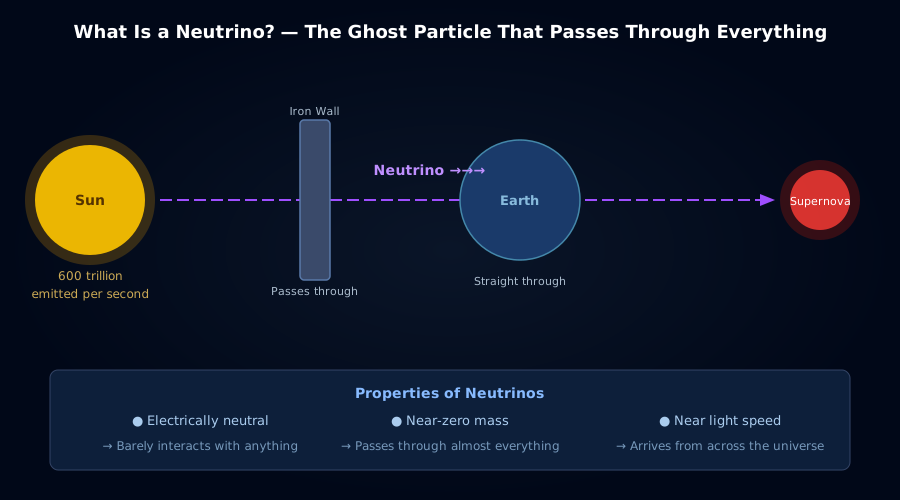
Neutrinos are fundamental particles in the Standard Model of particle physics — the theoretical framework that describes the basic building blocks of matter and the forces between them. There are three types: electron, muon, and tau neutrinos, each paired with a heavier counterpart. But neutrinos themselves have almost no mass and carry no electric charge.
Near-zero mass. No electric charge. Moving at nearly the speed of light. When all three conditions align, a particle barely interacts with matter at all. There is almost nothing for it to bump into. By one estimate, a neutrino would have a 50-50 chance of being stopped by a slab of lead one light-year thick. That number breaks your intuition.
So why do astrophysicists care so much about neutrinos? Paradoxically, the very fact that “almost nothing happens” is what makes them valuable. Photons get deflected by interstellar dust and magnetic fields; charged particles veer off course in stellar magnetic fields. But neutrinos fly in a straight line. They are the only particles that carry unaltered information directly from the violent hearts of supernovae and active galactic nuclei — the bright, turbulent cores of galaxies powered by black holes — straight to us.
Why 2.5 km Underground in Antarctica?
If neutrinos barely interact with matter, detecting them means doing one thing: putting an enormous amount of matter in their way and waiting for the rare interaction. A swimming pool’s worth of water isn’t nearly enough. A gymnasium isn’t even close. What you need is a cubic kilometer of transparent material.
Antarctica was the answer. Three conditions had to be met: the material needed to be transparent (minimal light scattering), available in vast quantities, and deep enough to shield out the noise created by cosmic rays — the high-energy particles raining down from space. Antarctic ice, compressed over tens of thousands of years into exceptionally pure crystals, checks all three boxes. And at depths below 2 km, most of that cosmic-ray noise is absorbed by the ice above.
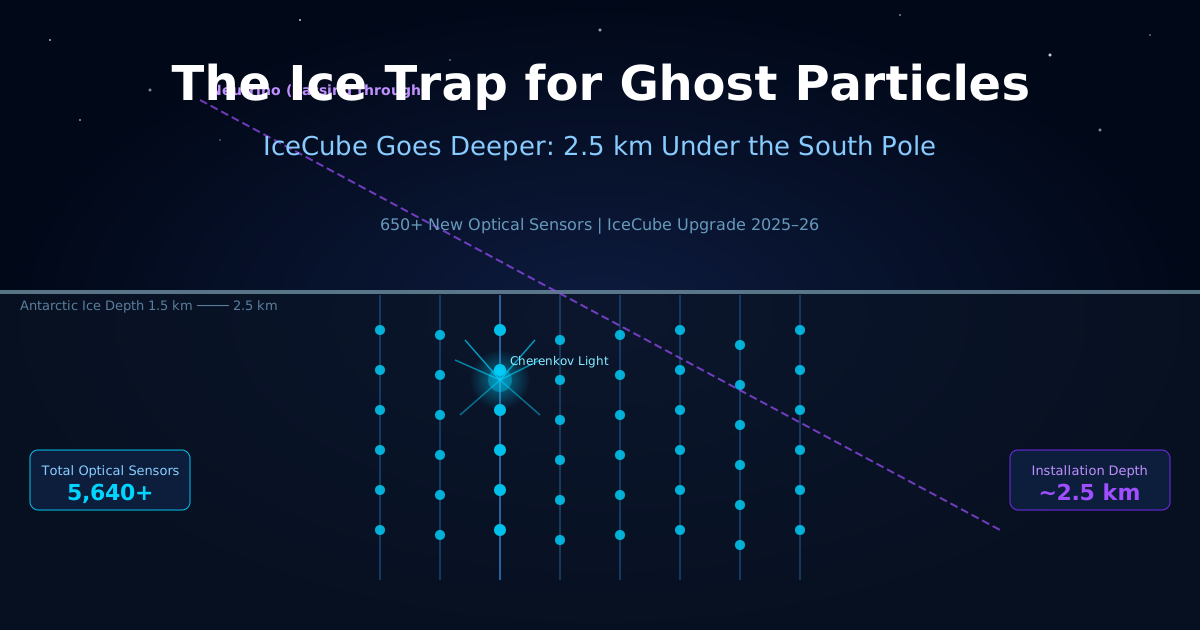
Construction began in 2005 and finished in 2010. The result: 86 vertical cables (strings), each studded with Digital Optical Modules (DOMs) — 5,160 sensors in total, forming a three-dimensional detector roughly 1 km across and 1 km deep. Buried beneath the South Pole, it is one of the largest particle detectors ever built.
So How Does IceCube Actually “See” a Neutrino?
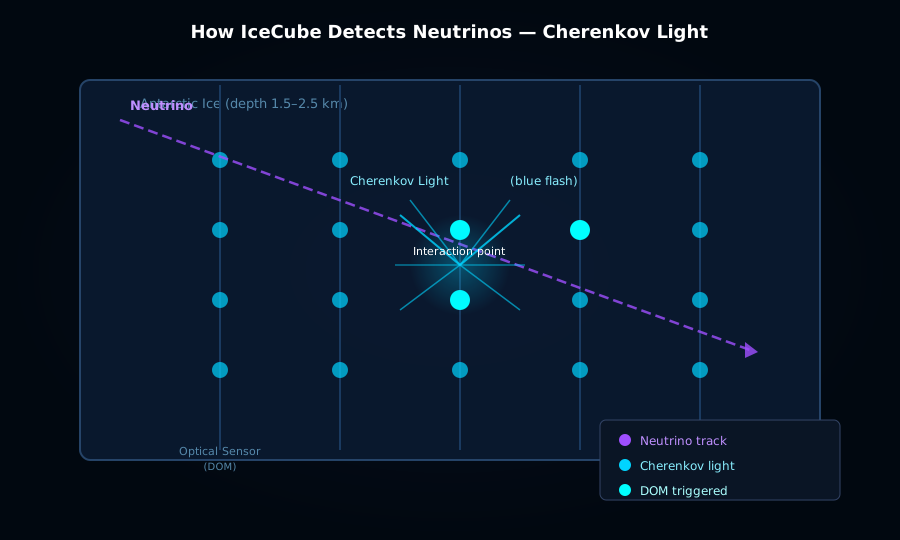
You can’t see a neutrino directly. What IceCube sees instead is the light produced by secondary particles when a neutrino very occasionally collides with an atomic nucleus in the ice.
When that collision happens, it creates charged particles such as electrons or muons. These charged particles travel through the ice faster than light can travel through ice — because ice slows light down more than it slows muons. That situation produces a burst of blue-white radiation called Cherenkov light, the same glow you see around nuclear reactor cores in underwater pools.
DOMs positioned throughout the ice detect that flash. From the precise timing and brightness at each sensor, computers reconstruct which direction the neutrino came from and how much energy it carried. A single neutrino interaction can light up multiple DOMs across several strings, and the time differences between each detection give away the direction.
One practical trick: the most useful neutrinos for astrophysics are the ones arriving from below. Using Earth’s entire mass as a shield blocks the flood of noise particles coming from the atmosphere above. Antarctica is ideally positioned for this — it naturally points the bottom of the detector toward the center of the Milky Way, a prime target for neutrino astronomy.
The 2025–26 Upgrade — What Actually Changed?
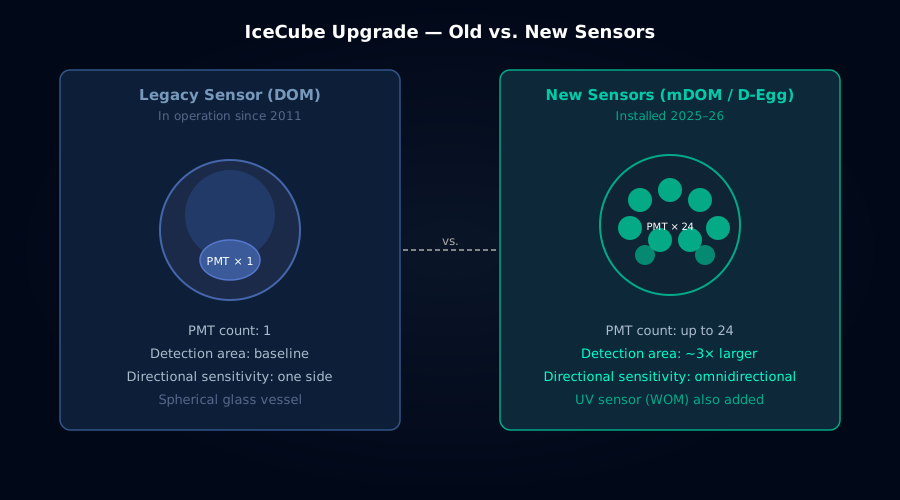
Between December 2025 and January 2026, seven new strings were installed near the center of the existing IceCube array, adding more than 650 new sensors and calibration devices to the ice.
The sensor technology took a significant leap. The original DOMs each contained a single photomultiplier tube (PMT) in a 33-cm glass sphere. The new “mDOM” model fits 24 PMTs into a sphere of the same size. Another new design, the “D-Egg,” uses two PMTs pointing in opposite directions — up and down — achieving roughly three times the effective detection area of the original. Together, these improvements sharpen calibration and make IceCube considerably more sensitive to lower-energy neutrinos, in the range of a few billion electron volts.
That shift toward lower energies is scientifically significant. It means IceCube can now measure neutrino oscillations in atmospheric neutrinos — the neutrinos produced when cosmic rays slam into the atmosphere — with greater precision. Neutrino oscillation is direct evidence that neutrinos have mass, which opened a crack in the Standard Model of physics. It’s the same phenomenon that earned Takaaki Kajita of the University of Tokyo the Nobel Prize in 2015, and IceCube can now probe it more deeply than before.
Three Mysteries IceCube Is Chasing
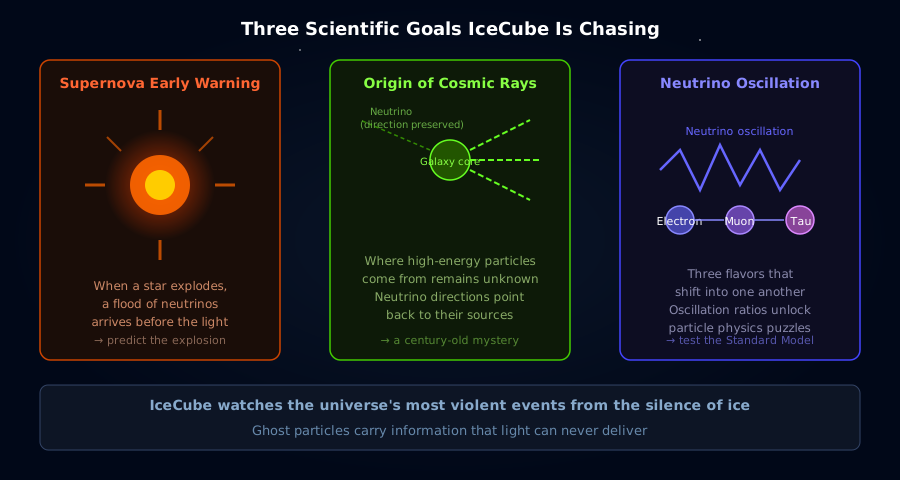
IceCube was built to pursue three broad scientific goals.
1. The origin of cosmic rays High-energy particles that rain down on Earth from space — cosmic rays — have been a mystery for over a century. Because they carry electric charge, they get bent by magnetic fields between the stars, arriving with no memory of where they came from. Neutrinos have no such problem: they travel in straight lines. If the same astrophysical events that produce cosmic rays also produce neutrinos, following those neutrinos home identifies the source. In 2017, IceCube reported a striking match between a high-energy neutrino and the direction of an active galactic nucleus called TXS 0506+056 — the first credible pointing toward a cosmic ray source.
2. Early warning for supernovae When a massive star explodes, roughly 99% of its energy escapes as neutrinos, and they escape before the light does — because light takes time to fight its way out through the collapsing stellar material. If IceCube detects a burst of neutrinos from a supernova within our galaxy, it can alert observatories around the world hours before the optical explosion becomes visible. This already happened once, with SN 1987A in the Large Magellanic Cloud, where neutrino detectors worldwide registered the signal hours before the visible flash. IceCube is ready to play that role on a grander scale.
3. Precision measurement of neutrino oscillation As they travel, neutrinos spontaneously shift between their three flavors — a quantum mechanical effect called oscillation. The upgraded IceCube can measure the oscillation parameters of atmospheric neutrinos more precisely than before, contributing to deeper questions: why do neutrinos have mass, and why is the universe made of matter rather than antimatter?
What Only Antarctica Can Offer
In scientific circles, Antarctica is often described as the end of the world — and in practical terms, it is. Temperatures drop below −40°C, the location is utterly isolated, and months of continuous daylight or darkness make logistics brutal. Maintaining equipment there is never simple, and the conditions limit how long researchers can stay on site.
And yet this is exactly where IceCube had to be built, because nowhere else on Earth offers the combination of ultra-clear, ancient ice and the geometry to use the planet itself as a cosmic-ray filter.
In the fifteen years since IceCube began operations, an entirely new discipline — neutrino astronomy — has taken shape. Alongside electromagnetic radiation and gravitational waves, neutrinos now form the third pillar of what scientists call multi-messenger astronomy: observing the universe through fundamentally different channels at once. With the upgraded array, IceCube is better positioned than ever to pull signals out of the universe’s most extreme events.
Right now, trillions of ghost particles are passing through your body every second. Down in the Antarctic ice, the detector waits in silence, listening for the rare moment one of them leaves a footprint.
Sources
- IceCube official press release (February 2026): The IceCube Neutrino Observatory gets a major upgrade beneath the ice
- phys.org (February 2026): The IceCube experiment is ready to uncover more secrets of the universe