When scientists melted 300 kilograms of Antarctic ice core and analyzed what came out, they found cosmic debris mixed in — and not the ordinary kind. What they discovered was a special radioactive element that can only be produced during a supernova explosion, when a massive star reaches the end of its life and detonates.
The team behind this discovery is an international group led by the Helmholtz-Zentrum Dresden-Rossendorf (HZDR). Their study, published in Physical Review Letters in May 2026, analyzed 80,000 years of accumulated deposits and shed new light on the nature of the space the solar system currently inhabits.
A Slightly Unusual Element: Iron-60
First, a quick primer on iron-60.
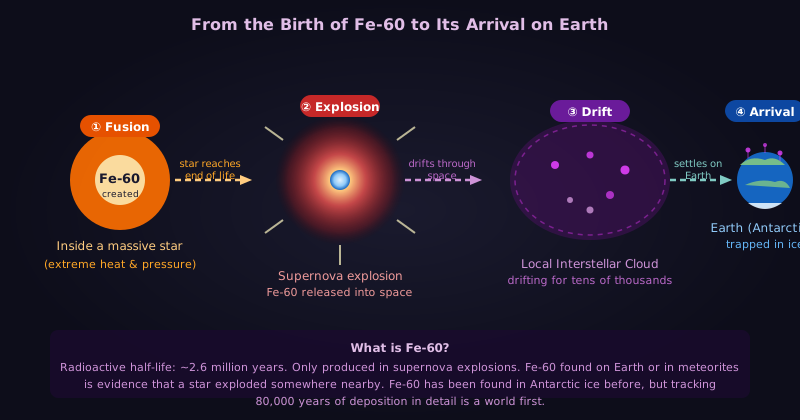
Iron-60 (Fe-60) is a radioactive isotope with a half-life of about 2.6 million years. That means if Fe-60 was produced 2.6 million years ago, exactly half of it remains today. What makes this element special is that virtually all the Fe-60 in the universe is born exclusively in supernova explosions. Even inside the Sun, ordinary stellar fusion cannot produce it.
So if Fe-60 turns up somewhere, it serves as direct evidence that a star exploded somewhere in the vicinity — at least in cosmic terms. Fe-60 has previously been detected in ocean floor sediments and lunar rocks, and each time, researchers have argued that a supernova must have occurred near the solar system in the past.
What makes this new study different is that the Antarctic ice core allowed the team to track changes over 80,000 years in precise detail. It wasn’t just a detection — it was a record of when concentrations were higher and when they were lower.
How Do You Extract Cosmic Particles From Ice?
Antarctic ice cores are frequently used as time capsules. Ancient ice traps samples of the atmosphere from the era in which it formed, which is why climate scientists use them to reconstruct past temperature records. This study, however, had a different goal entirely.
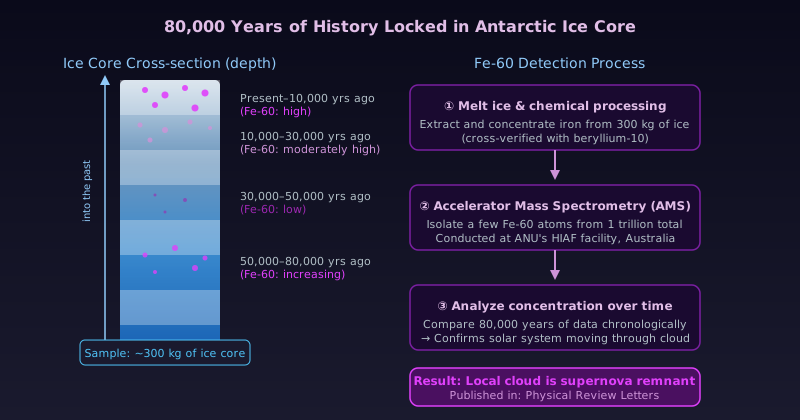
The team collected roughly 300 kilograms of ice deposited between 40,000 and 80,000 years ago. They melted it, applied chemical treatment, and extracted and concentrated the iron. That part is fairly standard. The challenge came next.
Fe-60 is vanishingly rare compared to other iron isotopes — you’re essentially picking a handful of atoms out of an astronomical number. The team used the Heavy Ion Accelerator Facility (HIAF) at the Australian National University, employing electric and magnetic filters to isolate and measure just a few Fe-60 atoms out of every trillion. It’s a staggeringly precise piece of work. But that precision is exactly what allowed them to detect the subtle signal: that ice from 80,000 years ago contains slightly less Fe-60 than ice from more recent periods.
Where the Solar System Actually Is
The analysis showed that Fe-60 concentrations vary depending on the era. More recent layers contain higher amounts; concentrations dip around 40,000 to 50,000 years ago; and they rise again in ice from roughly 80,000 years back.
This variation reflects the fact that the solar system is moving through dust as it travels through space. Space is not uniform — some regions are dense with interstellar gas and dust, others are nearly empty voids.
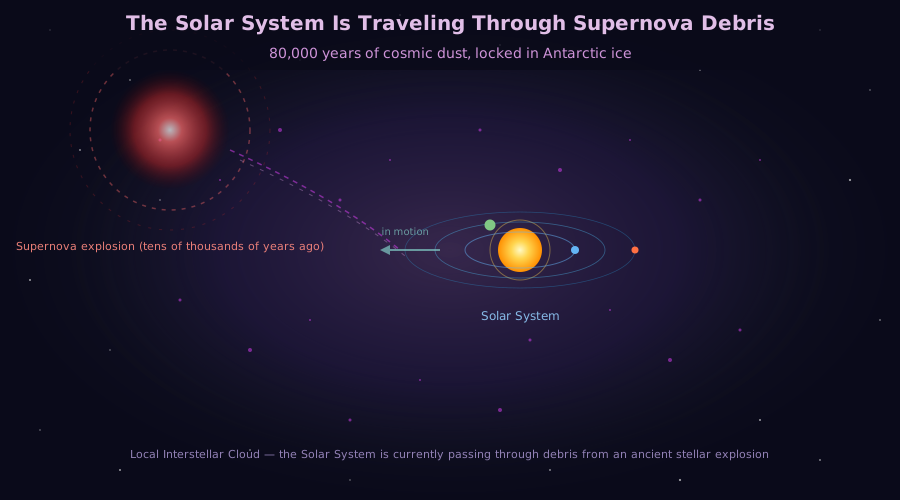
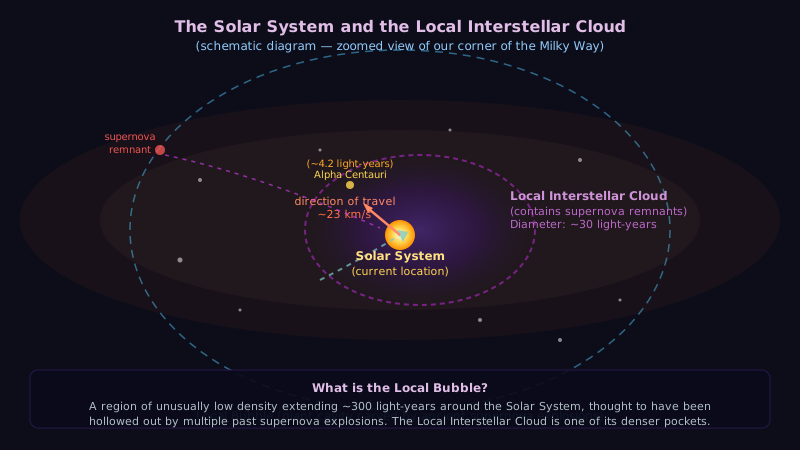
Around our solar system lies a structure called the Local Interstellar Cloud — a cloud-like region about 30 light-years across. The solar system is currently passing through it at roughly 23 kilometers per second.
This new study strongly suggests that the material inside the Local Interstellar Cloud is composed of supernova remnants. A star that exploded somewhere nearby long ago scattered its debris across the surrounding space. That debris became part of the cloud, and as the solar system passes through, it has been steadily accumulating a trickle of Fe-60. The varying concentrations reflect how densely packed different parts of the cloud are.
The Local Bubble: Our Cosmic Neighborhood
Zooming out a bit further, the solar system sits within a region called the Local Bubble — a vast, low-density cavity stretching roughly 300 light-years in all directions. Think of it as a bubble blown into the fabric of the galaxy.
The most likely explanation for how this cavity formed is a series of supernova explosions that occurred in the past, blasting away the surrounding material. The Local Interstellar Cloud is one of the denser remnant pockets left behind inside that bubble.
For decades, scientists have connected the formation of the Local Bubble to a stellar group called the Scorpius-Centaurus OB Association. The theory holds that repeated supernovae within that association over the past tens of millions of years carved out the bubble we now call home.
The Antarctic ice core data adds a sharper edge to that picture. By tracing precisely when and in what quantities supernova material reached the solar system over 80,000 years, researchers now have new raw material to work backwards from — reconstructing where and on what scale the relevant explosions occurred.
Earth as a Cosmic Dust Collector
It’s worth pausing to appreciate how strange this really is.
Earth orbits the Sun, but it’s also riding along with the Sun as the solar system cruises through interstellar space. Along the way, cosmic dust drifts in the path ahead, and some of it settles into Earth’s atmosphere and oceans over time. Right now, at this very moment, fragments of a star that exploded long ago may be falling somewhere on Earth.
The quantities involved are minuscule — nothing that affects health or the environment. But there’s something quietly poetic about the idea that melting Antarctic ice yields cosmic debris. We know intellectually that Earth is part of the universe, but research like this makes it visceral: this planet is a traveling object, and it picks things up along the way.
Fe-60 detection is also concrete evidence that extraterrestrial material reaches Earth on a regular basis. Meteorites are the obvious example, but invisible-scale cosmic dust falls constantly. What this study contributes is 80,000 years of that record, made visible.
The Questions This Opens Up
Looking ahead, the most anticipated next step is analyzing even older ice cores.
This study reached back 80,000 years, but the team believes that data from deeper layers could paint a more detailed picture of the solar system’s orbital history and the formation of the Local Interstellar Cloud. Antarctica holds ice laid down hundreds of thousands of years ago, and in principle, evidence of even older supernovae could be locked inside it.
Verification from other sites is another priority. Ocean floor sediments and lunar regolith have both been accumulating cosmic dust for vast stretches of time. Corresponding datasets from those sources would give a more three-dimensional view. Japan’s participation in the Artemis program through JAXA, along with ongoing lunar sample returns from China’s Chang’e missions, could provide useful material for exactly this kind of analysis.
There’s something remarkable about being able to probe the nature of the space just outside our planet by studying ice underfoot. The researchers who painstakingly isolated a handful of atoms from 300 kilograms of ice were driven, at bottom, by a profoundly human desire: to know where we are.
Fragments of a supernova — one of the universe’s most dramatic events — were lying quietly in Antarctic ice all along. Digging them out has sharpened our map of where the solar system sits. Cosmic exploration, it turns out, doesn’t only happen beyond Earth’s atmosphere.