It has been known for years that Mars has water. The polar ice caps contain frozen reserves, and a growing body of research points to large amounts of water ice underground. So when yet another headline announces “water found on Mars,” a certain weariness is understandable.
But a study published in summer 2025 carried a different kind of surprise. Not that water exists, but how pure it turns out to be.
Glaciers That Were Supposed to Be Mostly Rock
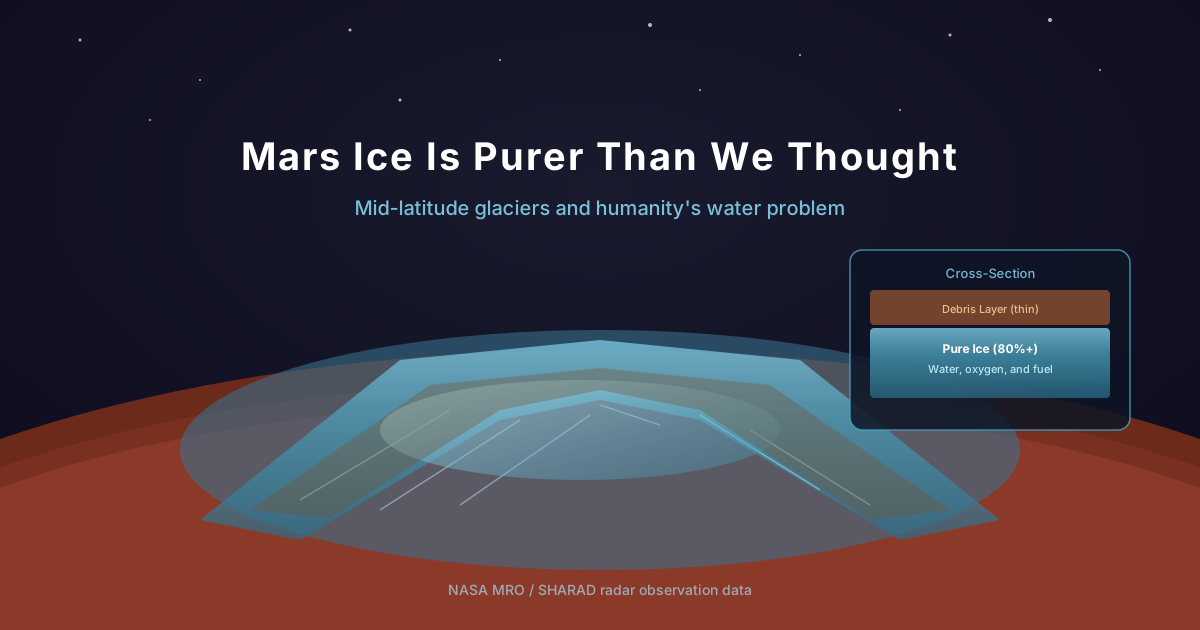
The ice in question sits in Mars’s “mid-latitudes” — between roughly 30 and 50 degrees north and south, the same belt where Japan and New York sit on Earth. This region is covered by formations called Lobate Debris Aprons (LDAs): slow-moving terrain that flows down from hillsides and looks, on the surface, like ridges of piled rock and sand.
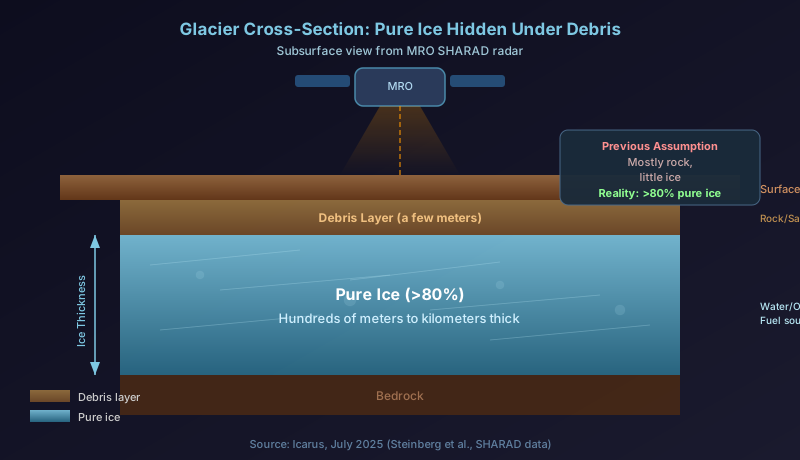
For a long time, researchers assumed these formations were mostly rock with a small amount of ice mixed in. The word “debris” in the name says it all — the mental image was more of a rocky junkyard than a glacier.
What changed the picture was the SHARAD radar instrument aboard NASA’s Mars Reconnaissance Orbiter (MRO).
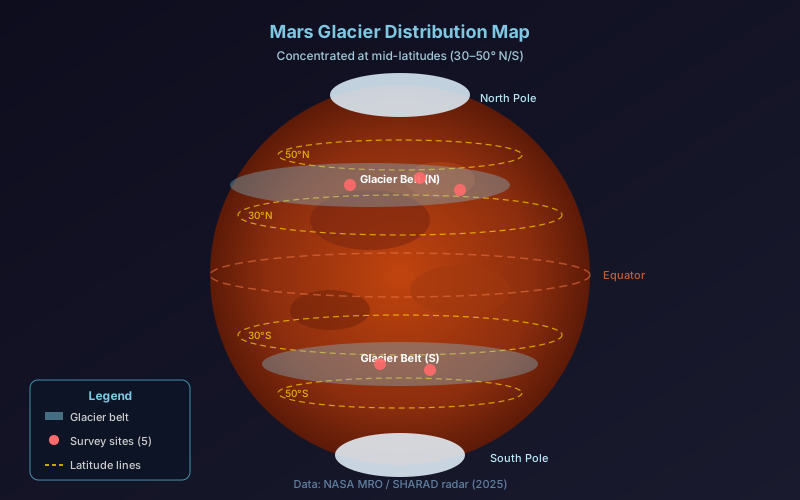
SHARAD sends radio waves into the ground and reads how they travel through subsurface layers — essentially seeing underground. By analyzing how the waves move through ice, researchers can estimate its purity. The team used this data to examine five glaciers in both the northern and southern hemispheres.
When the results came in, even the team was surprised. Every site showed ice purity above 80 percent. And all five sites returned nearly the same value.
Why Is the Ice So Pure?
Worth pausing on. Why would Martian ice be this pure?
On Earth, glaciers form as snow accumulates and slowly compresses over time. The melting and refreezing cycle lets air and minerals work their way in — 100% purity is never on the table.
Mars operates under different conditions. What caught researchers’ attention was the consistency across five different sites. The mid-latitudes vary in terrain and rock composition from place to place. Yet the ice quality was nearly identical everywhere. That strongly suggests these glaciers formed through the same process, at the same time.
Which leads to the idea that Mars once experienced a planet-wide ice age — or that similar conditions repeated multiple times across its history.
Mars’s axial tilt is far less stable than Earth’s. Earth has the Moon, a large satellite that stabilizes its spin. Mars has no such anchor, so its axial tilt has likely swung dramatically in the past. As the tilt shifted, so did how sunlight fell on the surface, triggering major climate upheavals. Those cycles could explain why ice ended up concentrated in the mid-latitudes in the pattern we see today.
There’s something quietly unsettling about this. The assumption that a planet’s climate stays roughly constant over time doesn’t hold up across the solar system.
A Thin Layer of Debris Acting as Natural Insulation
There’s another piece worth noting. On the surface of these glaciers lies a thin layer of rocky debris, just a few meters thick. Over long stretches of time, that layer has likely been protecting the ice beneath.
Mars’s atmosphere is less than 1% the density of Earth’s, and the temperature swing between day and night can exceed 100 degrees Celsius. In that harsh environment, the insulating effect of the debris layer may be what has kept the ice from sublimating — going straight from solid to vapor — and vanishing into space.
Hundreds of millions of years, wrapped in a thin coat of rock. There’s something almost stubborn and endearing about that picture.
Incidentally, that same thin debris layer is exactly what led earlier researchers to assume these formations were mostly rock. When you can only see the surface, everything looks like rubble. SHARAD’s ability to look underground is what revealed the truth.
Closing the Gap on In-Situ Resource Utilization
So what does this discovery actually do for us?
When people talk about humans living on Mars, the central problem is always what to bring. Water, air, food — spacecraft volume and mass have hard limits. The more you haul from Earth, the more the cost explodes. So “maximize what can be sourced locally” sits at the core of crewed Mars mission planning.
Water is the highest-priority resource of all. Not just for drinking — split by electrolysis, water becomes oxygen and hydrogen. Oxygen for breathing. Hydrogen as a potential rocket propellant. Which means water availability could start resolving the air problem and the fuel problem at once.
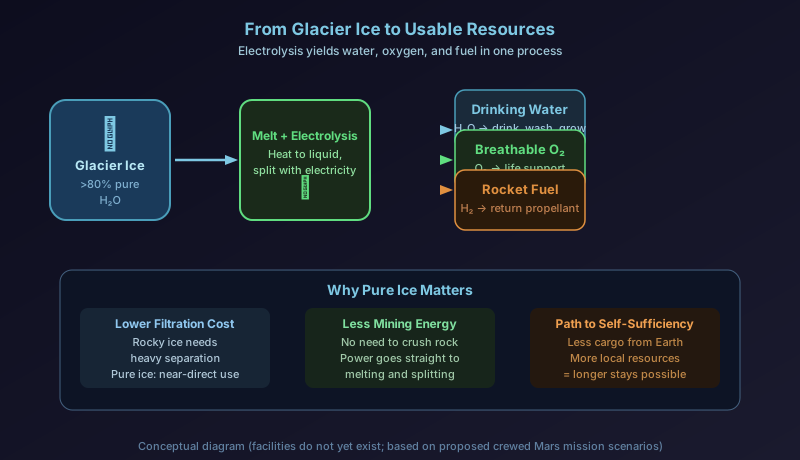
That’s where purity becomes critical. Ice mixed heavily with rock requires equipment and power to strip out the contaminants. Pure ice, melted and given basic treatment, can reach usable quality far more directly.
The finding that mid-latitude glaciers are more than 80% pure is, in that sense, genuinely welcome news. And since the ice sits just under a thin debris cover, “dig a few meters and hit ice” is a realistic scenario. You would not need heavy drilling rigs hauled across space.
Of course, there is still a vast distance between “discovered” and “operational.” Mining technology, transport to site, processing facilities, safety verification — the list of challenges is long. But “there is usable material here” and “we don’t even know if anything useful exists” are completely different starting points.
What Five Sites Represent
Only five glaciers were examined in this study, but the mid-latitudes hold countless formations of this type. Consistent purity across five independent sites suggests the same pattern likely holds across many others.
MRO’s SHARAD is still operating, still transmitting data. Future spacecraft will carry more capable radars. There is also active research into using drones to probe the subsurface from close range. Gradually, a more precise map of where the ice boundaries lie, and where it would be easiest to dig, will take shape.
Humans standing on Mars is probably still more than a decade away. But when that day comes, the 2025 finding that these glaciers are nearly all pure ice may well be looked back on as the research that changed how the base was designed from the ground up.
The Other Face of the Ice
One more thing.
The uniformity of this ice’s purity points to the fact that Mars was not always a dead world. There was a planetary ice age. There were eras when the axial tilt swung far and ice piled up in the mid-latitudes. That ice, now hidden under a thin layer of debris, is also a record of the climate shifts Mars has been through.
This article has mostly talked about melting the ice and drinking it. But this ice has another face entirely: trapped inside may be a record of ancient Martian atmosphere and climate. Just as ice cores drilled from Earth’s ice sheets let us read past climates, drilling into Martian glaciers could one day let us read Mars’s own history.
Before drinking it, there’s a strong argument for reading it first. That’s exactly the kind of person a scientist tends to be.
Sources: