A 500-kilometer-wide rock — and it has an atmosphere.
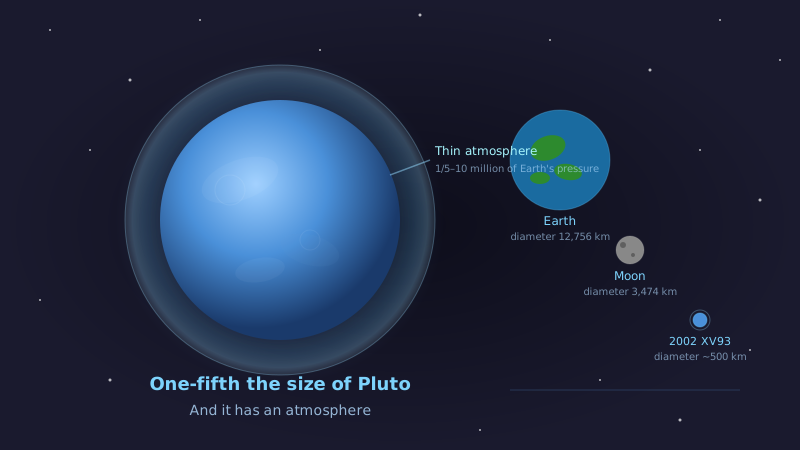
Honestly, my first reaction to that was: there must be some mistake. Five hundred kilometers is roughly the straight-line distance from Tokyo to Osaka. It’s one-seventh the diameter of the Moon, one-fifth that of Pluto. An object this small shouldn’t have nearly enough gravity to hold gas in place.
And yet, 2002 XV93 — a chunk of ice and rock orbiting beyond Neptune — really does have a thin atmosphere. Another piece of conventional solar system wisdom just got rewritten.
What Lies Beyond Neptune
The solar system’s “outer reaches” begin past the orbit of Neptune, roughly 30 astronomical units (AU) from the Sun — where one AU is the Earth–Sun distance, so we’re talking more than 30 times farther out than we are.
This region is home to the Kuiper Belt, a vast swarm of small bodies. Pluto is one of them. These objects are essentially frozen leftovers from the solar system’s formation 4.6 billion years ago: a time capsule preserved in deep cold.
2002 XV93, discovered in 2002, belongs to a subgroup called plutinos. Plutinos share a 2:3 orbital resonance with Neptune — for every three orbits Neptune completes, a plutino completes two. Pluto is one too, which means 2002 XV93 is practically a neighbor in the same orbital neighborhood as Pluto.
The difference is size. Pluto’s diameter is about 2,380 km; 2002 XV93 comes in at an estimated 500 km — less than a fifth as wide.
Nobody expected an object like that to have an atmosphere. That’s precisely what makes the discovery so striking.
How Starlight Reveals a Hidden Atmosphere
The technique that uncovered 2002 XV93’s atmosphere is called stellar occultation. The principle is straightforward: wait for a distant body to pass directly in front of a background star, then watch how the star’s light changes.
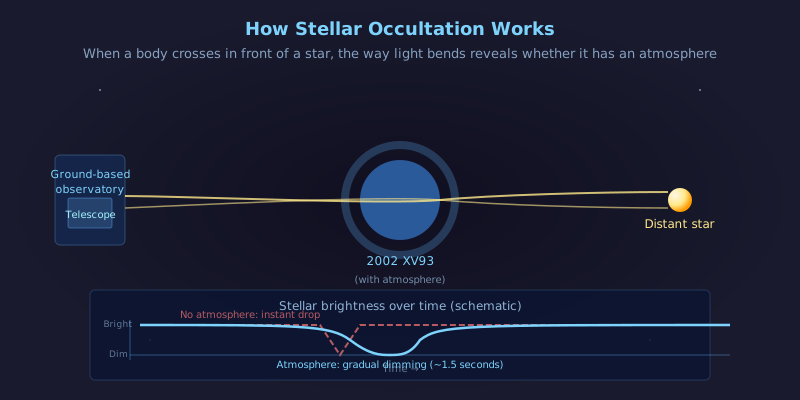
Here’s the key insight. If the object has no atmosphere, the star winks out in an instant — a clean on/off switch. But if there’s a layer of gas surrounding the body, that gas refracts the starlight, and the star dims gradually. Analyzing the shape of that gradual dimming mathematically gives you estimates of the atmosphere’s depth and density.
Pluto’s atmosphere was confirmed exactly this way. During an occultation in 1988, the background star faded slowly rather than snapping off — which meant something was bending the light. An atmosphere.
The same thing happened with 2002 XV93. When researchers examined the light curve closely, they saw the star’s brightness decline smoothly near the object’s edge. That’s a signature you simply don’t get without an atmosphere.
That said, this atmosphere is far thinner than Pluto’s. Pluto’s surface pressure is around 1 pascal — already about 1/100,000 of Earth’s atmosphere at sea level. The atmosphere of 2002 XV93 is thinner still, by at least another order of magnitude. Whether it even qualifies as an “atmosphere” is almost a semantic question — but scientifically, it’s unambiguously there.
Why a 500-Kilometer Body Can Hold an Atmosphere
This is where things get genuinely puzzling. How does a world this small keep gas from floating away?
The physics is simple enough: for an atmosphere to stick around, gas molecules have to move slower than the body’s escape velocity — the minimum speed needed to break free of its gravity. Smaller bodies have weaker gravity and lower escape velocities, so gas leaks away more easily.
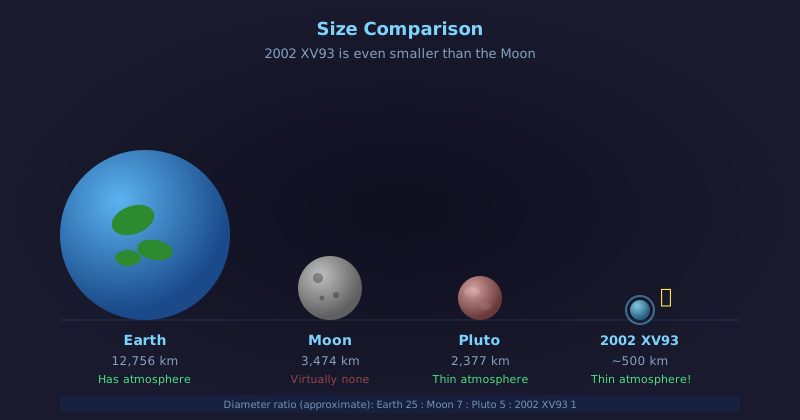
Earth’s escape velocity is about 11.2 km/s. The Moon’s is 2.4 km/s. Pluto’s is around 1.2 km/s. For 2002 XV93, it’s probably just a few hundred meters per second. Nitrogen molecules at room temperature already move at comparable speeds, so we’re barely in the range where retention is even possible.
So why does any gas stay? A few hypotheses have been put forward.
Hypothesis 1: Extreme cold is the key
The outer solar system is brutally cold. At these distances from the Sun, surface temperatures drop to around −230°C. At that temperature, gas molecules move very slowly — and slower molecules are easier for a weak gravitational field to hold. Put this object in the inner solar system and solar heating would strip its atmosphere almost instantly. Being far and cold is what makes atmospheric retention possible at all.
Hypothesis 2: Sublimation keeps topping it up
A second possibility is that the atmosphere isn’t surviving so much as being constantly replenished. Kuiper Belt objects have surfaces coated with ices — nitrogen, methane, and others. Even the tiny amount of sunlight reaching this far out slowly causes that ice to sublimate (go directly from solid to gas), continuously feeding a thin atmospheric layer. Gas escapes, more sublimates to replace it: a leaky bucket with a steady trickle of water going in.
Pluto’s atmosphere works on exactly this mechanism. Nitrogen ice plains on the surface — like the famous Tombaugh Regio — sublimate into the overlying atmosphere. Something similar may be happening on 2002 XV93, just on a far smaller scale.
Wilder Possibilities — Ice Volcanoes and Impacts
There are even more dramatic explanations in the mix.

Cryovolcanism
Pluto and Triton (Neptune’s large moon) both show evidence of cryovolcanism — eruptions that spew water, ammonia, or nitrogen ice instead of lava. The mechanics are nothing like a terrestrial volcano, but the result is similar: volatile material venting from the interior.
Could 2002 XV93 have a heat source inside? Possibly. Decay of radioactive elements generates heat even in small bodies. If that heat is driving cryovolcanic activity, erupting gases could create a temporary atmospheric layer. The problem is that we don’t yet know how warm the interior of a 500-km object can realistically get — researchers are genuinely divided on this.
A recent impact
This is the most dramatic scenario. The Kuiper Belt is crowded with small bodies, and collisions do happen. A sufficiently large impact would vaporize surface ice in a flash, producing a brief but detectable atmosphere. Under this interpretation, what we detected isn’t a stable, long-lived atmosphere — it’s whatever happened to be lingering from a recent strike.
The timing feels almost too convenient. But it can’t be ruled out.
Which hypothesis is correct will depend on follow-up observations. If astronomers can catch 2002 XV93 in multiple separate occultation events and compare the results, they’ll be able to tell whether the atmosphere is stable or varying — and that will point toward either the sublimation hypothesis or the impact one.
The Outer Solar System Is More Diverse Than We Thought
The real significance of this discovery goes beyond “a small body has gas around it.” It’s evidence that the outer solar system is far more varied and dynamic than our previous picture suggested.
Not long ago, Kuiper Belt objects were seen as inert lumps — frozen rock and ice, too distant and too dark to image properly, covered in craters, geologically dead. That was the assumption.
Then, in 2015, NASA’s New Horizons flew past Pluto and shattered that image. Pluto had glaciers of nitrogen ice flowing across its surface, mountain ranges, and multiple haze layers in its atmosphere. This wasn’t a dead world — it was astonishingly active.
Now we’ve found that even a body a fifth of Pluto’s size can host an atmosphere. Whatever New Horizons revealed about Pluto isn’t unique to large KBOs — something more fundamental is going on out there.
Consider the numbers: astronomers estimate there are tens of thousands of Kuiper Belt objects with diameters above 100 km. Of those, only a few dozen have been studied in detail via occultation or flyby. For the vast majority, we don’t even have reliable size estimates. There could be several other small worlds out there quietly holding onto thin envelopes of gas.
The natural next step is a systematic survey of other KBOs using the same occultation technique — particularly among the plutinos, which likely share surface compositions similar to Pluto’s. The discovery of 2002 XV93’s atmosphere will almost certainly push that work up the priority list.
Why the Dark, Distant Places Matter
Solar system research naturally gravitates toward the flashy targets — Mars rovers, Europa’s hidden ocean, Enceladus with its geysers. All of them carry the tantalizing possibility of life, which makes headlines easy to write.
Kuiper Belt dwarf objects don’t have that hook. Life is almost certainly absent. Through a telescope they’re barely points of light. They’re hard to fund and easy to deprioritize.
But these objects hold something equally valuable: the original material from the solar system’s birth, preserved almost unchanged for 4.6 billion years. Their composition is a direct record of what the early solar system was made of — a record that closer, warmer bodies have long since altered or erased.
And sometimes, as with 2002 XV93, they remind you that the universe has not finished surprising us.
Most people have never heard of 2002 XV93. It has no nickname, no famous photo, no flyby mission. Far from the Sun, in the cold and the dark, this small world quietly circles with a ghost of an atmosphere clinging to it — and turns out to be stranger than anyone expected.