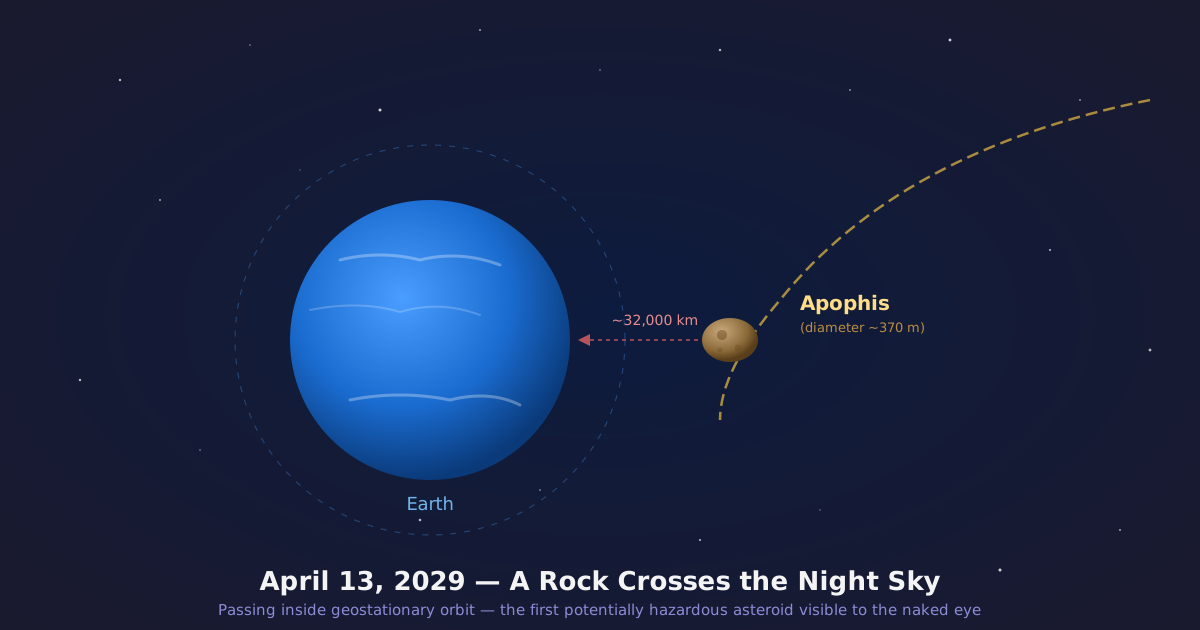
On Friday, April 13, 2029, a rock will cross the sky.
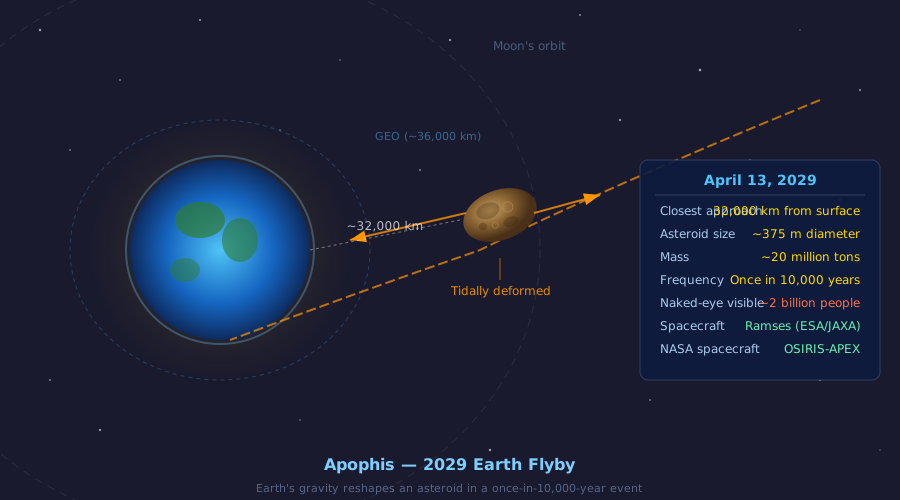
It is 375 meters across, weighs roughly 20 million tons, and will pass just 32,000 kilometers above Earth’s surface — closer than geostationary satellites. An encounter like this happens once every 10,000 years.
Most people have heard the name Apophis. It’s the asteroid that once seemed to have a real shot at hitting us. That collision risk has since been ruled out, but scientists are more excited about this flyby than ever. The reason is straightforward: for the first time in recorded history, we will watch Earth’s gravity reshape a rock in real time.
What Kind of Rock Is Apophis?
Apophis — officially asteroid 99942 — was discovered in 2004. It belongs to the class of near-Earth asteroids, objects whose orbits bring them close to our own. Thousands of these have been catalogued.
Most are entirely harmless, but when Apophis was first spotted, calculations suggested it had a non-trivial chance of hitting Earth in 2029 or 2036. At its peak, the probability ran to a few in a thousand — rare by everyday standards, but alarming by astronomical ones. For a time, it triggered the highest alert level in asteroid hazard tracking.
Additional observations eventually cleared it of any impact risk. What remained, though, was a striking fact: Apophis would still make an extraordinarily close approach, passing at 32,000 km. To put that in perspective, a round trip from Tokyo to New York is about 22,000 km. In cosmic terms, this is an almost absurdly narrow miss.
Apophis itself is an irregular, lumpy rock — a distorted ellipsoid elongated along one axis. It is composed mainly of silicate minerals with iron and nickel, making it what astronomers call an S-type (stony) asteroid. It orbits the Sun roughly every 0.9 years.
Earth’s Gravity Will Grab and Pull This Rock
Here is the crux of the story. At 32,000 km, Earth’s gravitational pull on Apophis will be substantial — not just in the abstract sense, but physically, in a way that will affect the asteroid itself.
Gravity follows an inverse-square law, which means the near side of Apophis will feel a noticeably stronger pull than the far side. That difference in gravitational force across a body is called a tidal force. It’s the same phenomenon that drives ocean tides: the Moon pulls harder on the side of Earth facing it than on the far side. In 2029, the roles reverse — Earth becomes the body exerting tidal forces on Apophis.
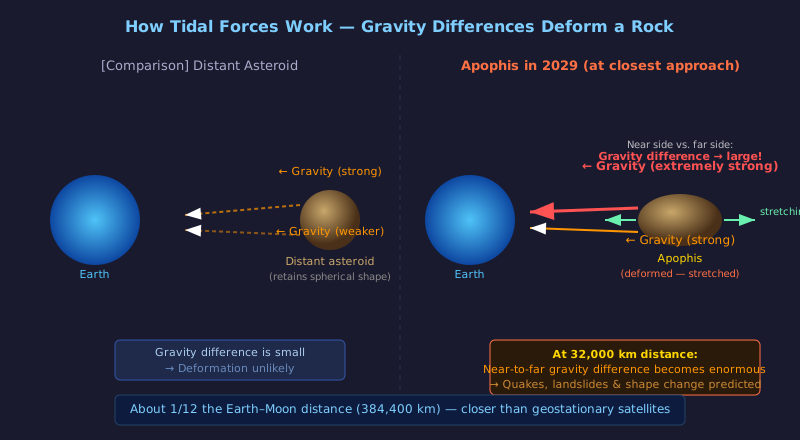
Researchers predict this force will be strong enough to trigger seismic activity inside Apophis — something like quakes or landslides on the asteroid’s surface. The rock’s shape may actually stretch and shift under Earth’s influence. From our perspective it’s just a rock drifting past, but for Apophis, this flyby will be something like running through a storm.
The idea that a close planetary approach can deform an asteroid is not new theory. What is new is the chance to observe it happening up close. Nothing in the past century of astronomical observation has offered this opportunity. That’s why researchers have been counting down to this moment for years.
After the Flyby, There’s No Going Back
The encounter will alter more than Apophis’s shape. Its orbit will shift permanently.
Right now, Apophis belongs to a group called Aten-type asteroids — bodies that orbit mainly inside Earth’s orbit, with a period of about 0.9 years. After the 2029 flyby, it will transition to the Apollo-type group, whose orbits cross and extend beyond Earth’s, with a predicted period of roughly 1.2 years.
It might not sound dramatic when framed in terms of orbital classification, but the underlying physics is significant.
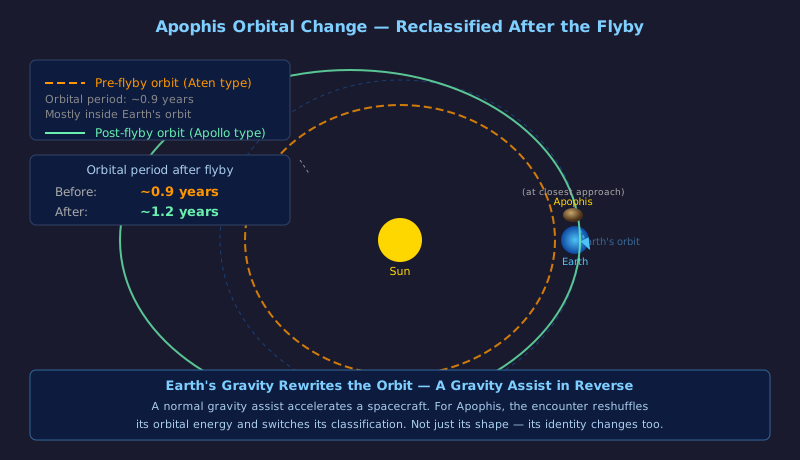
To be clear: this shift does not increase the chance of a future impact. The orbital change simply means Apophis won’t return to its original path. When the 10,000-year encounter is over, it will continue drifting through space as a subtly different asteroid than it was before.
Ramses Will Be the Witness on the Scene
Humanity has no intention of watching this passively from afar.
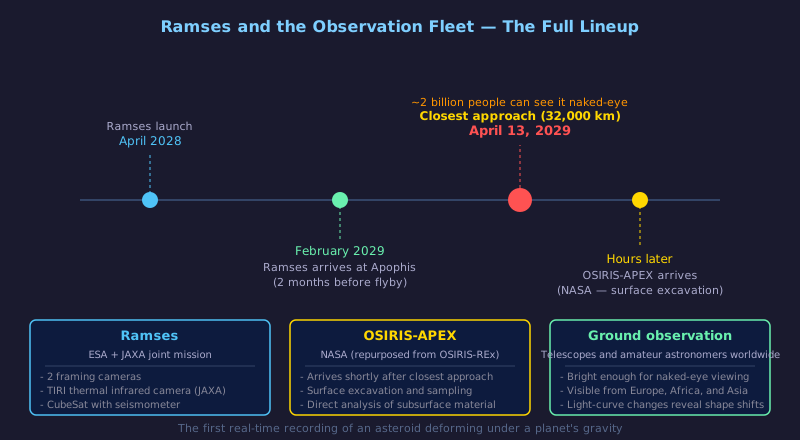
ESA and JAXA formalized a cooperation agreement in May 2026 to send a spacecraft called Ramses — short for Rapid Apophis Mission for Space Safety — directly to the asteroid. Launch is scheduled for April 2028, with arrival at Apophis planned for February 2029, about two months before closest approach.
Ramses carries two CubeSats. One is a lander-type equipped with a seismometer, gravimeter, and magnetometer, designed to attempt a surface touchdown before the flyby. The other is an orbiter-type that will probe Apophis’s internal structure using low-frequency radar. The goal is to capture what the tidal forces do — not just from the outside, but from within.
JAXA is contributing a thermal infrared camera called TIRI. The same instrument flew aboard Hayabusa2 on its mission to asteroid Ryugu, so it comes with a solid track record. By mapping the temperature distribution across Apophis before and after closest approach, TIRI may reveal physical changes that are otherwise invisible.
NASA is also in the picture. Its spacecraft OSIRIS-APEX — a repurposed version of OSIRIS-REx, which brought samples back from asteroid Bennu — will arrive at Apophis shortly after closest approach. It will drill into the asteroid’s surface to analyze subsurface material that the tidal forces may have stirred up.
A Rock You Can See with Your Own Eyes
There will be plenty to witness from the ground too.
On the night of April 13, 2029, Apophis will be visible to the naked eye from Europe, Africa, and much of Asia — a slow-moving point of light crossing the sky. No telescope required; binoculars will let you track its motion clearly. At closest approach, its apparent magnitude is expected to be around 3, easily visible away from city lights. Estimates suggest around 2 billion people will be able to see it from their windows or back yards.
Seeing something with your own eyes leaves a different impression than any photograph or video. Ancient peoples were unsettled by comets passing overhead. Whatever you think about astronomy, watching a 375-meter rock move across the sky in real time is the kind of thing that tends to change how you see Earth’s place in the solar system.
Apophis, of course, is indifferent to all of this. It has been on its current trajectory for a very long time. We only recently started paying close attention.
What Deformation Can Tell Us
The science here runs deeper than the spectacle.
Asteroids are time capsules. Unlike Earth, Mars, or the Moon — bodies that have been melted, pressurized, and chemically reworked over billions of years — asteroids like Apophis have preserved the chemistry of the early solar system, 4.6 billion years ago, largely intact. Understanding their internal structure is a window into how planets first assembled from dust and rock.
Whether tidal forces trigger internal quakes, whether the shape measurably changes, and by how much — all of this reflects Apophis’s rigidity and internal uniformity. Is it a solid monolith, or a rubble pile held together loosely by self-gravity? Think of it as shaking a building to find out where the weak joints are.
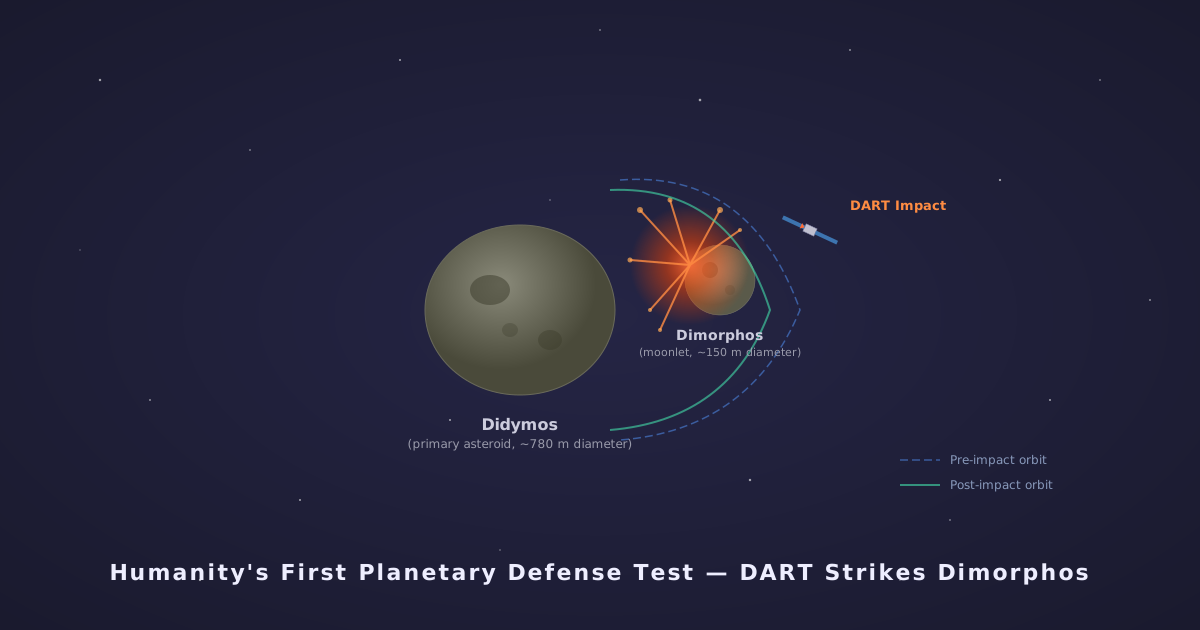
Planetary defense depends on the answer. If a future asteroid were found on a collision course with Earth, the right response would look completely different depending on whether the target is a solid rock or a loose collection of gravel. A DART-style kinetic impactor? A gravity tractor? Something else entirely? Apophis will be a real-world case study.
2029 Will Be a Banner Year for Space Science
Here’s the summary: on April 13, 2029, humanity witnesses a once-in-10,000-year encounter with an asteroid. Spacecraft will record the deformation from close range as it happens. Two billion people on the ground will have the chance to watch a point of light drift across the sky. The rock will pass, settle into a new orbit, and never be quite what it was before.
Events like this don’t get written into textbooks after the fact — they happen in real time, to people who are paying attention. Three years from now, that’s you.
As of 2026, Apophis is still too faint to see without a telescope. But it is absolutely getting closer. There are about 1,100 days left until the day Earth’s gravity reshapes this ancient rock forever.
Sources: ESA/JAXA Ramses mission official information; NASA OSIRIS-APEX mission information