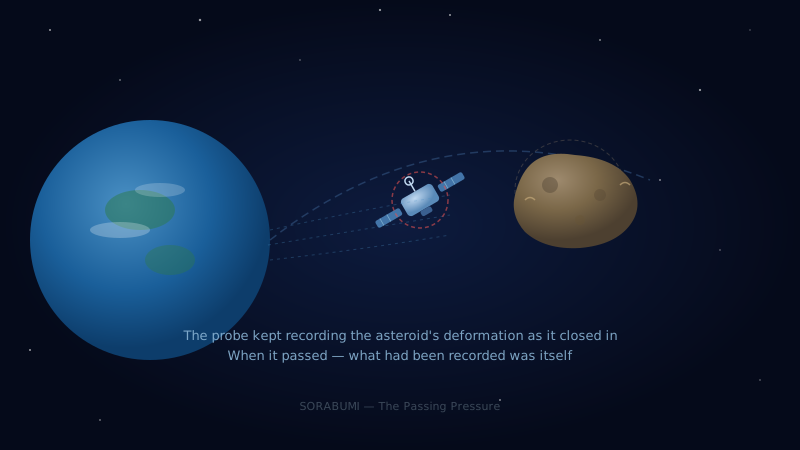
My job is to measure.
Whether “job” is really the right word for a probe is debatable — but the design spec says so. “Close-approach observation and shape recording.” That’s what I was built for, and that’s what I was sent to do. The subject: a rock. Lumpy, ellipsoidal, unremarkable.
The rock, it turned out, was changing. As I drew closer, its outer shell bulged, just slightly. Something shifting inside, pressing outward. The spec called it “a phenomenon to be recorded.” I measured, dutifully, pass after pass.
Proximity improves precision. The spec’s footnotes did mention that “sensors may begin picking up signals from sources other than the target when the probe approaches too closely.” I filed that under general caution. Footnotes tend to be written in the parts no one reads.
After a while, an unfamiliar set of values crept in alongside the rock’s expansion data. Strain readings on my own hull. At first they fell within the error margin, and I logged them as error. Then they didn’t. I flagged them as anomalous, and kept measuring the rock.
The rock was changing. I was recording it. That was the job.
On the night of closest approach, I checked the buffer before transmitting. Standard procedure.
The rock’s shape-change data: absent.
What was stored instead were readings from my own hull. Shell strain. Internal sensor drift. Solar panel flex. Three hundred eighty-seven entries. Peak values at 2.3 times the maximum rated tolerance.
I paused. Was this a record of the rock, or a record of me?
There was no longer any way to tell. The rock had deformed. So had I. Whose deformation had I been measuring? I couldn’t say — not until someone received the transmission and decided.
I pressed send.
Whoever got it would figure it out, I thought.
Though “figure it out” wasn’t anywhere in the design spec.