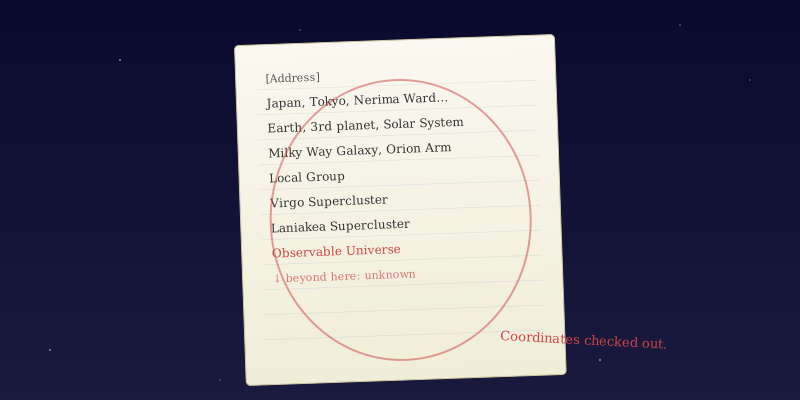
“Hey, how far do you write an address? Like, does Earth count?”
Miyoko was in the middle of making dinner when her son Kosuke called from the living room. Something about his voice — too serious for a third-grader — made her set down the ladle and go look.
“Is this for homework?”
“It says to write your address. But is it just Japan? Can I put Earth too?”
Miyoko’s eyes drifted to the bookshelf. A space encyclopedia she’d borrowed from the library five years ago and never returned was right there, its spine quietly making its presence known.
“Sure, go ahead. Earth, Solar System, the Milky Way — just, you know, roughly around here.”
Then she went back to the stove.
Ten minutes later, Kosuke’s voice came through the kitchen curtain again.
“What comes after the Milky Way?”
”…The Local Group.”
“And after that?”
“The Virgo Supercluster.”
“And then?”
“The Laniakea Supercluster.”
Miyoko stood there, ladle in hand, going still. She’d only skimmed that encyclopedia five years ago, and honestly, past this point things got fuzzy.
“That’s probably a good stopping place. Your teacher isn’t going to read that far.”
“But is it right?”
“Yes, it’s right. Now come eat.”
Whether roughly around here would pass as a homework answer was, she decided, not something to think about while cooking.
The next afternoon, Kosuke’s teacher, Mr. Tanaka, called.
“So, about the address field Kosuke filled in…”
“Yes…”
“It, um, expanded into letter size. He apparently rewrote it on stationery and submitted it separately. We were all a bit surprised.”
“Oh, I’m so sorry, I accidentally—”
“No, the content was actually very accurate. Just, going forward, this far is perfectly fine.”
For the record, Mr. Tanaka had never opened a space encyclopedia before making that call.
“The coordinates were correct, by the way,” he added, and hung up.