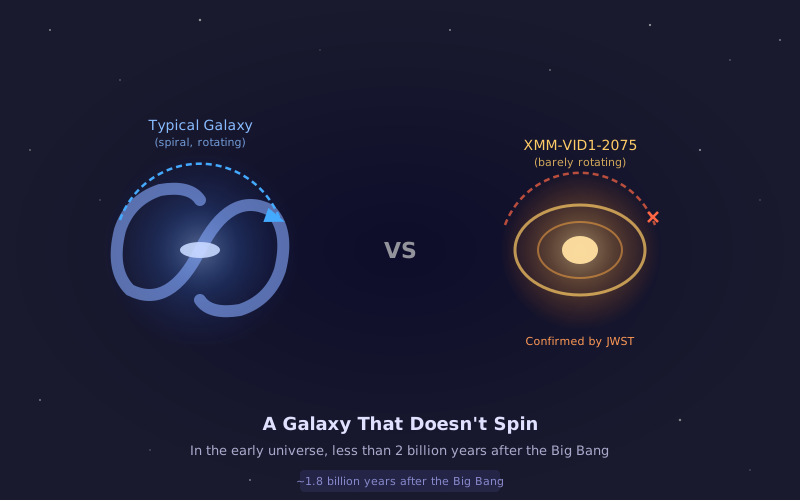
A galaxy that doesn’t rotate was found in the universe just 1.8 billion years after the Big Bang.
Galaxies spin. That felt like one of the universe’s ground rules. The Milky Way spins. Andromeda spins. Nearly every galaxy we can point to in the night sky is doing some version of a slow, majestic pinwheel. Then in 2026, JWST — the James Webb Space Telescope — quietly upended that assumption. A galaxy called XMM-VID1-2075, sitting 12 billion light-years away, turned out to have gas and stars arranged in near-perfect stillness.
Why Young Galaxies Were Supposed to Spin
To understand why this discovery matters, it helps to know why galaxies rotate in the first place.
When matter clumps together to form a galaxy, the raw ingredients are enormous clouds of gas and dust. These clouds are never perfectly stationary — they drift, they get tugged by nearby objects, they carry a faint twist in their motion from the moment they form.
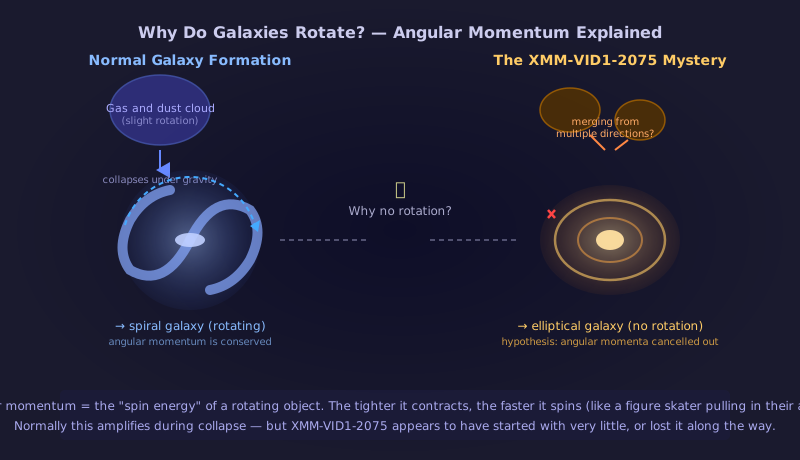
As gravity pulls such a cloud inward, that faint twist amplifies. The same physics that makes a figure skater spin faster when they pull in their arms. In physics, this is called conservation of angular momentum: the total “spin energy” of a system doesn’t change unless an outside force intervenes.
Galaxy formation follows the same script. As the cloud collapses toward a center, whatever small rotation existed at the start gets cranked up — producing the sweeping spiral arms we recognize as the classic galaxy shape.
This mechanism shows up in virtually every large galaxy we can observe in today’s universe. So astronomers reasonably assumed that large galaxies in the young universe would rotate too.
XMM-VID1-2075: The Outlier
XMM-VID1-2075 broke that assumption.
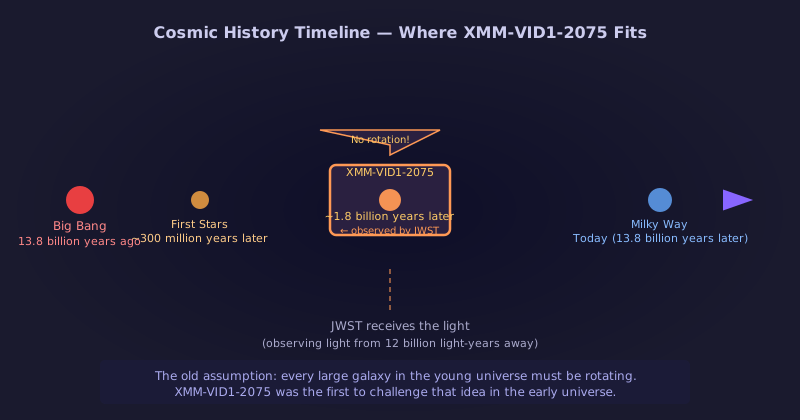
This galaxy existed when the universe was roughly 1.8 billion years old — about 13% of its current age of 13.8 billion years. When the research team pointed JWST’s NIRSpec (Near Infrared Spectrograph) at it, the data came back surprising. The spectral signatures of gas and stars inside the galaxy showed almost no evidence of rotation.
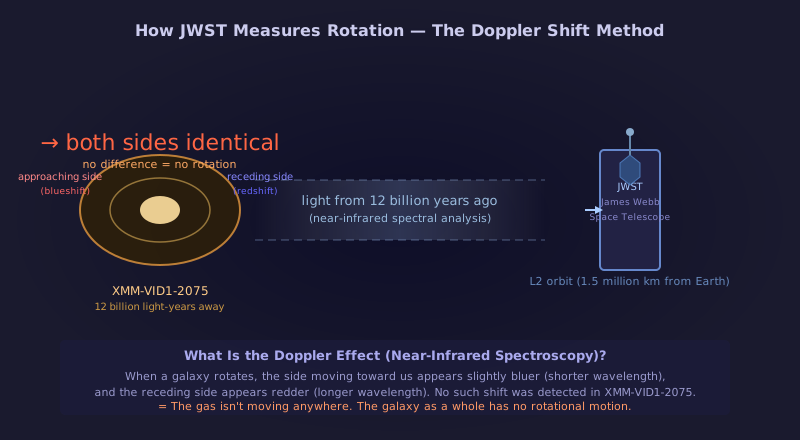
Here’s how astronomers measure rotation from 12 billion light-years away. When a galaxy spins, the side moving toward us compresses its light waves — shifting them slightly toward blue. The side moving away stretches them toward red. This is the Doppler effect, and in a rotating galaxy, you always see this color asymmetry.
XMM-VID1-2075 had none of it. The light from the left side of the galaxy looked essentially the same as from the right. No velocity gradient. No rotation.
What makes this especially striking is the galaxy’s size. Its mass is estimated at tens of billions of times the mass of the Sun — comparable to a large galaxy today. And in today’s universe, galaxies that massive are essentially always rotating. A large, quiescent galaxy in the early universe was not something anyone had expected to find.
Did the Rotation Disappear — or Was It Never There?
This is the part that’s keeping researchers up at night.
The universe today contains a class of galaxies called elliptical galaxies — smooth, featureless, and largely rotation-free. The leading explanation for how they form involves galactic mergers. When two or more galaxies collide, their individual spins can be oriented in opposite directions. The rotations cancel each other out, and the merged system ends up with little net angular momentum.
A few hypotheses have emerged to explain XMM-VID1-2075.
The first is “early large-scale merging.” Under this scenario, multiple galaxies collided and merged within the first 1.8 billion years of cosmic history, and the resulting cancellation of angular momentum left behind a non-rotating remnant. This happens in the present-day universe too, but for it to occur on this scale this early would challenge our models of how structure forms in the cosmos.
The second hypothesis involves the geometry of gas inflow. Galaxies grow by accreting gas from the cosmic web — vast filaments of matter that thread through space. If that gas streamed in from many different directions simultaneously, rather than along a preferred axis, the angular momenta could have partially canceled before the galaxy even formed properly.
Both remain hypotheses. Testing them will require finding more non-rotating galaxies from the same cosmic epoch and mapping their distribution.
What Only JWST Could Have Seen
The observation was only possible because of what JWST can actually do.
Twelve billion light-years is an almost incomprehensible distance — the time it takes light to cross it is longer than the age of Earth, more than twice over. Light from a galaxy that far has been stretched and dimmed by the expansion of the universe, arriving as faint infrared radiation rather than visible light.
Hubble, for all its achievements, couldn’t parse the internal kinematics of galaxies at that distance with the precision needed here. JWST’s NIRSpec can detect tiny velocity differences between gas clouds on opposite sides of a distant galaxy — enough to tell whether it’s spinning. Measuring the rotation of a galaxy 12 billion light-years away, in just a few hours of observation, is the kind of thing that still seems like it should be impossible.
Since science operations began in 2022, JWST has overturned multiple assumptions about the early universe: galaxies that were brighter than expected, galaxies that matured far too quickly, and now a galaxy that simply refuses to spin. Each finding points to the same conclusion — our models of how the early universe evolved are incomplete.
The Textbook Is Being Rewritten
The significance of XMM-VID1-2075 isn’t just that it’s an unusual object. It’s that it could force a rethink of how galaxy formation worked in the early universe.
The standard cosmological model — ΛCDM — predicts that dark matter clumps first, gas falls in afterward, and galaxies grow within those dark matter halos. Under this picture, rotation is nearly inevitable. Angular momentum naturally builds up as gas flows inward.
XMM-VID1-2075 doesn’t fit that picture. If non-rotating galaxies like this one turn out to be more than isolated flukes — if they appear at a predictable rate across the early universe — then something is either missing from the model or working differently than we thought.
The research team plans to search systematically for other non-rotating galaxies from the same period. Whether this galaxy is a one-in-a-billion exception or the first member of a recognized class is the question that will determine how far-reaching this discovery actually is.
What a Still Galaxy Tells Us
In the full 13.8-billion-year arc of cosmic history, the era when XMM-VID1-2075 existed was the universe’s adolescence — barely out of its earliest phase of star formation.
Yet by that point, a galaxy packing tens of billions of solar masses already existed, and it wasn’t rotating. That’s genuinely hard to picture. Even the astronomers who found it acknowledged as much, saying they hadn’t expected an object like this to exist at this epoch.
Understanding the universe means receiving light that left its source billions of years ago and reading the history encoded in that light. XMM-VID1-2075’s photons spent 12 billion years in transit. JWST analyzed them in hours, turning the ancient light into numbers that described a galaxy’s motion.
Why it’s still — nobody knows yet. But knowing that we don’t know is itself a step forward. That’s how science inches closer to a universe that, it turns out, has more to say about itself than we thought.