Three hundred million years after the birth of the universe. Can you picture what the cosmos looked like back then?
Human civilization spans about 10,000 years. Earth is roughly 4.6 billion years old. If you compressed the universe’s 13.8-billion-year history into a single calendar year, 300 million years wouldn’t even reach January 2nd. It was the very start of the year — a chaotic era of swirling gas and dust, nothing more.
And yet, something was there that shouldn’t have been.
A Galaxy That “Shouldn’t Exist”
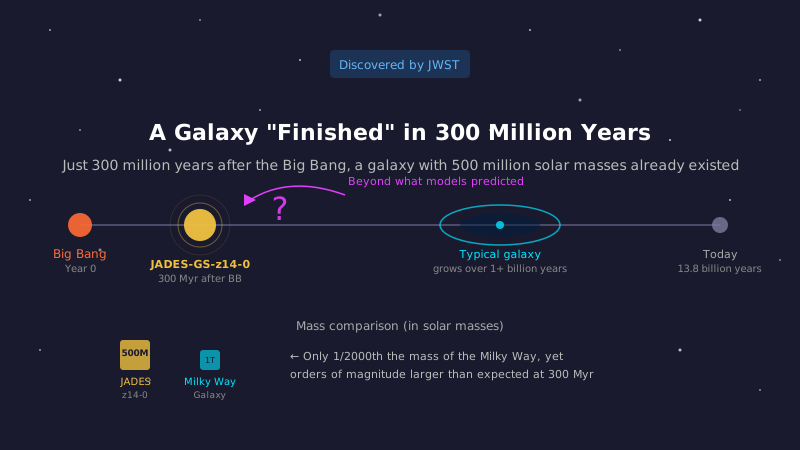
In 2024, an observing program called JADES (JWST Advanced Deep Extragalactic Survey), using the James Webb Space Telescope (JWST), broke a record. JADES-GS-z14-0 was confirmed as the most distant galaxy ever observed.
Its redshift: z = 14.32. That number means we’re seeing light from a time when the universe was only about one-fifteenth its current size — roughly 300 million years after the Big Bang.
The raw number might not mean much on its own, but the real issue is the galaxy’s size. Its mass is approximately 500 million times that of the Sun. That’s a lot of stars. Its diameter stretches 1,600 light-years (for reference, the Milky Way spans about 100,000 light-years) — remarkably large for a galaxy of that era.
Frankly, the researchers themselves were stunned. Under the standard cosmological model, a galaxy this developed should have needed far more time to grow.
Growth Too Fast for Theory
Why “shouldn’t it exist”? Galaxy growth follows a sequence of steps.
First, as the universe cools after the Big Bang, hydrogen and helium gas begins to clump together. This gas contracts under its own gravity, giving birth to the first stars. Stars gather into primitive galaxies. Those proto-galaxies collide and merge, gradually building up into larger galaxies — a process that was thought to require a considerable amount of time.
That’s the prediction of the ΛCDM (Lambda-CDM) model, the standard framework of modern cosmology. Built on dark energy (Λ) and cold dark matter (CDM), it represents the leading edge of our understanding of the universe.
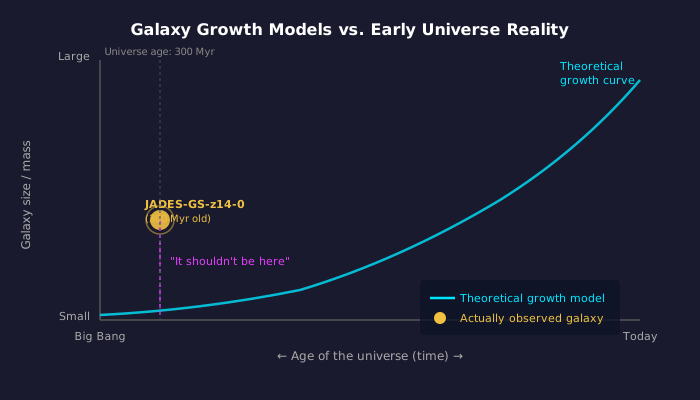
The mass of JADES-GS-z14-0 far exceeds what the ΛCDM model says should be possible for a galaxy just 300 million years after the Big Bang. The model imposes time constraints on galaxy growth, and this galaxy appears to have ignored them entirely, growing “too fast.”
There’s another surprise. Oxygen was detected in this galaxy. Oxygen barely existed right after the universe began. In a cosmos that started with only hydrogen and helium, oxygen can only be produced after massive stars are born, evolve, and explode as supernovae. The presence of oxygen at 300 million years means multiple generations of stars had already completed their life cycles in that short window.
How Could It Grow So Fast?
At this stage, it’s all hypotheses, but researchers are exploring several explanations.
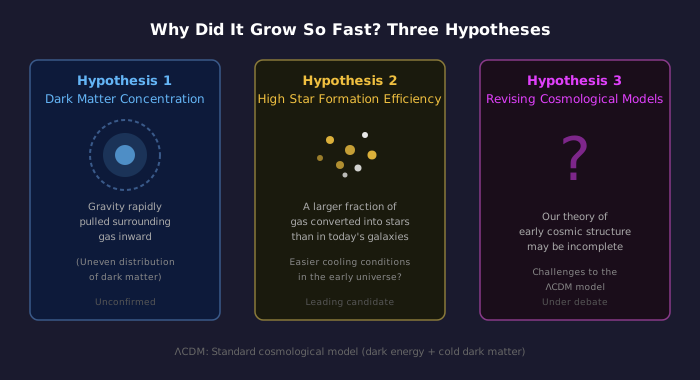
Dark matter concentration is one idea. The large-scale structure of the universe forms along the invisible distribution of dark matter. If dark matter happened to concentrate in a particular region of the early universe, it could have pulled in gas and accelerated the growth of a galactic seed beyond the normal pace.
Another possibility is star formation efficiency. In present-day galaxies, a surprisingly small fraction of available gas actually becomes stars. But conditions in the early universe may have been different. What if dense, hot gas cooled rapidly, creating an environment where stars formed with exceptional efficiency?
And then there’s the most fundamental possibility: the ΛCDM model itself may need revision. This is a big deal — it would mean reconsidering the very framework of modern cosmology. JADES-GS-z14-0 is just one example, but JWST is finding multiple galaxies that exceed model predictions. Whether these are mere outliers or symptoms of a theoretical flaw is still under investigation.
What JWST Made Possible
Why are we only making these discoveries now? The answer is straightforward: before JWST, we simply couldn’t see this far.
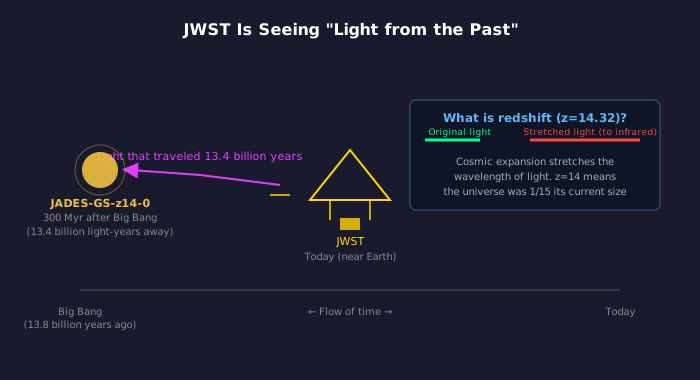
The light from JADES-GS-z14-0 took 13.4 billion years to reach Earth. That means we’re seeing it as it was 13.4 billion years ago — its current state is unknown. A space telescope effectively functions as a time machine: the farther you look, the further back in time you see.
JWST (the James Webb Space Telescope) was launched in late 2021 as an infrared-specialized space telescope, designed as the successor to the Hubble Space Telescope. Its key advantage is its ability to precisely capture “redshifted light” — the infrared radiation emitted by distant galaxies that optical telescopes can’t reach. The farther away a galaxy is, the more cosmic expansion stretches its light toward the infrared (redshift). JWST is optimized for exactly this wavelength range, enabling it to clearly observe galaxies from eras that were invisible to Hubble.
JWST also carries a primary mirror 6.5 meters in diameter, giving it vastly greater light-gathering power than Hubble’s 2.4-meter mirror. Even the faintest glimmers from the cosmic abyss don’t escape its gaze.
Rethinking the “Standard Life” of a Galaxy
At first glance, “there was a big galaxy in the early universe” might sound too specialized to feel personally relevant. But think about it for a moment.
The “standard model of cosmology” in astronomy doesn’t just explain what the universe looks like today. It provides the framework for how the universe began, how structures formed, and when galaxies, stars, and planets were born. If that framework is off, everything downstream is affected — the timing of planet formation, the conditions under which life could emerge, all of it.
JADES-GS-z14-0 may be a galaxy saying, “Hold on — let’s reconsider.” In the history of science, observation getting ahead of theory is nothing new. When Copernicus proposed heliocentrism, when Einstein published relativity — both were initially met with “that can’t be right.”
No Answer Yet — and That’s What Makes It Interesting
The research team continues its analysis, and every new observation deepens the debate. JWST is expected to keep operating for years to come, and there’s a real chance it will find galaxies even more distant and even larger than JADES-GS-z14-0.
Each such discovery will test the standard model. It may be revised. It may emerge stronger. Either way, the light streaming through the “window to the past” that JWST has opened carries something every year that could rewrite the cosmology textbooks.
A galaxy grew up in just 300 million years — and we still don’t know why. But “we don’t know yet” is, I think, the most honest kind of answer when it comes to the universe.