When I heard that benzene had been found around a young star, my honest first reaction was: “Again?”
That reaction is probably correct. Finding organic molecules in space is no longer a surprise. The more serious question runs the other way: if the raw materials are this abundant, why haven’t we found life? What exactly lies between a collection of chemicals and something alive?
Benzene in Space — How Ordinary Has This Become?
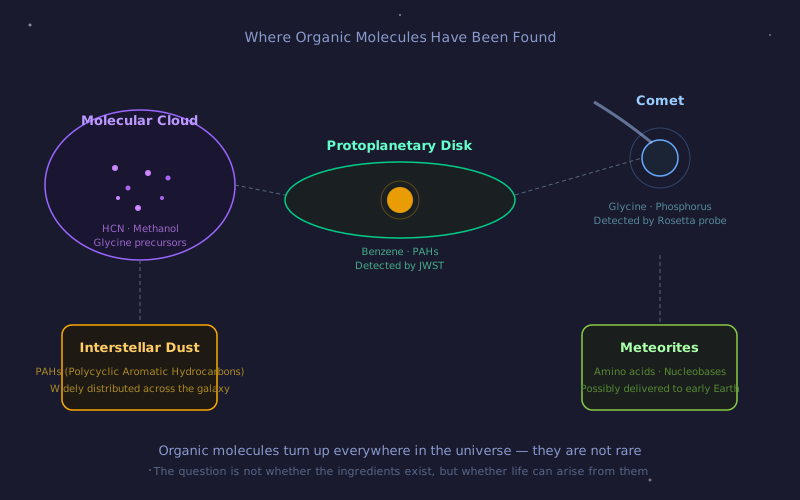
In 2023, JWST detected benzene (C₆H₆) in the disk surrounding a young star just four light-years away. Benzene is one of chemistry’s canonical molecules — six carbon atoms arranged in a ring, the structural backbone of countless organic compounds. Most people associate it with paint factories and petroleum refining, not the cosmos.
So what does finding it in space actually mean?
For one thing, this wasn’t the first detection. Benzene had already turned up in Jupiter’s atmosphere, on Titan (Saturn’s largest moon), and inside meteorites. Even more complex molecules — precursors to glycine (the simplest amino acid) and substances that make up DNA’s bases — have been detected inside molecular clouds, the vast reservoirs of gas and dust where stars are born.
What made the JWST result striking was where it looked: the disk around a star that had just formed, before any planets had assembled. Complex organic molecules were already present at that stage. Life’s ingredients don’t wait for a planet to show up — they arrive before one exists.
That’s the part that genuinely unsettles me. Long before Earth took shape, the components of life were already drifting through space. Benzene rings may have been assembling inside the molecular cloud that predated our solar system. Rather than saying life’s materials were “made on Earth,” it might be more accurate to say they were delivered.
Mapping Organic Molecules Across the Universe
The catalog of organic molecules detected in space has grown rapidly over the past few decades. Radio telescopes and space observatories have now identified more than 270 distinct molecular species in our galaxy, and a significant portion of them contain carbon.
Closer to home: when the Rosetta spacecraft rendezvoused with comet 67P/Churyumov-Gerasimenko, it found glycine and phosphorus. Glycine is an amino acid and a basic component of proteins. The idea that comets like this one rained such molecules down on the early Earth remains one of the stronger hypotheses in astrobiology.
PAHs — polycyclic aromatic hydrocarbons, organic molecules built from fused carbon rings — are estimated to account for up to 20 percent of all carbon in the Milky Way. The dark nebulae scattered across the night sky are filled with them.
The intuition that organic compounds exist only under special conditions is simply wrong. They are a standard ingredient of the universe.
Head toward the galactic center and things get stranger still. In 2021, a giant molecular cloud called Sagittarius B2 yielded propanol and ethyl ether — relatively complex organics. In regions where molecular clouds are dense, chemical reactions proceed on the surfaces of dust grains, building molecules that chemists would normally synthesize in a lab. The cosmos functions, in this sense, like an enormous chemical factory operating at scale.
The Enormous Wall Between Ingredients and Life
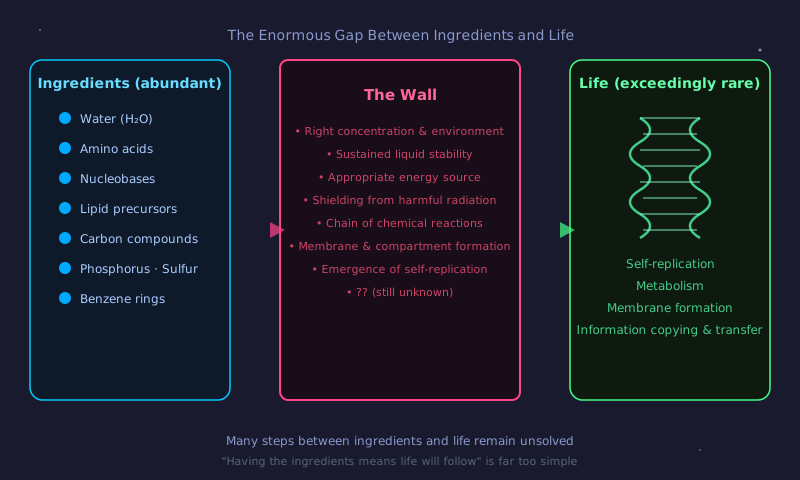
So why is life still so rare — or at least so hard to find?
A cooking analogy comes close. Flour, sugar, eggs, and salt don’t bake themselves into bread. You need the right temperature, the right sequence of steps, the right timing, and the technique of how to combine everything. Remove any one of those and you end up with a mess, not a loaf.
Life is the same. Having the ingredients is just the starting point. Those organic molecules have to come together at the right concentrations, react with each other, form membranes, begin replicating themselves, develop metabolism, and eventually reproduce. Miss any one step in that sequence, and you end up with chemistry — not biology.
The trickiest hurdle is self-replication. Modern life encodes information in DNA, which RNA reads to build proteins. But that system didn’t appear fully formed. Something much simpler must have come first, and over a very long time it evolved into the machinery we see today. What that first step looked like — which chemical reaction kicked it off — we still don’t know.
How JWST Is Rewriting the Rules on Life
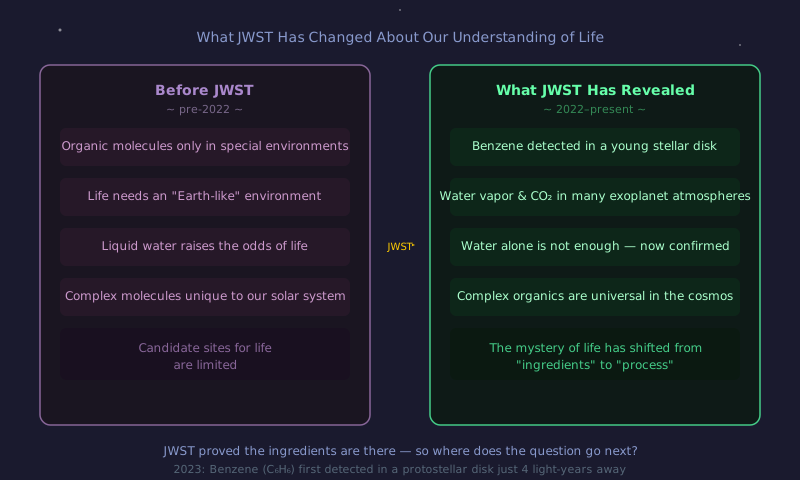
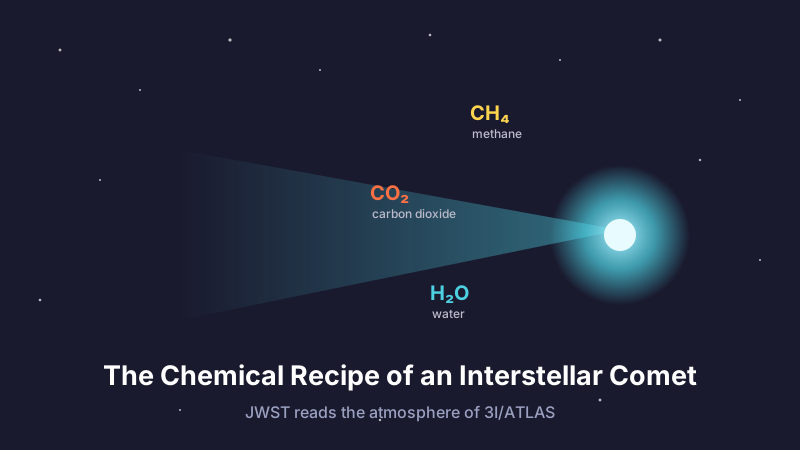
Since JWST began operating, the pace of “potential life ingredient” discoveries has accelerated. Water vapor, carbon dioxide, and methane have been detected in exoplanet atmospheres one after another. The picture of organic molecules as a universal feature of the cosmos is becoming harder to dispute.
But that’s also a double-edged result. It exposes the limits of the approach that says: “look for the ingredients, find the life.” If organic molecules reaching a planet is no longer remarkable, the question becomes what happens after they arrive.
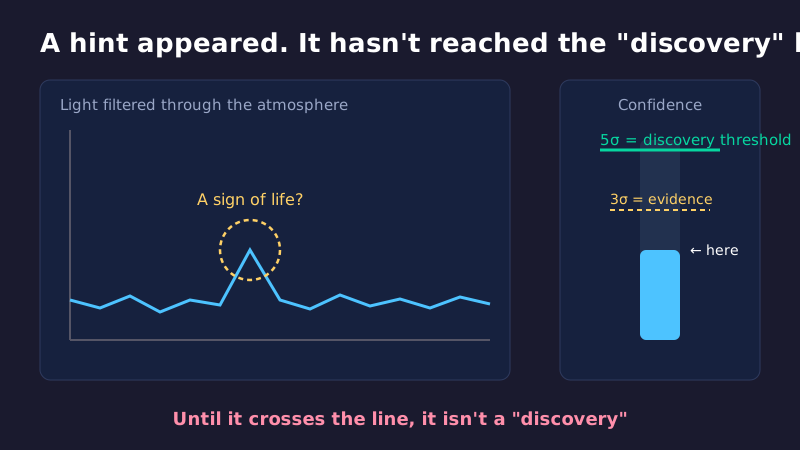
JWST’s observations have also complicated what we thought we knew about biosignatures — the chemical markers that might indicate life. For a long time, ozone and oxygen were considered the most promising candidates. But it’s becoming clear that non-biological processes can produce chemically similar signatures. We still haven’t identified any single substance that constitutes ironclad evidence of life.
Questioning the Assumption That Water Equals Life
“Habitable zone” is a term with real staying power — the band of orbital distances around a star where liquid water can exist on a planet’s surface. The concept still matters, but reading it as “planets in the habitable zone probably have life” oversimplifies things badly.
Mars once sat comfortably inside the habitable zone. It has dried riverbeds. Something liquid flowed there. The ingredients were probably present in some form. And yet there is no evidence of complex life — past or present.
Enceladus, on the other hand, sits far outside any classical habitable zone, orbiting Saturn. Water jets erupting from cracks in its icy shell carry organic molecules into space. Something resembling a hydrothermal vent system may be operating beneath that ice. Enceladus has everything astrobiologists got excited about for years — and it’s nowhere near the habitable zone. Water may be necessary, but it clearly isn’t sufficient.
The Ingredients Are There. What’s Missing?
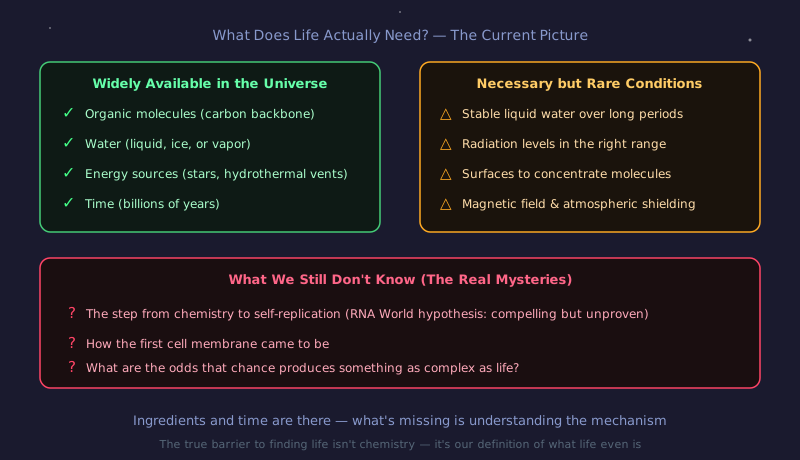
The focus of the search for life is slowly shifting. It’s moving away from “are the materials present?” toward “are the right processes actually happening?”
We still don’t fully understand how life arose on Earth itself. The hydrothermal-vent hypothesis holds that organic molecules concentrated near submarine vents and began reacting. The shallow-pool hypothesis suggests that ultraviolet light drove reactions in sun-drenched tidal pools. The panspermia angle says the key ingredients arrived via meteorite. All of these are still under investigation, none definitively proven.
What we know is that on Earth, the step happened. Chemistry produced a self-replicating system, and that system spent four billion years becoming the biosphere we live in. Whether that first transition occurred once or many times — we can’t say.
Organic molecules are abundant. Liquid water isn’t rare. Energy sources exist. Time runs into the billions of years. And yet life appears to be scarce — or at least, scarce enough that we haven’t found it anywhere else. If the shortage isn’t in the materials, maybe what’s missing is a very specific chain of unlikely events. Or maybe humanity simply doesn’t yet understand what that chain looks like.
JWST is steadily drawing a more detailed map of organic molecules across the cosmos. It isn’t delivering answers. It’s sharpening the question.