What Was That “Donut Photo” Actually Showing?
In April 2019, news feeds around the world filled with a single image: a glowing orange ring around a pitch-black void. It was the first-ever picture of a black hole’s “shadow,” captured by the Event Horizon Telescope (EHT). The subject was the supermassive black hole at the center of M87, a giant galaxy in the Virgo cluster, about 55 million light-years from Earth.
“If a black hole swallows light, why is it glowing?” A lot of people asked some version of that question. The trick is that the light isn’t coming from the black hole itself. We’re seeing the gas and light around it, stretched and bent by overwhelming gravity into a shape we can recognize.
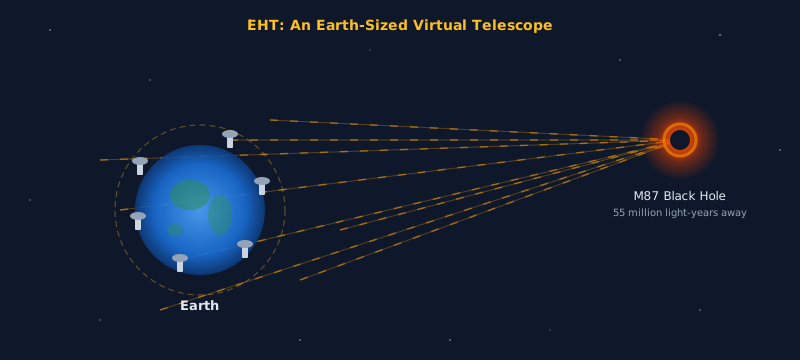
The EHT pulled this off by linking eight radio telescopes scattered across the planet—Hawaii, Chile, Antarctica, Spain, and elsewhere—into a single observation. The technique is called Very Long Baseline Interferometry (VLBI), and it effectively turns Earth into one Earth-sized virtual telescope.
The black hole in M87 weighs about 6.5 billion suns. That’s hard to picture, but try this: our entire solar system would fit comfortably inside it with room to spare. When that much mass is packed into a single point, gravity gets strong enough that not even light can escape.
That bright ring in the photo? It exists because of today’s main character: the photon sphere. You can’t talk about black hole physics without it—and once you know what to look for, it’s a strange and beautiful place.

The Photon Sphere: A Strange Place Where Light Can Orbit
A black hole is surrounded by several invisible but physically critical “boundaries.” The photon sphere is one of them.
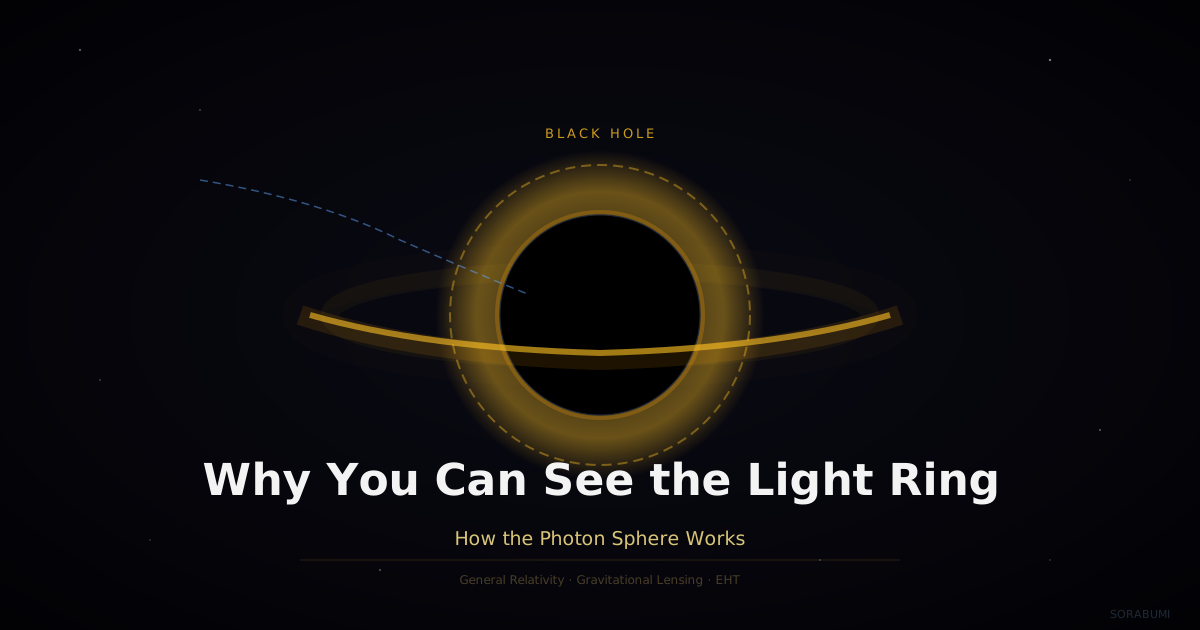
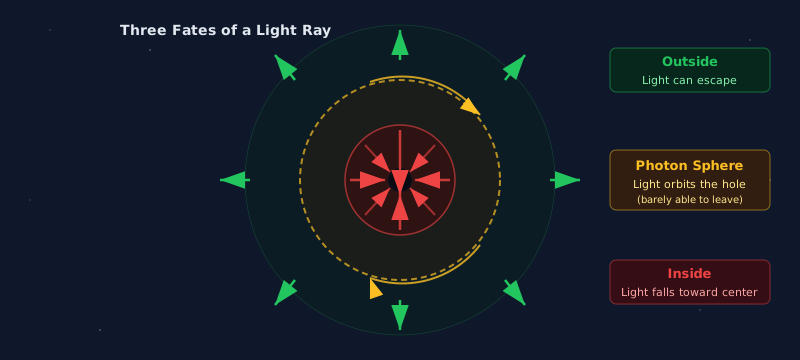
What is it, exactly? In one sentence: the photon sphere is the just-barely-possible orbit for light. Normally, light travels in a straight line. But in a strong gravitational field, space itself is curved—so light’s path curves with it. At the photon sphere, that curvature hits a sweet spot, and light can keep going in a circle around the black hole.
For a non-rotating (Schwarzschild) black hole, the photon sphere sits at 1.5 times the Schwarzschild radius. The Schwarzschild radius is the size of the event horizon, so the photon sphere is just outside it.
The catch: this orbit is wildly unstable. The slightest nudge sends a photon either escaping outward or falling inward. It’s like balancing a marble on top of a hill—any small disturbance and it rolls. So no light stays in the photon sphere forever.
That instability is actually the point. Some of the light that grazes the photon sphere veers outward and reaches our eyes. This is what defines how a black hole looks from the outside. Without the photon sphere, that ring of light wouldn’t exist.
How Gravity Bends Light: Gravitational Lensing
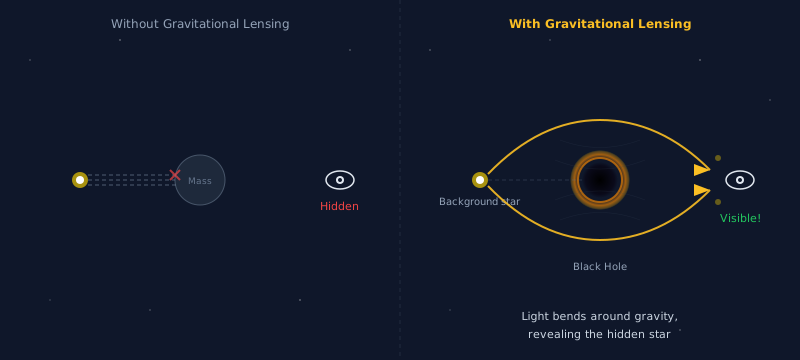
To get why a black hole looks the way it does, you need gravitational lensing. Predicted by Einstein’s general theory of relativity, it says that mass curves space, and curved space bends the path of light passing through it.
You don’t notice this effect day to day. Earth’s mass is way too small to bend space measurably. But near a black hole, space is warped to an extreme—and light’s path bends visibly.
Picture a star sitting directly behind a black hole. You shouldn’t be able to see it. But the black hole’s gravity warps space, and light from the star detours around the black hole and reaches you. Stretched into a ring, this is the famous “Einstein ring.”
The ring in the EHT image is also a product of gravitational lensing. Hot gas in the accretion disk emits light, the black hole’s gravity bends and amplifies it, and light that grazes the photon sphere gets the strongest bending of all—producing that bright circular structure.
There’s a fun detail: the ring isn’t equally bright everywhere. In the M87 image, the south side is brighter than the north. That’s because the disk gas rotating toward us gets brightened by relativistic beaming, while the gas moving away dims. From a single image, you can read off which way the black hole is spinning. Not bad.
The One-Way Door: The Event Horizon
Just inside the photon sphere lies an even more decisive boundary: the event horizon. Cross it, and even light can never get back out.
The event horizon isn’t a physical wall. There’s nothing visible to bump into. But it enforces the strictest one-way trip in the universe: stuff can fall in, nothing can come out. Not even information.
What would happen if an astronaut approached the event horizon? Watching from a distance, you’d see them slow down—movement stretching into ever-slower motion as gravity dilates time itself. Eventually they’d appear frozen against the surface, their light reddening as wavelengths stretched, and then they’d fade from view.
Meanwhile, the astronaut themselves might not feel anything special. For a supermassive black hole like M87’s, the tidal forces near the event horizon are surprisingly mild. They might cross the boundary without realizing it. After that, of course, they’re on a one-way trip toward the singularity.
Together, the photon sphere and the event horizon produce a black hole’s signature look: a bright ring around a dark shadow. The photon sphere bends light into a visible halo; the event horizon swallows light to make the dark center.
What the Black Hole’s “Shadow” Tells Us
The EHT image isn’t just pretty. It’s direct evidence for general relativity’s predictions.
The shadow’s predicted size and the shadow’s observed size matched up cleanly. Einstein’s 1915 theory was, more than a century later, still describing the universe accurately.
In 2022, the EHT released an image of Sagittarius A*, the black hole at the center of our own Milky Way. It’s much smaller than M87’s—about 4 million solar masses—but still an absurdly massive object on solar-system scales.
Sagittarius A* is about 27,000 light-years from Earth, sitting at the rotational center of the Milky Way. Our solar system orbits it. We’re riding a galactic merry-go-round whose pivot is a black hole.
Going forward, the EHT is aiming for sharper resolution and even moving images of black holes. If we can track gas motion near the photon sphere in real time, our understanding of black hole physics will jump forward—and we might find clues to physics beyond general relativity.
Wrapping Up: Light From the Dark, Telling Us How the Universe Works
A black hole is the ultimate darkness, swallowing even light. And yet it reaches us as a ring of light. Behind that apparent contradiction is an elegant piece of physics: the photon sphere and gravitational lensing.
Light bends at the photon sphere; light disappears at the event horizon. The contrast between those two boundaries produces that donut-shaped image. The darkest object in the universe puts on the most dramatic light show—which feels both ironic and pretty cool.
The 2019 EHT image changed how humans understand the cosmos. Use a telescope, test a theory, find a new mystery. That cycle keeps going. The physics of the photon sphere has plenty more to teach us.