The universe is expanding. That much we know. The problem is that when you ask how fast, the universe seems to give two different answers — and the gap between them has been growing more stubborn with every passing year. A major measurement published in April 2026 has now pushed the discrepancy past the point where anyone can blame it on statistical noise.
Something in our understanding of the universe’s fundamental laws is off. Here’s why that’s worth getting excited about.
What “Expansion Rate” Actually Means
The discovery that the universe is expanding traces back to Edwin Hubble’s observations in 1929. He noticed that distant galaxies are receding from Earth — and the farther away a galaxy is, the faster it’s moving away. Reduce that relationship to an equation and you get: recession velocity = H0 × distance. That H0 is what astronomers call the Hubble constant.
Get H0 right and you can calculate the age of the universe, its size, and its eventual fate. It’s the single most fundamental number in cosmology. Which is why astronomers have spent nearly a century pouring effort into pinning it down precisely.
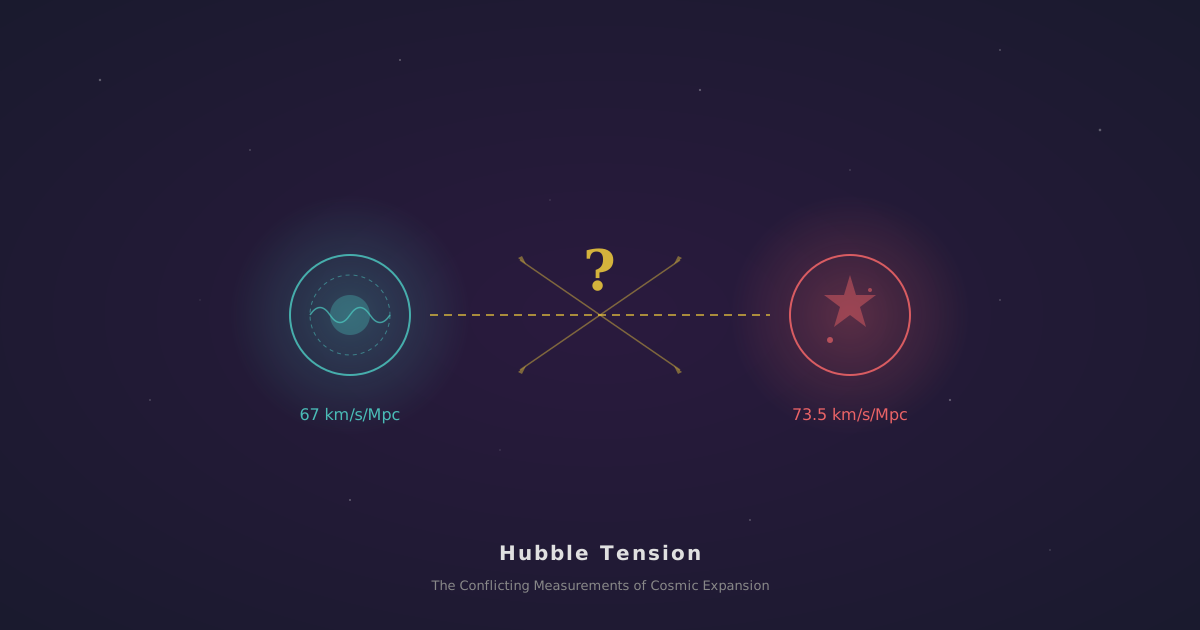
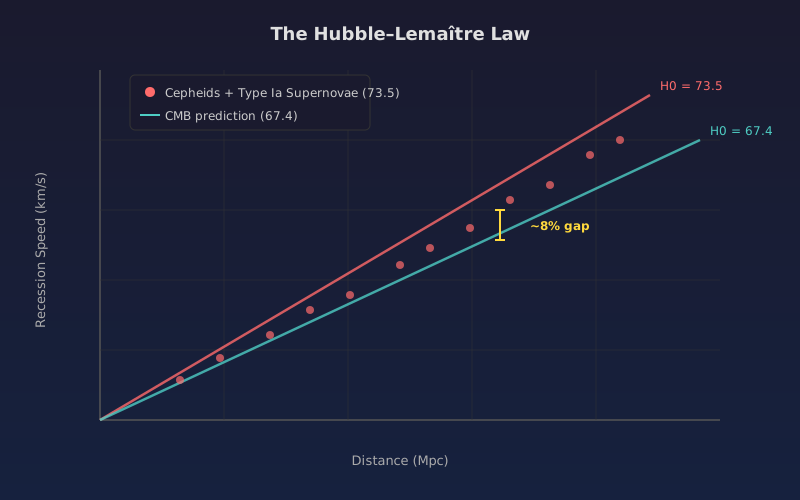
The catch is that there are two independent ways to measure H0 — and they keep disagreeing. The gap is only about 8%, but both measurements have become too precise to chalk the difference up to error. This standoff is the “Hubble Tension,” and it’s currently the hottest problem in astrophysics.
Method One: Reading the Universe’s Baby Photo
The first approach reaches all the way back to the universe’s infancy. About 380,000 years after the Big Bang, the cosmos cooled enough for light to travel freely for the first time. That ancient light — the cosmic microwave background, or CMB — still washes over Earth from every direction. It’s essentially a snapshot of the baby universe.
ESA’s Planck satellite mapped the CMB with extraordinary precision. Feed that data into the standard cosmological model (ΛCDM) and you get H0 ≈ 67.4 km/s/Mpc. That means a galaxy sitting one megaparsec away — roughly 3.26 million light-years — is receding at 67.4 kilometers per second.
The logic here is elegant: if you know the universe’s starting conditions, you can simulate its entire expansion history and work backwards to derive today’s rate. It’s physics at its most straightforward — set the initial state, run the equations.
Method Two: Climbing the Cosmic Distance Ladder
The second method is more hands-on. Astronomers use specific objects in the universe as distance markers, measure their actual distances and recession speeds, and derive H0 directly. It’s intuitive, but measuring cosmic distances is brutally hard.
The trick is to build up gradually — use objects at known distances as stepping stones to reach objects even farther away. Astronomers call this the cosmic distance ladder.
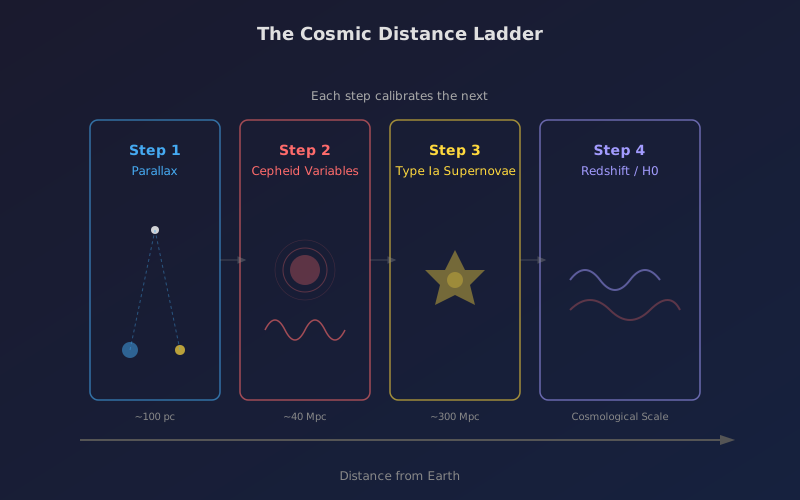
The ladder has roughly four rungs. First, you measure nearby stars using parallax — the tiny apparent shift in a star’s position as Earth moves from one side of its orbit to the other. Next, you use Cepheid variable stars, whose brightness pulses with clockwork regularity, to reach much farther out. After that, Type Ia supernovae — explosions of white dwarf stars that always reach the same peak brightness — serve as “standard candles” for galaxy-scale distances. Finally, you read off recession speeds from redshift and calculate H0.
The result: about 73.5 km/s/Mpc. That’s roughly 9% higher than the CMB-derived value of 67.4.
April 2026: The Moment It Became Undeniable
On April 10, 2026, the H0 Distance Network (H0DN) collaboration published a paper in Astronomy & Astrophysics that sent a jolt through the field. The team combined Cepheids, the tip of the red giant branch (TRGB), Type Ia supernovae, and several other techniques into a single large-scale analysis, using each method to cross-check the others. Their result: 73.50 ± 0.81 km/s/Mpc — below 1% uncertainty.
What that precision means in practice: the probability that the gap with the CMB value of 67.4 is just a statistical fluke has effectively dropped to zero. The discrepancy now exceeds 5 sigma — the same threshold particle physicists use to declare a discovery. The odds of a chance fluctuation producing a gap this large are roughly 1 in 3.5 million.
So the possibility that one measurement is simply wrong has nearly vanished. What remains is a harder conclusion: humanity is missing something about how the universe works.
Three Ideas That Could Explain It
The leading candidates break down roughly like this.
1. Dark energy isn’t constant
In the standard model, dark energy — the force driving cosmic acceleration — has been the same strength throughout the universe’s history. But if it has varied over time, the entire expansion history changes, and the CMB-derived prediction shifts along with it. There’s a certain irony in the possibility that the thing we named the “cosmological constant” turns out not to be constant at all.
2. Unknown particles populated the early universe
If a lightweight, previously undiscovered particle was zipping around in the moments after the Big Bang, it would have subtly altered the universe’s early expansion pattern. That “dark radiation” could skew how we interpret the CMB signal. The idea that some cousin of the neutrino is still hiding from us is genuinely on the table.
3. Gravity itself needs revision
Einstein’s general relativity has survived more than a century of tests. But those tests have mostly happened on scales far smaller than the full universe. At cosmological scales, some modification to gravity might be needed — a possibility that also connects to the galaxy rotation problem, one of the original motivations for dark matter. If this is the answer, textbooks will need rewriting from the ground up.
Which of these, if any, is right? Nobody knows yet. But “we now know precisely what we don’t know” is real progress in science.
What Comes Next
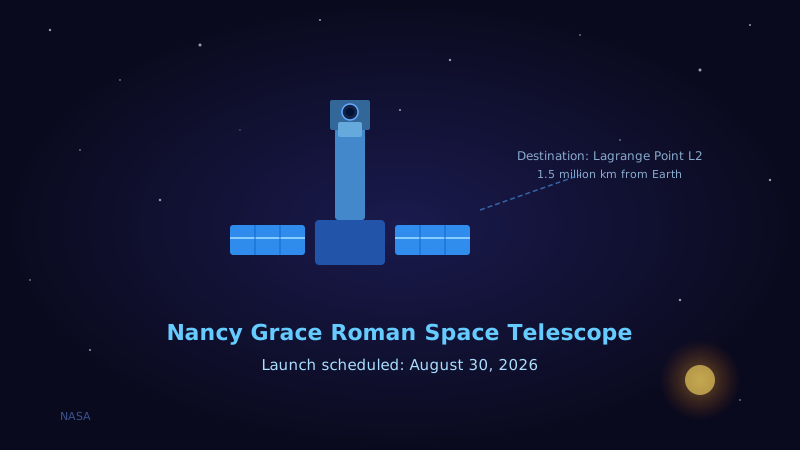
Several instruments are already being aimed at this problem. NASA’s Nancy Grace Roman Space Telescope, set to launch in 2027, will survey the sky with a field of view 100 times wider than Hubble’s, capturing enormous numbers of Type Ia supernovae and Cepheids. That should sharpen the distance ladder considerably.
ESA’s Euclid space telescope was designed specifically to probe the nature of dark energy. By tracking the universe’s expansion history era by era, Euclid may be able to settle once and for all whether dark energy is truly constant.
Gravitational waves offer a third route. When two neutron stars merge, they produce both gravitational waves and a flash of light. Detecting both simultaneously gives you a completely independent measurement of cosmic distances — no distance ladder required. As LIGO and Virgo continue to improve their sensitivity, these “standard sirens” will add another voice to the debate.
What the Universe Is Telling Us
The real appeal of the Hubble Tension isn’t the numbers — it’s what the numbers imply. A discrepancy of just 6 km/s/Mpc in an abstract cosmological constant has managed to implicate dark energy, undiscovered particles, and the foundations of gravitational theory all at once.
Honestly, there’s something thrilling about moments like this — when a clean, deceptively simple measurement starts pulling at the threads of everything we thought we understood. The universe keeps score, and it’s telling us, politely but firmly, that we haven’t solved it yet.
73.5 or 67.4 — the question isn’t which number is right. It’s why they disagree. And when we finally have that answer, the cosmology textbooks are going to look quite different from the ones we have today.