Saturn’s rings are the solar system’s most recognizable decoration. Think back to the planet diagrams in an elementary school science book — Mercury, Venus, Earth, Mars, and so on, with Saturn uniquely adorned by that distinctive halo. Without the rings, Saturn would be just another enormous ball of gas.
So here’s a thought: those rings are currently vanishing, bit by bit.
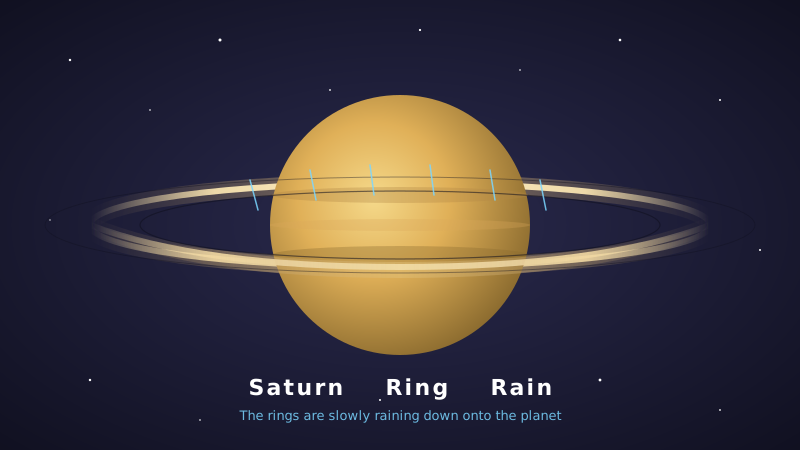
NASA observations have confirmed that Saturn’s rings are continuously raining down onto the planet itself in a process called “ring rain.” The rate is faster than anyone expected. Even conservative estimates from astronomers put the remaining lifespan at under 100 million years.
In cosmic terms, 100 million years is not a long time — it’s slightly shorter than the span from the age of the dinosaurs to the present day. Saturn has existed for 4.5 billion years, and its rings haven’t been there the whole time. They won’t last forever, either. We’ve only really understood this in the past decade or so.
What the Rings Are Actually Made Of
Let’s start with the rings themselves. From a distance they look like a single flat disc, but up close they’re mostly empty space — individual particles of ice, rock, and dust all orbiting Saturn independently.
The particles range wildly in size, from specks of dust to chunks as large as a house. The total mass is surprisingly modest: roughly half that of Saturn’s moon Mimas. More than 95% of the rings by mass is water ice, with the rest being rocky dust and organic material. That’s why they’re sometimes described as “dirty snowballs.” The ice reflects sunlight brilliantly, making the rings visible from Earth across hundreds of millions of miles. The rings span about 280,000 km in width — about three-quarters of the Earth-Moon distance — yet in most places they’re less than 10 meters thick.
To put that proportion in perspective: imagine the Tokyo Dome stretched razor-thin like a blade. That’s the kind of extreme disc orbiting Saturn. It’s a remarkably delicate structure.
The Discovery of Ring Rain
Back in the 1980s, when Voyager 1 and 2 flew past Saturn, scientists noticed something odd. The density of Saturn’s ionosphere was unusually low at specific latitudes.
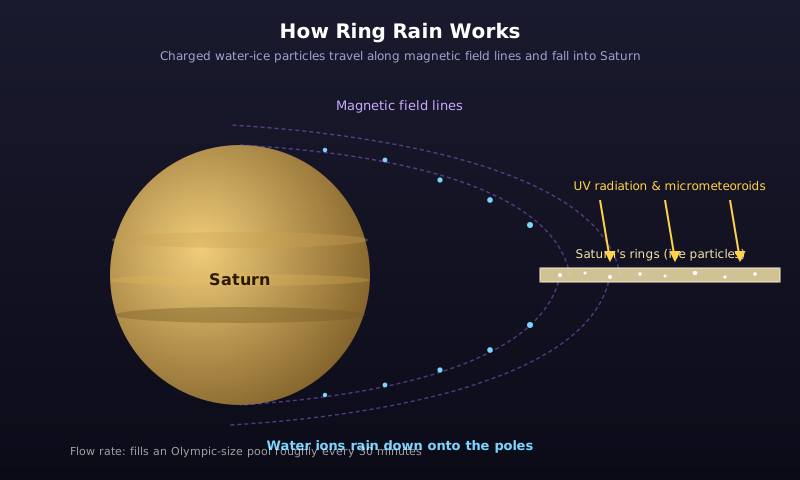
Nobody could explain it at first. But infrared observations from ground-based telescopes eventually revealed the cause: water ions were streaming from the rings down into Saturn’s atmosphere along magnetic field lines.
That’s ring rain. The mechanism works like this: ring particles hit by ultraviolet radiation or micrometeoroids become electrically charged. Once charged, a particle gets locked onto Saturn’s powerful magnetic field and funneled along field lines straight into the upper atmosphere — like rain being guided by invisible wires.
The “rain” isn’t liquid water, though. It arrives as water ions — particles in the form of H3O+ and similar species. Once they hit Saturn’s atmosphere, they break apart into hydrogen ions and other components, altering the ionosphere. The density drop Voyager observed was caused by these reactions neutralizing electrons.
Cassini’s Final Act in 2017
The most definitive observations came from Cassini, the joint NASA/ESA mission that spent 13 years orbiting Saturn between 2004 and 2017. For its grand finale, the spacecraft was given a daring last assignment: thread the 2,000-kilometer gap between Saturn and its rings, not once but 22 times.
In September 2017, with its fuel nearly exhausted, Cassini plunged into Saturn’s atmosphere and burned up — transmitting data until the very end.
Those final passes allowed scientists to directly measure what was falling and how much. The results were striking: far more material was raining onto Saturn’s equator than ring rain alone could account for.
Researchers estimated that the rings are losing enough water to fill an Olympic-sized swimming pool every 30 minutes — hundreds of kilograms per second, like a faucet left wide open. If ring rain were the only process, the rings might last another 300 million years. But factoring in the equatorial infall Cassini measured, that estimate drops below 100 million years. That’s what NASA calls the “worst-case scenario.”
When Did the Rings Form? More Recently Than You’d Think
This raises an obvious question: if the rings are disappearing, when did they form?
For a long time, astronomers assumed Saturn’s rings were as old as the planet itself — remnants of the protoplanetary disc from 4.5 billion years ago.
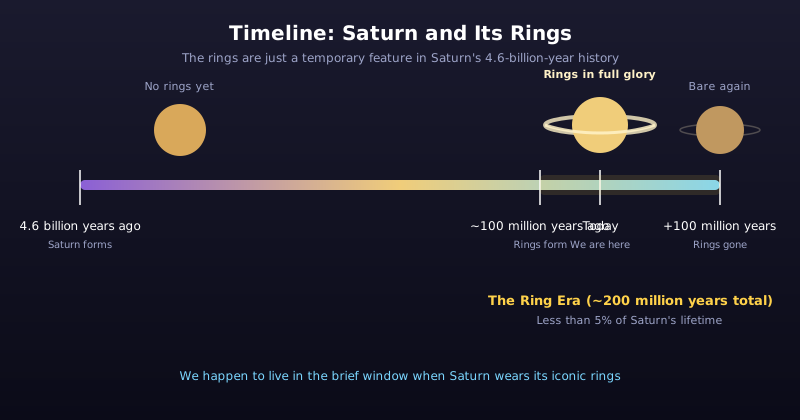
That assumption got overturned in the late 2010s. Cassini data revealed the rings are surprisingly young. Ice darkens over time as it accumulates cosmic radiation and micrometeorite impacts, but Saturn’s rings are still remarkably bright. Working backward from the contamination levels, scientists estimate the rings formed somewhere between 100 million and 400 million years ago.
That means Saturn may have had no rings at all while dinosaurs roamed the Earth. Born recently, gone soon — the rings appear to be a short-lived adornment after all.
How they formed remains an open question. Two leading hypotheses exist. One proposes that an ancient moon of Saturn was shattered by a collision with another body. The other suggests a comet or icy object strayed too close and was torn apart by tidal forces. Both stories begin with destruction.
It’s worth noting that the other gas giants — Jupiter, Uranus, Neptune — all have rings too. But none of them come close to Saturn’s in visibility. Those rings are faint and dark, nearly invisible even through a telescope. If Saturn’s rings disappear, the solar system’s “ringed planet” category will be left with some very unremarkable options.
We happen to live in the flashy era. That makes tonight’s Saturn look a little different, doesn’t it?
The Day the Rings “Disappeared” in 2025
On March 23, 2025, Saturn’s rings briefly seemed to vanish as seen from Earth. Not physically — they’re still there. What happened is that Earth crossed the plane of Saturn’s rings and we ended up looking at them exactly edge-on.
The rings are at most 10 meters thick. Viewed from the side, they all but disappear — thinner than a line even through a telescope. This “ring plane crossing” happens roughly every 15 years, with the next one due in 2039.
The slow disappearance driven by ring rain and this temporary edge-on vanishing are completely different phenomena. But holding both in mind at once gives the whole thing a strange poetry. Over the long haul, the rings are being lost. And every 15 years, they hide from us for a few days. Saturn just keeps orbiting, unchanged — yet how we see it shifts dramatically depending on our angle and our timeframe.
Lucky to Be Here Now
A hundred million years might sound impossibly remote. But think of it this way.
Over Saturn’s 4.6-billion-year history, the planet has probably had visible rings for less than 5% of that time. The dinosaurs may have looked up at a ringless Saturn. A hundred million years from now, someone — or something — will see a plain, unadorned planet where those brilliant rings once were.
We were born in the window when Saturn has rings. That’s not quite like happening to glance up and see a crescent moon. It means humanity is watching, in real time, one of the most beautiful structures in the solar system — one that exists for only a sliver of cosmic history.
One of Cassini’s last images showed a view looking down across Saturn’s surface toward the ring edge — golden curves meeting thin lines of ice. Whenever I see that photo, something strange happens in my chest. That ice is falling right now, today, and someday every last gram of it will be gone, leaving Saturn as just another large sphere.
But that day isn’t coming soon. It’s a hundred million years off. Tonight, if you have a telescope, point it at Saturn. The rings are there. Still shining. Doomed, eventually — but tonight, undeniably, beautifully present.
The beauty of the universe doesn’t last forever. Maybe that’s exactly what makes seeing it now so special.