When Galaxies Were Starving for More
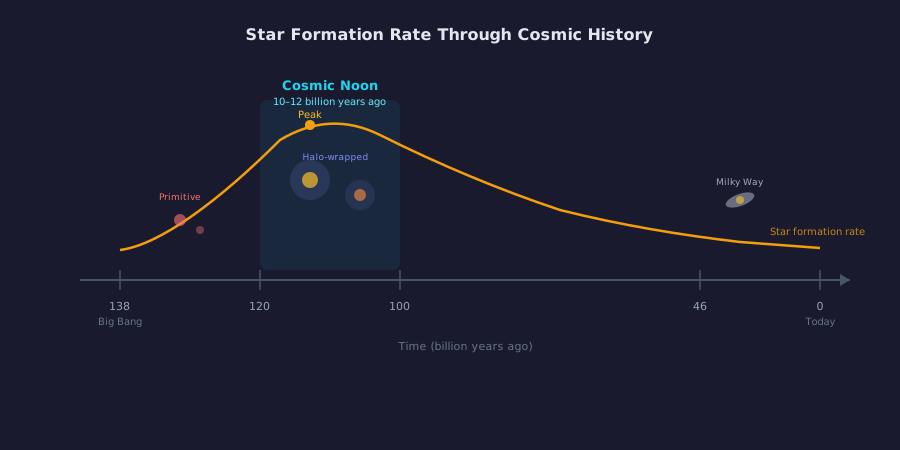
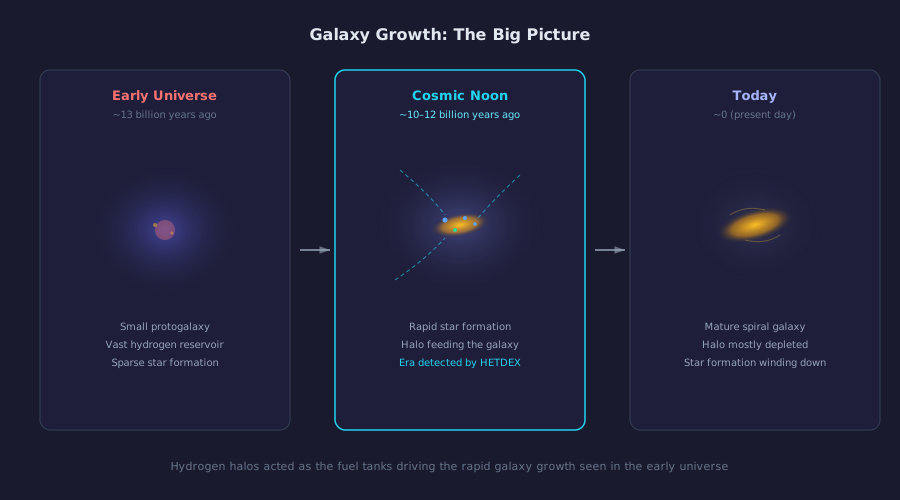
There is a moment in cosmic history known as Cosmic Noon. It falls roughly two to four billion years after the Big Bang — ten to twelve billion years ago — and during that window, galaxies were absolutely ravenous. They were building stars at the fastest rate the universe has ever seen, more than ten times the pace of today.
But here’s the thing: stars are made of hydrogen. Feeding that kind of star-formation frenzy required staggering amounts of it — far more than any galaxy could store within its own walls. So where was the fuel coming from?
Astronomers had been wrestling with this question for a long time. Theory predicted that galaxies should be surrounded by enormous clouds of hydrogen gas. The problem was actually finding them. Hydrogen doesn’t shine on its own. It sits in the dark like an invisible presence, nearly undetectable by ordinary telescopes.
Finding Invisible Hydrogen
Enter the Hobby-Eberly Telescope at McDonald Observatory in Texas — a massive instrument with a mirror nearly ten meters across, fitted with a specialized instrument suite called HETDEX.
HETDEX was originally designed to study dark energy. To map the universe’s expansion with precision, it needed to spectroscopically survey vast numbers of distant galaxies, capturing up to 100,000 spectra in a single pointing. Think of it as a cosmic spectroscopy machine, sweeping the sky in broad strokes rather than staring at single targets.
The trick with hydrogen is this: while it doesn’t emit light on its own, it does glow faintly at a specific wavelength when bathed in ultraviolet radiation from a nearby galaxy. That wavelength is the Lyman-alpha line — 121.6 nanometers, deep in the ultraviolet. For galaxies close to us, that signal is blocked by Earth’s atmosphere. But at cosmic distances, the universe’s expansion redshifts the line into the visible range, where ground-based telescopes can actually catch it.
Because HETDEX was already recording spectra of over a million early galaxies, the signal from surrounding hydrogen halos was baked right into the data. It was, in a sense, a discovery hiding inside a different discovery. The research team selected the brightest 70,000 sources from more than 1.6 million early-universe galaxies, then ran the analysis on supercomputers at the Texas Advanced Computing Center.
What they found exceeded expectations.
33,000 — and They’re Enormous
Before this study, astronomers had confirmed roughly 3,000 hydrogen halos (also called Lyman-alpha nebulae). HETDEX pushed that number past 33,000 in one go — more than a tenfold increase.
Even more striking: halos turned up around roughly half of all the galaxies examined. That means hydrogen halos weren’t rare anomalies at Cosmic Noon. They were essentially standard equipment.
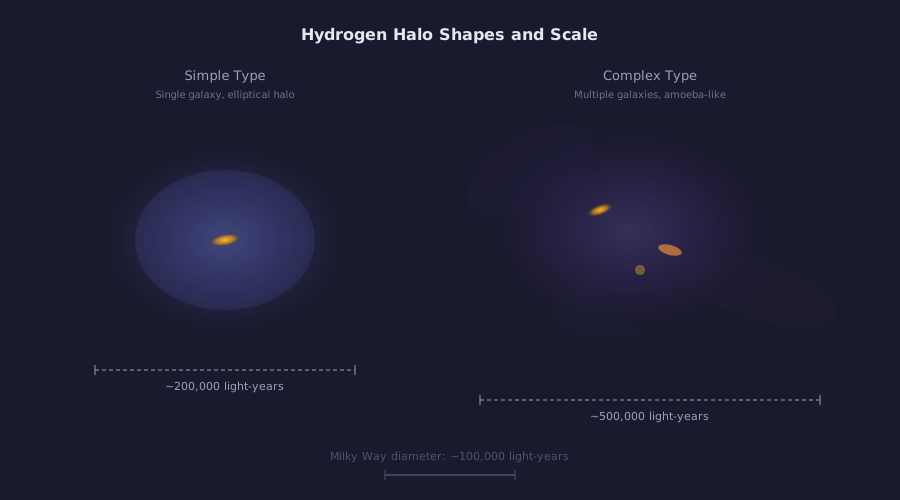
The sizes are what really grab you. The smaller ones span tens of thousands of light-years. The larger ones reach hundreds of thousands. For context, the Milky Way’s disk is about 100,000 light-years across — meaning some of these halos were as wide as an entire galaxy, or wider, wrapped around the galaxy like a vast invisible atmosphere.
That reframes what a galaxy even is. When we picture one, we imagine a luminous spiral or ellipse hanging in the dark. But the visible part may be just the tip of the iceberg. The real structure — most of the mass and volume — could be this enormous, unseen envelope of gas.
The shapes add another layer of interest. Some halos are simple ellipsoids, wrapping a single galaxy like a rugby ball. Others sprawl across multiple galaxies in amoeba-like structures, extending tendrils in several directions. Lead researcher Erin Mentuch Cooper described them as “giant amoebas stretching out their tentacles” — which, honestly, is a pretty accurate picture.
A Refueling Pipeline for Galaxies
Why does any of this matter? Because it connects directly to how galaxies grow.
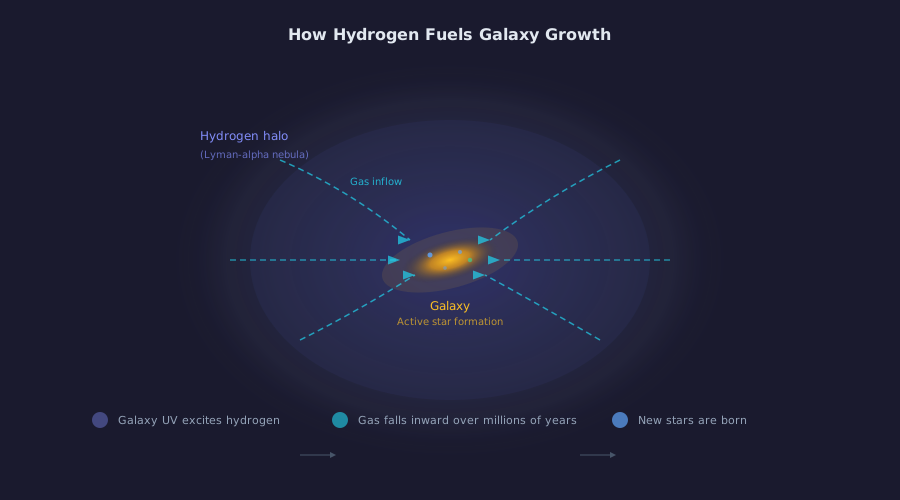
During Cosmic Noon, a galaxy might be converting the equivalent of dozens of solar masses of gas into new stars every single year. Run the math, and the gas inside the galaxy itself would be exhausted within a few hundred million years. Yet star formation didn’t stop — it kept going for billions of years. Something had to be resupplying the tank.
Hydrogen halos are almost certainly that supply. Gas from the surrounding envelope gradually fell inward, feeding the galaxy’s star-forming regions with fresh material over long timescales. Call it a cosmic gas station, or more aptly, the ocean a galaxy swam in while it grew.
The cases where multiple galaxies share a single halo are particularly intriguing. Those systems may preserve evidence of gas bridges between galaxies — a record of matter flowing not just inward, but between neighbors. Galaxies didn’t evolve in isolation. They were embedded in, and shaped by, the gas environment around them.
Why Nobody Spotted Them Before
The existence of hydrogen halos was theoretically predicted decades ago. Detecting them in large numbers, though, was practically impossible — for a simple reason: they are extraordinarily faint.
The Lyman-alpha glow from a halo is orders of magnitude dimmer than the galaxy it surrounds. Picking it out is like trying to spot a firefly next to a streetlight. And for nearby objects, the atmosphere blocks the signal entirely, so ground-based observatories can’t see local halos at all.
Fortunately, distant halos get a free pass from redshift, their Lyman-alpha emission shifted into the visible band. HETDEX happened to be built with spectrographs that cover exactly that wavelength range — not because anyone was hunting halos, but because that’s where distant galaxies used for dark energy research happen to live.
The other ingredient was sheer volume. Capturing 100,000 spectra per observation, sweeping large swaths of sky over several years, built up a statistically meaningful sample that no single-target deep observation could have produced. It’s a different philosophy: go wide, not just deep.
One Piece of a Larger Puzzle
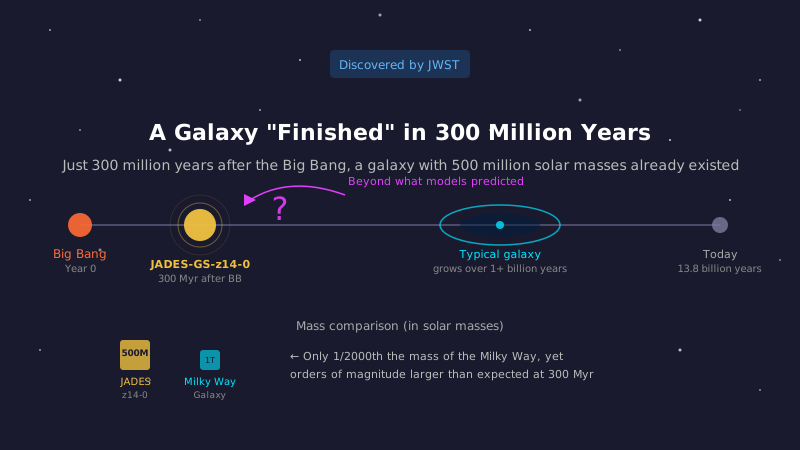
In 2023, JWST delivered a startling result: the early universe contained galaxies that were already surprisingly massive and mature. Standard galaxy-formation models struggled to explain how those giants could have assembled so quickly.
HETDEX’s hydrogen halos help fill that gap. If galaxies had access to enormous external fuel reserves from the beginning, rapid early growth becomes much easier to account for. The “overcrowded” early universe that JWST revealed starts to make more sense when you imagine each galaxy sitting at the center of a vast hydrogen ocean, drawing from it continuously.
That said, plenty of questions remain. The precise mechanism by which halo gas transfers into galaxies is still poorly understood. How halos evolve over time — whether they thin out gradually or get disrupted by stellar winds and supernovae — is an open area. Mapping their internal structure will likely require the next generation of extremely large telescopes.
The Pleasure of Seeing the Invisible
What I find most compelling about this result isn’t the numbers, impressive as they are. It’s the act of detection itself.
Hydrogen is the most abundant element in the universe. It’s everywhere. And yet, precisely because it doesn’t emit light on its own, it has been hiding in plain sight for the entire history of astronomy. Dark matter gets more mystique, but the frustration is similar: something you know must be there, stubbornly refusing to show itself.
HETDEX caught these halos as a byproduct of a completely different experiment. That’s a recurring theme in the history of astronomy — pulsars, the cosmic microwave background, the accelerating expansion of the universe. The instrument aimed at one problem stumbles onto another, bigger one.
Ten billion years ago, hydrogen clouds hundreds of thousands of light-years wide were slowly draining into young galaxies, building stars, building planets, eventually building chemistry complex enough to produce life. Some of the hydrogen atoms in your body were, quite possibly, part of one of those halos. The fact that we can now see them, faint and distant as they are, feels like a small but genuine miracle of physics and engineering working together.
The invisible ocean was always there. We just needed the right net to catch it.