A Baby Universe With a Full-Grown Galaxy
The universe is about 13.8 billion years old. Its first few hundred million years are known as the “cosmic dark ages” — a period before stars or galaxies had formed. There were no light sources, so darkness was total and literal. Eventually, the first stars ignited, gas gathered, and primitive galaxies began to take shape.
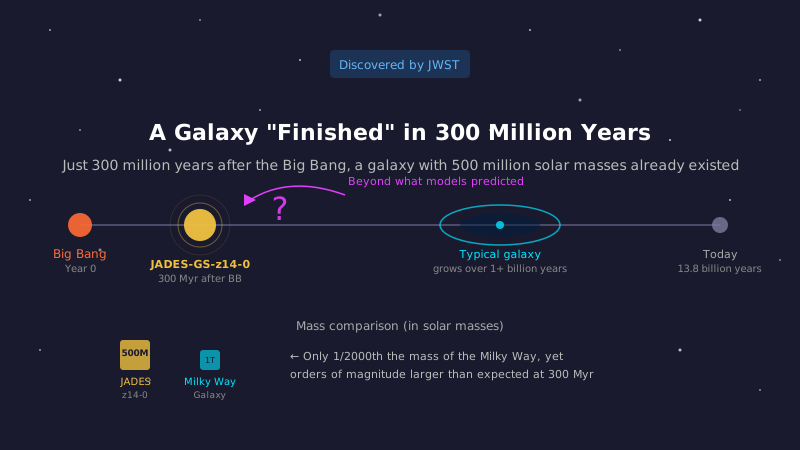
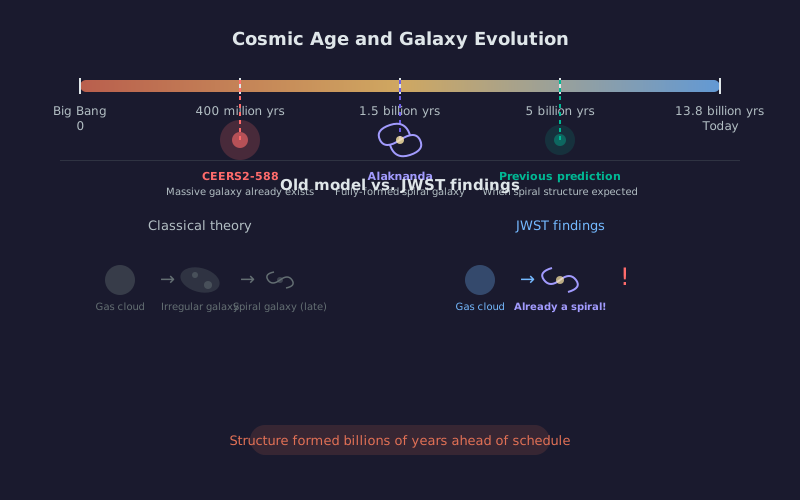
According to the standard theory, early galaxies were small and irregular. Galaxies with organized spiral arms weren’t expected to appear until at least five billion years after the Big Bang. The early universe, in other words, was supposed to be a chaotic construction site. Finished buildings weren’t due for a very long time.
Then the James Webb Space Telescope (JWST) flipped that picture upside down.
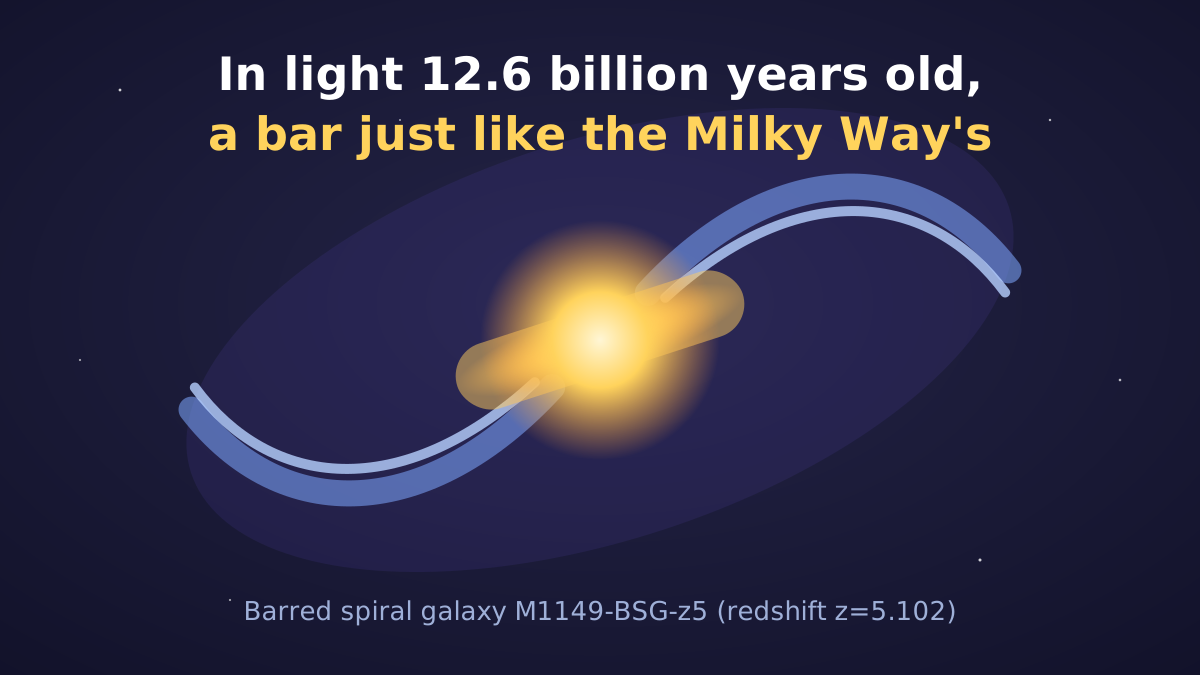
A galaxy called Alaknanda, reported in late 2025, already had a beautiful spiral structure just 1.5 billion years after the Big Bang — a miniature version of the Milky Way. That’s billions of years earlier than anyone predicted. The universe was still an infant, and yet a fully formed adult galaxy was already there.
“Too Mature, Too Soon” — What JWST Actually Saw
How did we find this in the first place? The answer is JWST’s infrared observation capability.
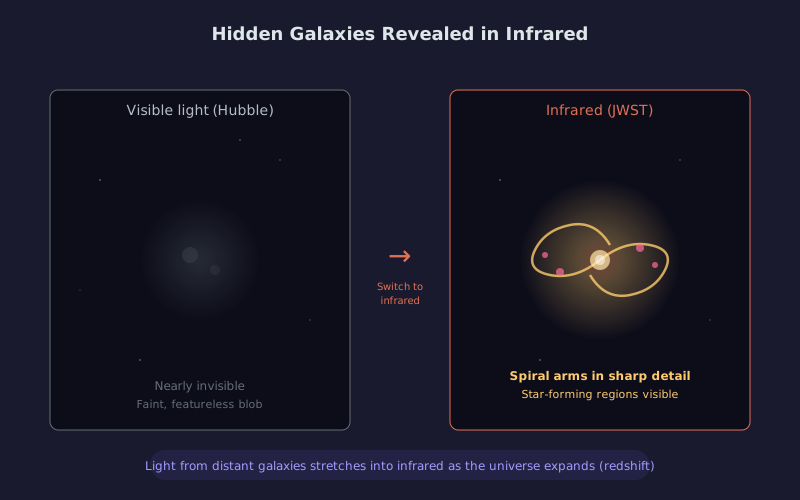
Light from distant galaxies gets stretched as it travels through an expanding universe. What started out as visible light arrives at Earth as infrared radiation — that’s redshift. The Hubble Space Telescope was optimized for visible light, so those distant galaxies appeared only as faint blurs.
JWST has a 6.5-meter primary mirror tuned for infrared. That lets it capture sharp images of light more than 13 billion years old. Alaknanda’s spiral arms are clearly visible through JWST — reports note that the same object appears as nothing more than a faint smudge in Hubble’s imagery.
And Alaknanda isn’t the only surprise. CEERS2-588, a galaxy discovered just 400 million years after the Big Bang, already had a mass billions of times that of the Sun. It was producing stars at a rate of 8.2 solar masses per year — a pace that existing models simply cannot explain at that epoch.
Five Galaxies Colliding at Once
Early galaxies weren’t floating alone in the dark.
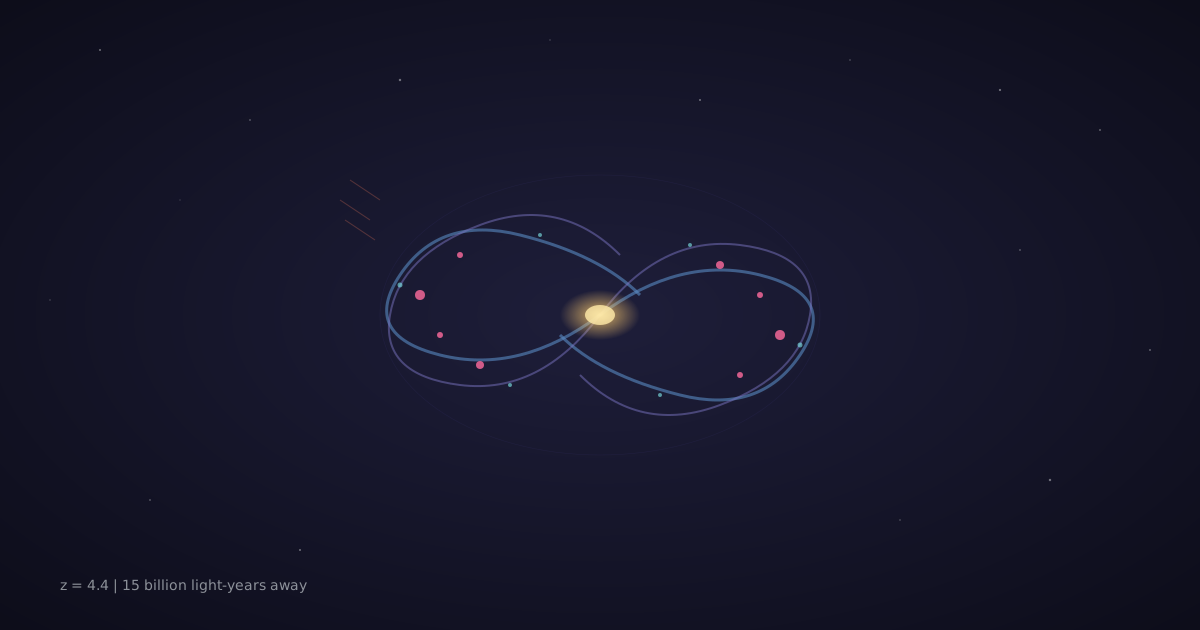
A research team at Texas A&M University found, in JWST data, evidence of five or more galaxies simultaneously merging just 800 million years after the Big Bang. On top of that, the collisions were scattering heavy elements — oxygen, carbon — far beyond the galaxies’ own boundaries.
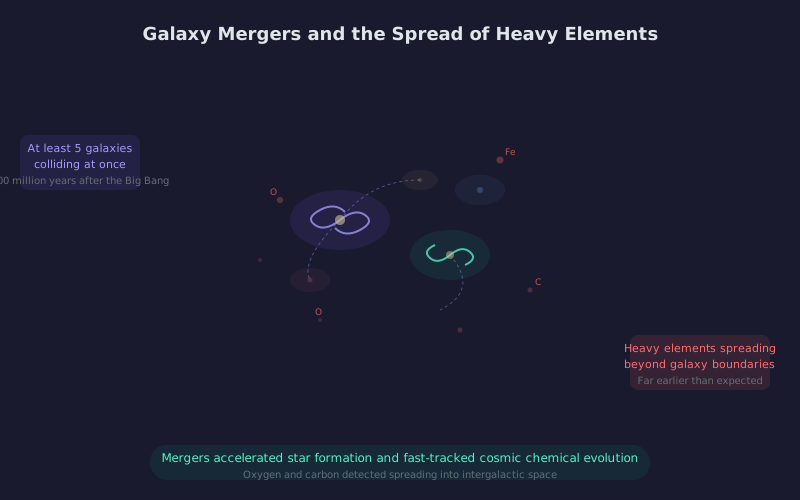
That finding carries real weight. Heavy elements are forged in the cores of stars through nuclear fusion. Their presence outside galaxy boundaries at this point in time means that multiple generations of stars had already been born and died. The “chemical maturation” of the universe was running far ahead of schedule.
Standard simulations had heavy elements spreading significantly into intergalactic space only after a billion years or more. Seeing it at 800 million years suggests something unusual was at work — some mechanism the models didn’t account for.
Why Did the Old Theory Predict a Slower Universe?
It’s worth pausing to understand what the conventional model actually said.
Standard cosmology holds that galaxies grow inside “nests” of dark matter. Dark matter clumps together under gravity to form halos, and ordinary matter — gas — falls into those halos and forms stars. This is called hierarchical formation: small structures merge repeatedly to build larger ones.
Under that framework, organized structures like spiral arms take time to develop. Small galaxies collide over and over; each collision disrupts their shape. Only gradually do they settle into stable, rotating disks. That’s why spiral galaxies were considered a “late-type” — they were supposed to come after a long period of chaos.
JWST’s data challenges that narrative. If early galaxies had a sufficient supply of cold gas, it’s possible that disks — and even spiral arms — could form far faster than anyone expected. Alternatively, dark matter itself might not behave quite the way current models assume.
Virgil: The “Hidden Monster”
Of all JWST’s early-universe revelations, the one that most stopped me cold is the galaxy nicknamed Virgil.
In visible light and ultraviolet, Virgil looks like an ordinary galaxy from about 800 million years after the Big Bang. But in JWST’s infrared view, a supermassive black hole lurks at its center, pouring out enormous amounts of energy. Calm-looking in optical; ferocious in infrared. Think Dr. Jekyll and Mr. Hyde.
What does this mean? Supermassive black holes existed in the early universe — and some of them were hidden from any telescope that didn’t see in infrared. Before JWST, we had no way to know how many of these “obscured active galactic nuclei” were out there.
Virgil suggests that black holes grew far faster in the early universe than previously thought. Objects with masses millions to billions of times that of the Sun had already matured before the universe reached its first billion years.
The Theory Is Being Rewritten Right Now
JWST has now been collecting data for nearly four years. The problem of early galaxies being “too numerous,” “too massive,” and “too structured” even earned a nickname in astronomy circles: the “JWST crisis.”
But step back, and this isn’t a crisis — it’s an opportunity. Observations outpacing theory is exactly how science advances.
Several competing explanations are now on the table. One is that star formation in the early universe was simply more efficient than assumed. If gas converted to stars at twice or three times the standard efficiency, galaxies could grow much faster. Another involves dark matter’s true nature: models that posit lighter particles, such as axion dark matter, predict accelerated structure formation in the early universe.
Which explanation wins — or whether we need new physics entirely — remains to be seen. What’s already clear is that the universe’s “childhood” was far more eventful than we imagined.
The Universe Doesn’t Grow Up Slowly
Galaxies take billions of years to gradually organize themselves. Until quite recently, most astronomers believed that. What JWST has shown us defies that intuition at every turn.
A spiral galaxy 1.5 billion years after the Big Bang. A massive galaxy at 400 million years. A five-way collision with heavy elements scattered across intergalactic space at 800 million years. If you mapped cosmic history onto a human lifetime, it would be like a kindergartner already running a company.
What all this tells us is that the universe doesn’t play by our sense of time. Within 13.8 billion years of total history, the first billion were extraordinarily dense with activity. JWST keeps sending data every day. Whatever long-held assumption it overturns next, honestly — I can’t wait to find out.