Four Eyes on the Moon, 52 Years Later
On April 1, 2026, an SLS (Space Launch System) rocket lifted off from Launch Complex 39B at Kennedy Space Center in Florida. Atop it sat the Orion spacecraft, carrying four crew members: NASA’s Reid Wiseman, Victor Glover, and Christina Koch, joined by Jeremy Hansen of the Canadian Space Agency.
The last time human beings traveled to the vicinity of the Moon was December 1972, aboard Apollo 17. That’s a gap of 52 years.
Artemis II doesn’t land. It swings around the Moon and comes home — a “free-return flyby” trajectory. No boots on the surface. Which raises the obvious question: why bother sending people at all? That question sits right at the heart of the mission.
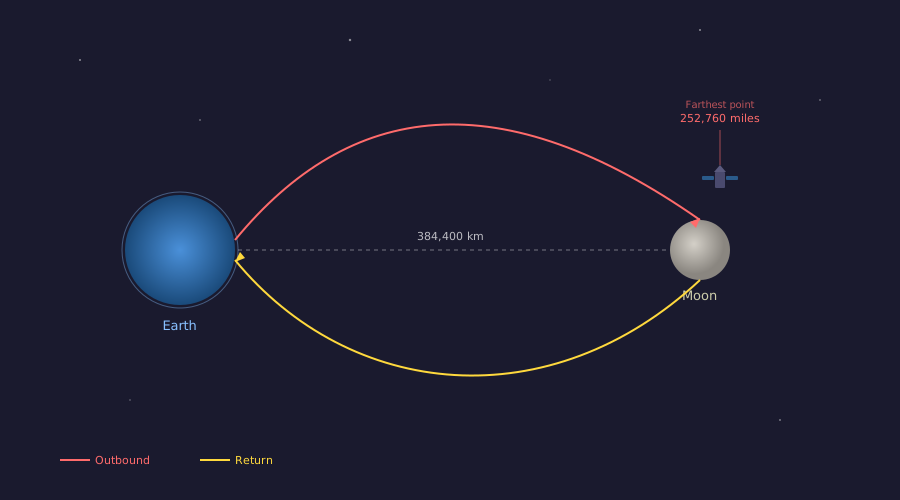
252,760 Miles From Home — Breaking Apollo 13’s Record
At 1:56 p.m. Eastern time on April 6, Orion reached a point 252,760 miles (roughly 406,700 km) from Earth. That surpasses the 248,655-mile mark set by Apollo 13 in 1970 — making this the farthest any human being has ever traveled from Earth.
Apollo 13’s record was a byproduct of disaster. When an oxygen tank exploded, the crew had to abort the lunar landing and slingshot around the far side of the Moon to get home. Ironically, that emergency route sent them farther than any planned mission had gone. Artemis II broke the record deliberately, on purpose, as part of the plan. The difference in meaning is everything.
At that distance, Earth through the window looks roughly the size of your thumbnail held at arm’s length. Glover reported over comms that “the blue dot just keeps getting smaller.” Radio signals take over a second each way. Only a few dozen people in history have felt what that distance actually means from the inside — and four more just joined that list.
Seven Hours Over the Moon
The closest approach lasted roughly seven hours, stretching from afternoon into the evening of April 6. During that window, the crew worked through 30 observation targets, using both naked eyes and cameras.
The standout target was the Orientale Basin — a multi-ring impact structure about 960 kilometers across, formed some 3.8 billion years ago. It sits near the Moon’s limb and is frustratingly hard to see from Earth because the viewing angle is so oblique. From a flyby trajectory, the crew could study it from multiple angles over the course of the pass.
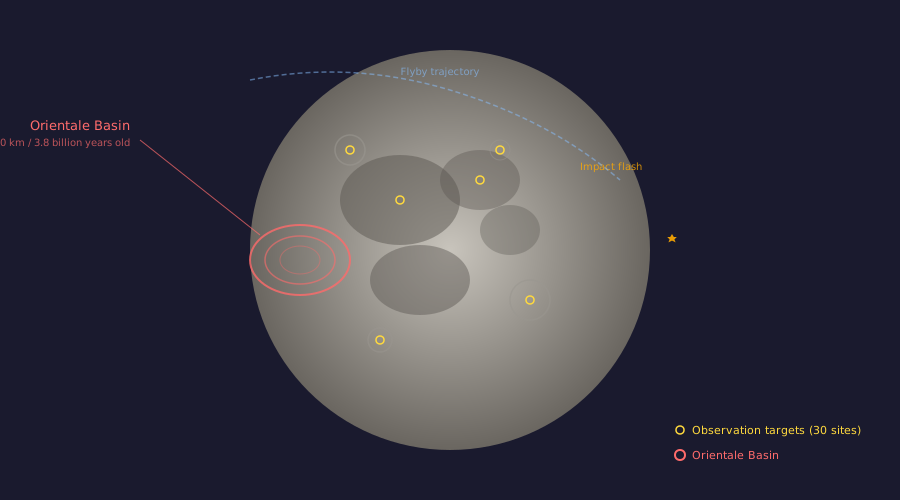
The observation log covered a wide range:
- Color, brightness, and texture differences between impact craters
- Boundary lines of ancient lava flows
- Rille patterns — long fractures in the lunar surface
- Meteoroid impact flashes on the night side (six confirmed)
That last item deserves a moment. Earth-based telescopes occasionally catch these flashes, but having crew members confirm them by eye from just a few thousand miles away is unprecedented. A small rock traveling tens of kilometers per second hits the airless surface, releases its kinetic energy in a brief burst of light, and leaves a new crater the size of a dining table. Without an atmosphere to burn things up, the Moon takes that kind of hit constantly.
54 Minutes of Solar Corona
Near the end of the observation window, something rarer happened. From Orion’s vantage point, the Moon drifted across the face of the Sun — a total solar eclipse, seen from space.
On the ground, totality lasts at most about seven minutes. Orion’s orbital geometry stretched that to 54 minutes of uninterrupted totality.
For that entire stretch, the Sun’s disk was hidden behind the Moon, leaving only the corona — the outermost layer of the solar atmosphere — blazing in the darkness. The corona runs at temperatures of roughly a million Kelvin, orders of magnitude hotter than the visible surface below it. Why the outer atmosphere is so much hotter than the surface it surrounds remains one of the central unsolved problems in solar physics: the coronal heating problem.
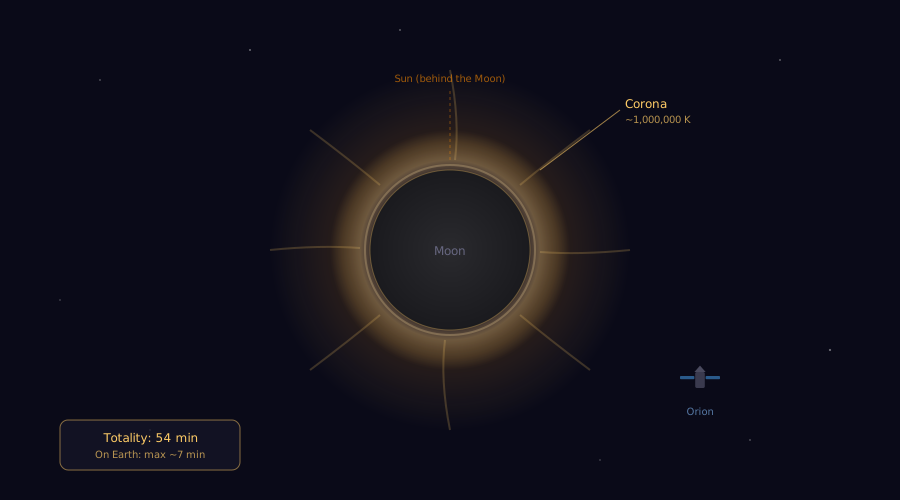
The crew documented corona structure in photos and video. Satellite-based coronagraphs can image the corona too, but they observe through Earth’s magnetic field and use occulting disks that aren’t quite as clean as a real lunar shadow. Human eyes in the loop also provide something sensors alone don’t: real-time annotation. “That streamer on the left is brighter.” “There’s a loop structure at two o’clock.” That kind of in-the-moment narration adds context that no automated system reconstructs after the fact.
Couldn’t a Robot Have Done This?
Honestly — mostly yes. The scientific data Artemis II gathered could, in large part, have been collected by an uncrewed probe. The Lunar Reconnaissance Orbiter has been mapping the Moon in high resolution since 2009. India’s Chandrayaan missions have added their own detailed coverage. Robots are already very good at this.
So why send people? There are a few reasons that actually hold up.
The first is verification. The entire point of Artemis II was to put humans inside the Orion/SLS system and prove it works — life support, navigation, communications, reentry heat shield, all of it running with a crew aboard. Simulation can only go so far. You need to fly it for real to know for real. Artemis III plans to land on the lunar surface, and you don’t attempt that without first making sure the vehicle performs with people in it.
The second is flexibility. Robots execute pre-programmed sequences well, but they’re slow to respond to surprises. A human crew can notice something unexpected and pivot immediately. The Artemis II crew reportedly turned their cameras toward terrain that wasn’t on the original observation list, simply because it looked interesting. That kind of opportunistic science is hard to pre-program.
And there’s a third reason, one that doesn’t show up in data tables.
Earthset — The View That Changes You
In December 1968, Apollo 8 astronaut Bill Anders photographed the Earth rising above the lunar horizon. That single image — Earthrise — is credited with helping spark the modern environmental movement. Seeing the planet whole and alone and fragile did something to people that no data set had managed.
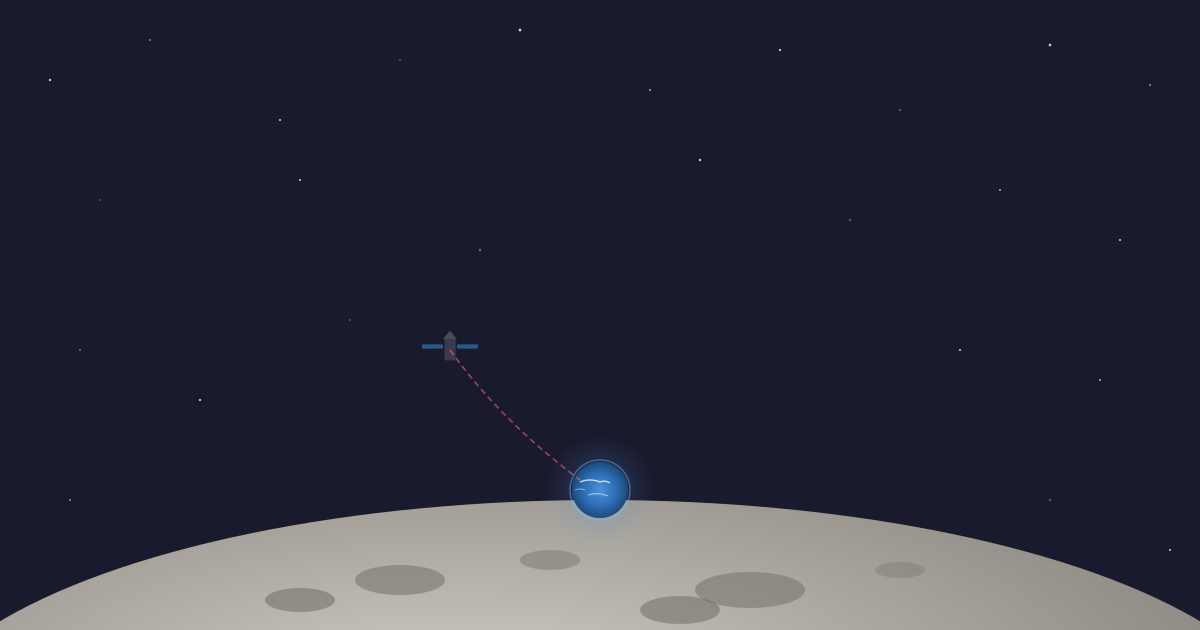
Artemis II’s crew saw the same thing. At 6:41 p.m. on April 6, Orion’s windows framed an “Earthset” — the Earth sinking below the lunar horizon. A blue-gray sphere swathed in white cloud. Small enough to cover with a thumb.
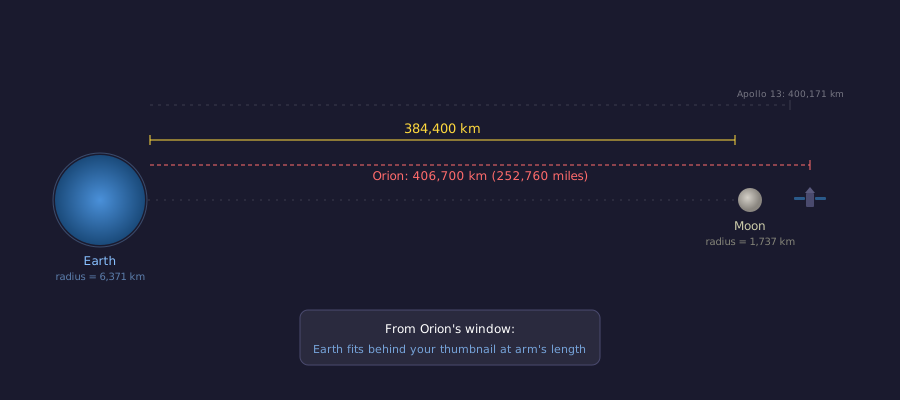
Astronauts call this the Overview Effect. It’s a well-documented cognitive and emotional shift that most people who’ve seen Earth from deep space describe in similar terms: no visible borders, the atmosphere impossibly thin, the whole of human civilization compressed into a faintly glowing ball surrounded by nothing. The scale of the emptiness hits you in a way that photographs — even very good photographs — don’t quite replicate.
Robots don’t have that experience. Their sensors record light, not significance. Part of the case for sending humans is that humans come back and talk about it, write about it, carry something home that isn’t in the data files. It’s not science exactly, but it’s not nothing either. As a motivation to keep exploring, it’s remarkably durable.
Artemis III: Next Stop, the Surface
Artemis II is scheduled to splash down in the Pacific Ocean off San Diego on April 10, wrapping up a 10-day mission. If everything checks out, Artemis III follows — and that one actually lands.
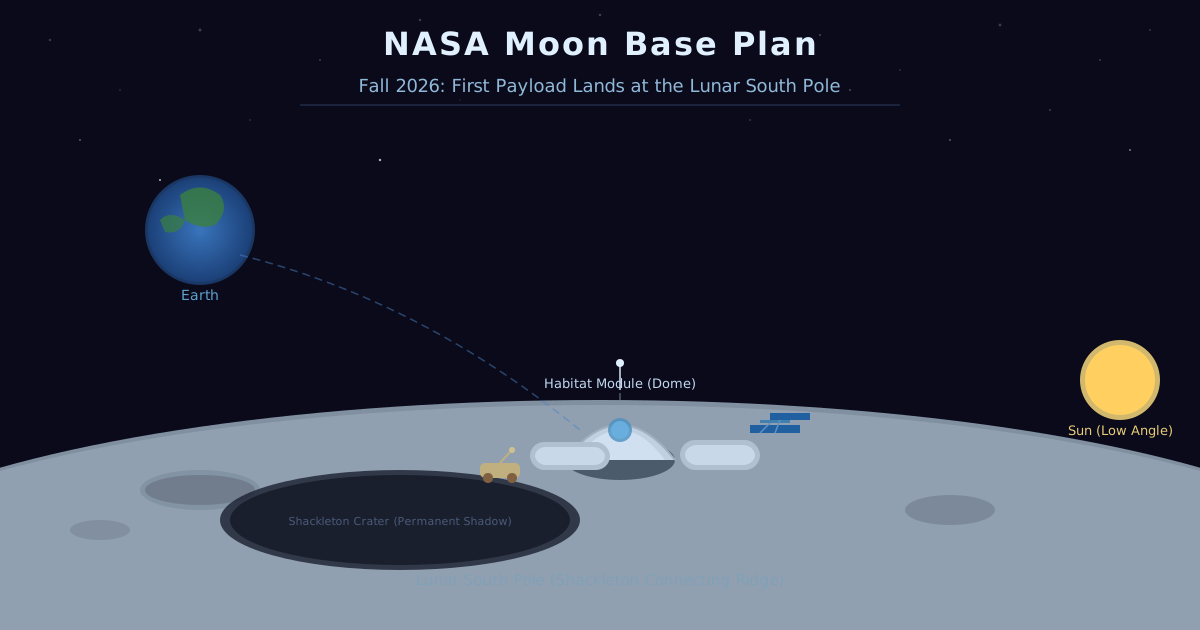
The plan calls for SpaceX’s Starship to serve as the Human Landing System. The target zone is the Moon’s south polar region, where permanently shadowed craters — crater floors that sunlight has literally never touched — are believed to hold water ice. Confirming that ice and characterizing it would be a major step toward long-duration surface operations: water for drinking, oxygen for breathing, hydrogen for rocket fuel, all potentially sourced locally.
Artemis II’s contribution to making that happen is quieter but essential. Every system that needed to work with people aboard — and all of them did — is now verified at actual lunar distance. Simulations told engineers the heat shield would hold. Artemis II showed the shield holding, with four people inside, coming home.
Fifty-two years is a long time. The institutional knowledge of how to fly people to the Moon had eroded badly. The blueprints existed, but the people who built Apollo had retired or died, and the manufacturing capacity had scattered. Artemis II is the proof that the road was rebuilt.
They went around the Moon and came home. They didn’t land. A robot probably could have matched most of the science. But four people now know from the inside what it feels like to be a quarter-million miles from everything they’ve ever known — and that turns out to be a surprisingly good reason to go back.