When people hear “send humans to the Moon,” most picture a bold surface base — habitat domes, rovers kicking up regolith, the whole scene.
But flip through NASA’s Artemis blueprints and something odd turns up: a structure placed neither on the lunar surface nor anywhere near Earth. It orbits the Moon, small and quiet, like a waystation hanging in the dark.
Its name is Gateway. Literally: a door, an entry point.
Why stop in lunar orbit before landing? Is there any real point in keeping a crewed outpost that close to the Moon? Let’s dig into the logic behind this peculiarly placed station, starting from the most basic questions.
What Gateway Actually Is
In one sentence: a very small space station in lunar orbit.
You might reach for “mini-ISS,” but that framing misses how different the two really are. Gateway, in its earliest configuration, has just two modules. Nobody lives there permanently. Crews visit in groups of four and stay for roughly thirty days — less like an apartment, more like a mountain hut.
Even so, the milestone matters. Gateway would be the first crewed outpost beyond Earth orbit, full stop. Since the ISS went up, humans have had a permanent home in space; once Gateway is in place, we will also have a temporary one near the Moon. That is not nothing.
The partnership behind it is genuinely international. NASA builds the core, while ESA (Europe), JAXA (Japan), CSA (Canada), and the UAE each contribute hardware. Think of it as the ISS’s successor in spirit, even if the two stations look and function quite differently.
Gateway and the ISS Have Completely Different Missions
The fastest way to understand Gateway is to compare it with the ISS.
The ISS floats roughly 400 km above Earth, inside the planet’s magnetic cocoon. Its whole reason for being is conducting experiments that are impossible to run on the ground — microgravity is the product, not a side effect. The ISS is not a waystation to anywhere; it is the destination itself.
Gateway is the opposite. The destination is the lunar surface; Gateway is just the connection. Spacecraft from Earth stop there, crew members switch to a lander, drop to the Moon, and come back up. The round trip reverses: climb to Gateway, switch back to the Earth-return vehicle, head home.
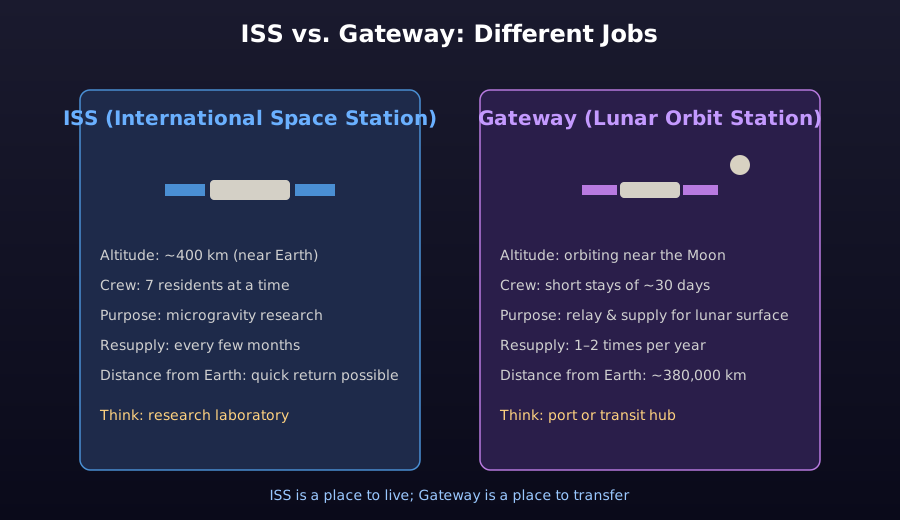
A useful analogy: the ISS is a research station anchored offshore. Gateway is a harbor. Both float, but one is there to be used; the other is there to let you get somewhere.
That difference in purpose explains why Gateway skips the ISS’s sprawling experiment racks. Instead, it carries docking ports for landers, cold storage for lunar samples, and antennas capable of reaching the Moon’s far side — infrastructure for moving people and things, not for running long-term science.
Why Orbit the Moon Instead of Landing on It?
This is probably the most natural objection: if you’re going to the Moon anyway, why not just build a base on the surface?
A permanent lunar surface base is a long-term goal, and it does exist in NASA’s plans. But the Moon’s surface turns out to be a hostile place in ways that are easy to underestimate.
Day and night each last about two weeks. The dayside broils past 120 °C; the nightside plunges to −170 °C. Keeping a structure insulated and powered through that cycle is genuinely hard. And lunar regolith — the dusty top layer of the surface — is jagged at the microscopic scale, roughly like shards of glass. It damages machinery and, if inhaled, would damage lungs.
Lunar orbit sidesteps most of those problems. It is a vacuum, but thermal management is far more tractable when you can design the orbit to optimize sun exposure. No regolith. And from the right orbit, you can look down on the whole Moon and reach virtually any landing site.
That last point carries more weight than it might seem. If you park a station in orbit, you don’t have to rebuild your base every time you want to land somewhere new. The south pole this mission, the equatorial highlands the next — Gateway stays put while the landing zone shifts. A fixed surface base can only serve its immediate neighborhood.
Gateway, in short, is what makes the whole lunar program flexible rather than locked to a single spot.
NRHO — The Orbit That Cheats
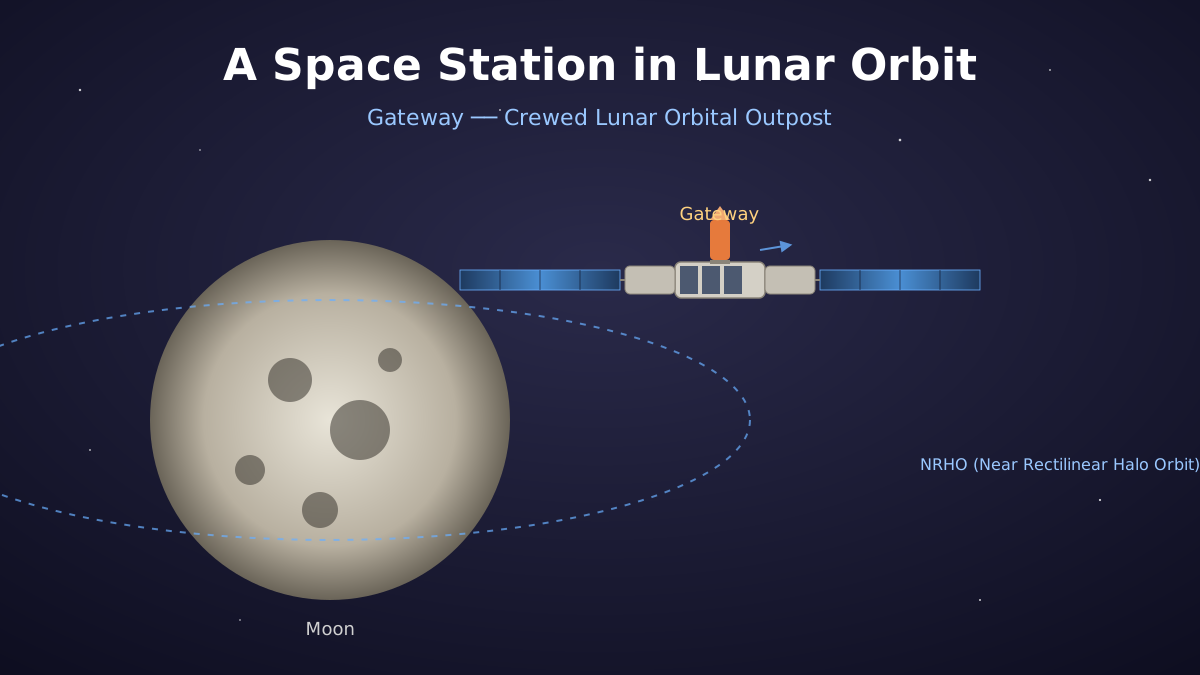
The specific orbit Gateway will use has an unwieldy name: NRHO, or Near Rectilinear Halo Orbit. Translated into plain English, it means something like “a halo orbit that is nearly a straight line.” That still sounds strange, so let’s picture it.
Most orbits around a planet or moon are roughly circular or gently elliptical. NRHO is neither — it is an extreme elongated loop. At its closest pass to the Moon (perilune), Gateway sits about 3,000 km out. At its farthest (apolune), it swings out to roughly 70,000 km. The altitude varies by a factor of more than 20, like a rollercoaster that barely grazes the treetops before looping out to near-stratosphere height.
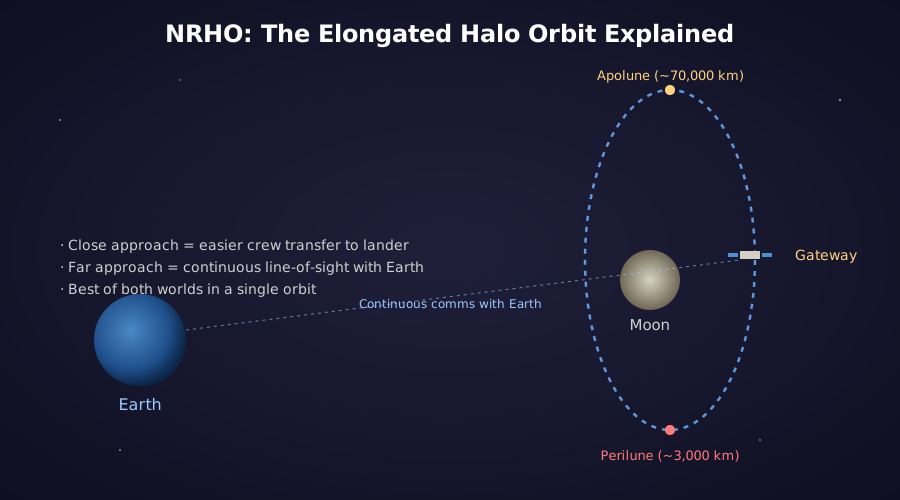
Two things make this shape worth the weirdness.
First, Gateway never disappears behind the Moon from Earth’s perspective. The loop swings so far above and below the lunar poles that the station is almost never fully blocked from Earth’s line of sight. Communication is a lifeline for crewed spacecraft — losing it for even a few minutes can become a crisis — so this near-constant visibility matters enormously.
Second, the orbit is nearly free to maintain. NRHO sits at a gravitational sweet spot where Earth’s and the Moon’s gravity pull against each other in just the right way. Keeping Gateway on course demands only a few tens of kilograms of propellant per year. For a station that will be there indefinitely, that is an extraordinary saving.
Close enough to the Moon to matter, far enough to stay in contact with Earth, cheap to keep in place. NRHO threads a needle that a conventional orbit cannot.
Building Gateway Piece by Piece
Gateway does not arrive complete. It goes up in sections over several years, assembled in orbit as each module docks.
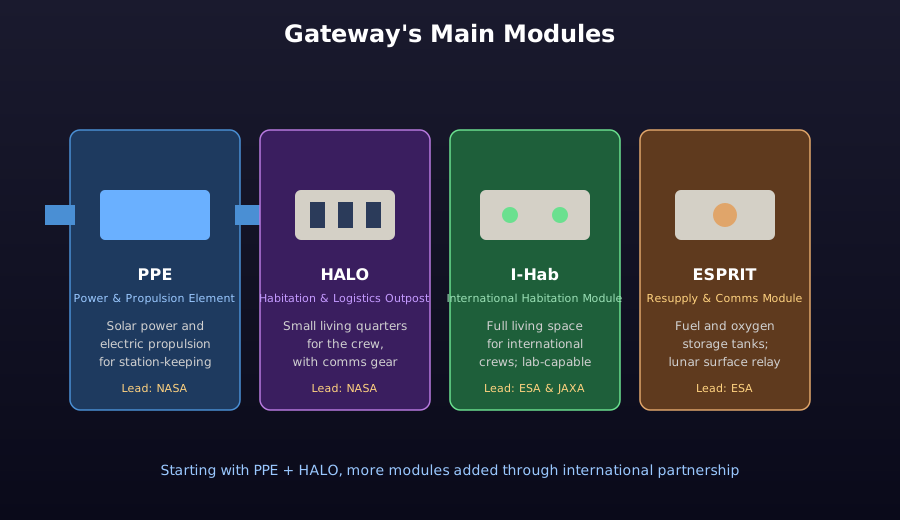
The first two pieces to launch are the PPE (Power and Propulsion Element) and HALO (Habitation and Logistics Outpost). Together they provide electricity, attitude control, and just enough room for four people to live for a month. This pairing is the skeleton of everything that follows.
Next comes I-Hab, the International Habitation Module, built jointly by ESA and JAXA. I-Hab is what makes Gateway a true multi-agency outpost rather than a NASA-only station. Japan’s contribution is substantive: JAXA is responsible for the environmental control and life-support systems at I-Hab’s core — the same expertise the agency developed for the Kibo module aboard the ISS.
Finally, ESPRIT (the European System Providing Refueling, Infrastructure, and Telecommunications) joins the stack. ESA leads this module, which carries propellant and oxygen tanks along with communications relay for the lunar surface.
The full four-module configuration is expected in the early 2030s, but the design is intentionally staged: even just the PPE and HALO together are enough to support the Artemis crewed lunar landings. It is built to grow.
The Bigger Picture: A Rehearsal for Mars
Spend enough time with Gateway’s documentation and a pattern becomes clear — the Moon is not the only destination in mind.
The Moon is roughly 380,000 km away, which feels distant until you compare it with Mars at closest approach: about 55 million kilometers. But even on the Moon, the environment around Gateway is radically harsher than Earth orbit. The planet’s magnetic field, which shields ISS from much of the solar radiation, offers almost no protection that far out. Cosmic rays and solar particle events hit harder.
NASA and JAXA both treat Gateway as a training ground for Mars. Long-duration exposure beyond the magnetosphere, component degradation in deep-space conditions, operating with limited resupply — these are things you cannot fully simulate on the ground or test in low Earth orbit. You have to actually do them.
The Moon lets you try. Mars does not forgive early mistakes: the journey takes more than six months one way, and crews cannot come home for at least two years. Going to Mars before proving out your hardware and protocols near the Moon would be reckless. Gateway is the proving ground.
A small station, a strange orbit, module names that most people have never heard. None of it is particularly cinematic. But taken together, they sketch a route that humanity is actually following — a map that leads, eventually, a very long way from here.
Somewhere near the Moon, a single station is being assembled, a piece at a time. The day when someone stops there on the way to the surface, and you can watch it happen, is closer than it has ever been.