The emptiest patch of space you can imagine turns out to be prime real estate.
If you’ve heard of JWST — the James Webb Space Telescope — you probably know it’s not hanging around close to Earth like Hubble does. It’s sitting about 1.5 million kilometers away, in what looks like a whole lot of nothing. That’s four times the distance to the Moon. You’d be forgiven for wondering: why go all the way out there?
I had the same question when I first looked into it. But that “empty” location has a name, and the name tells you everything: Lagrange point L2 — one of the solar system’s most coveted parking spots.
Space as a Parking Lot
When people talk about satellites, they usually talk about orbits — circular or elliptical paths that loop endlessly around Earth. GPS satellites, weather satellites, the ISS: they’re all on some kind of orbit, always moving.
Spacecraft at Lagrange points are different. Technically, they do move — slowly drifting around the Sun — but in practice they stay fixed relative to both the Sun and Earth. They make one full lap around the Sun every 12 months, exactly in sync with Earth. They don’t crash into anything, and they don’t drift away. Like a car in a parking space.
The mathematician who figured this out was Joseph-Louis Lagrange, working in the 18th century. He showed that when you have two large gravitating bodies — say, the Sun and Earth — there are exactly five points where a third, much smaller object can sit in a stable-ish balance. The math accounts for both gravity and centrifugal force. He called them L1 through L5.
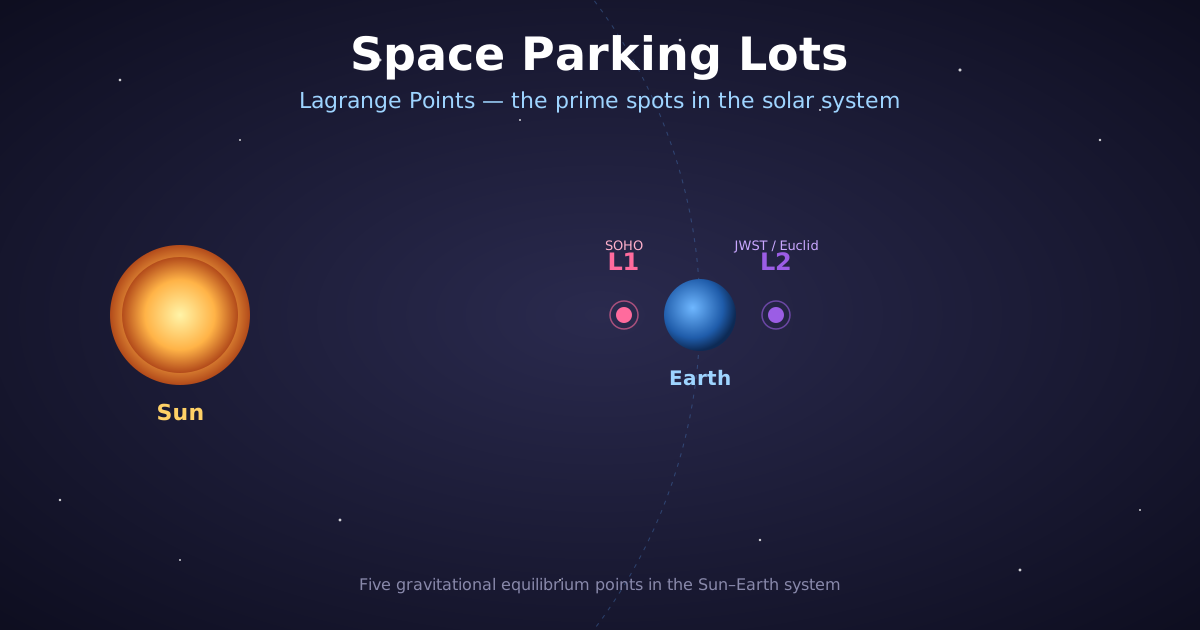
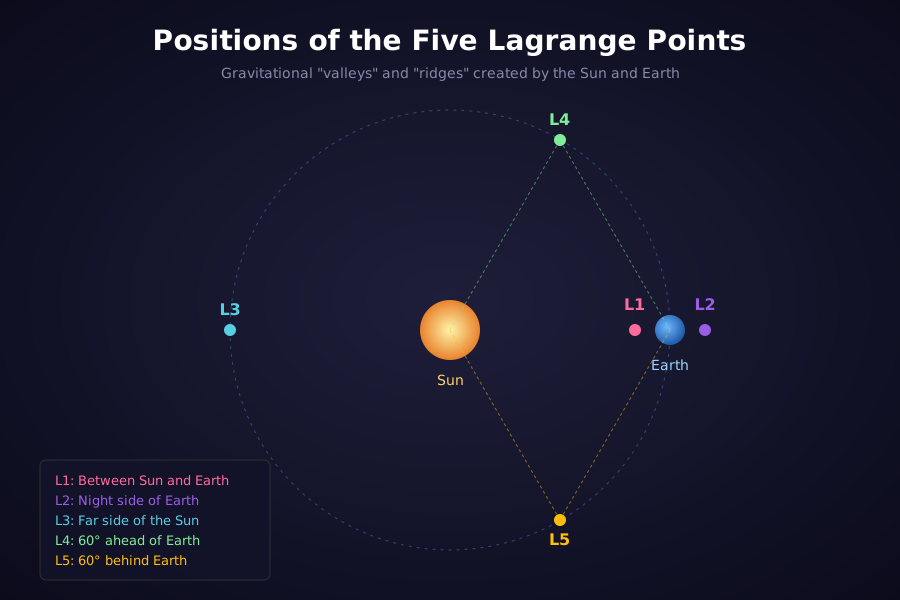
The diagram below shows where they fall.
L1 and L2: Two Very Different Views
Of the five Lagrange points, L1 and L2 see the most use. Both sit about 1.5 million kilometers from Earth, on the line connecting Earth and the Sun — L1 on the sunward side, L2 on the opposite side. Earth sits in the middle, with a parking spot on each flank.
What makes them useful is how different their perspectives are.
L1 has an unobstructed, permanent view of the Sun. Earth never gets in the way. That makes it ideal for solar observation — SOHO (the Solar and Heliospheric Observatory) has been there since 1995, along with DSCOVR, both watching for solar flares and solar wind gusts before they reach Earth. Think of them as a 24/7 weather station for space weather.
L2 faces away from the Sun entirely. From there, the Sun, Earth, and Moon are all tucked behind the spacecraft — and that’s exactly what you want if you’re an infrared telescope. JWST needs to stay cold to detect the faint infrared light from the earliest galaxies. Any warmth from the Sun or Earth would drown out the signal. L2 lets it keep its back to all three heat sources at once.
JWST isn’t alone out there. Euclid, the European Space Agency’s dark-energy mission launched in 2023, shares the neighborhood. So does Gaia, which is patiently mapping the positions of a billion stars in our galaxy. L2 is becoming something of a telescope village.
Why Exactly Five?
It’s a fair question: why five balance points? Why not one, or two?
The short answer: rotation complicates things.
If Earth and Sun were just sitting still in space, the only place where their gravity perfectly cancels would be a single point along the line between them. But the Earth orbits the Sun, and when you analyze forces from a rotating frame of reference, a fictional outward push called centrifugal force enters the picture.
Add centrifugal force to the gravitational tug-of-war, and you get five balance points rather than one: three along the Sun–Earth line (L1, L2, L3), and two more sitting on Earth’s orbital path — one 60° ahead and one 60° behind (L4 and L5). The math works out this way, and it checks out every time.
L4 and L5 are the geometrically elegant ones. They form the apex of equilateral triangles with the Sun and Earth at the other two corners. Sixty degrees, exactly.
Not All Parking Spots Are Equal
Here’s where it gets interesting. Five Lagrange points exist, but they don’t behave the same way.
L1, L2, and L3 are mathematically balanced — but they’re like a ball balanced on top of a hill. A small nudge and it rolls off. Spacecraft stationed there don’t stay on their own; they need periodic thruster burns to keep themselves from drifting. Engineers call this “station-keeping.”
L4 and L5 are the opposite: they’re like the bottom of a bowl. Push something away from center, and the combined forces gently guide it back. Stable, naturally.
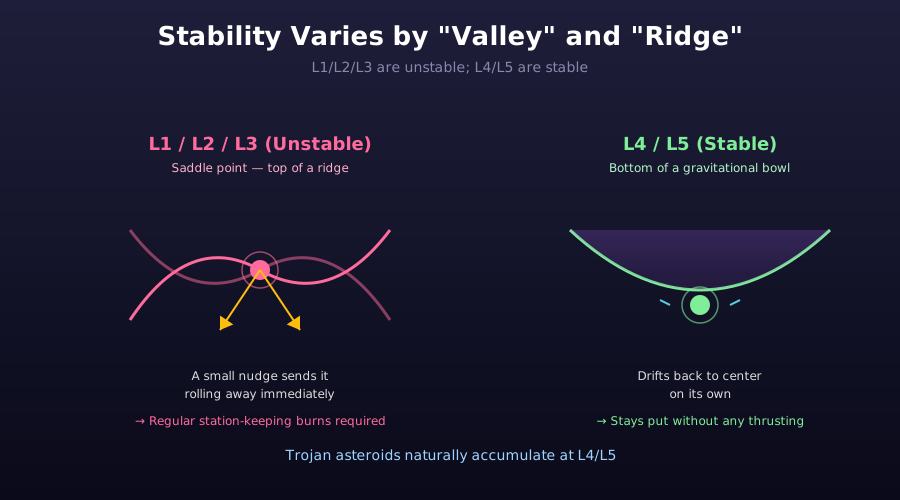
Nature is honest about this. The stable L4 and L5 points in Jupiter’s orbit have accumulated thousands of asteroids over the 4.6-billion-year life of the solar system. They’re called the Trojan asteroids, named after figures from Greek mythology. Rocks drifted in and simply never left.
The telescopes at L1 and L2, by contrast, need to keep firing their thrusters. When the fuel runs out, the game is over. JWST’s operational life of “around 20 years” isn’t about the hardware wearing out — it’s about the fuel. Once the tank is empty, the spacecraft can no longer hold its spot. Think of it less like a machine failing and more like a parking meter running out.
What It’s Actually Like Out There
Here’s a tour of who’s parked where.
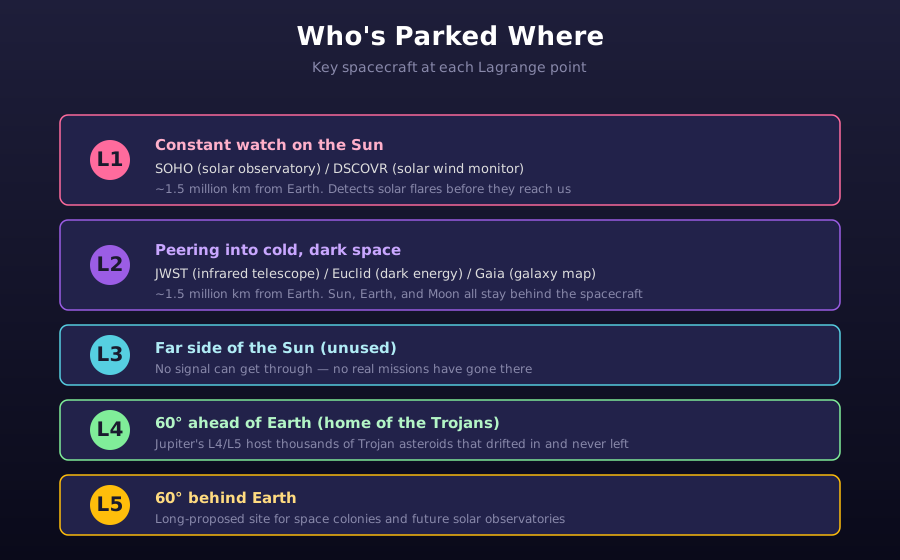
SOHO at L1 is one of the longest-running missions in space history. Launched in 1995, it has been staring at the Sun for more than three decades. As a bonus, citizen scientists poring over its imagery have spotted over 6,000 comets drifting through the field of view — a completely unintended discovery.
JWST at L2 launched in late 2021 and took 30 days to reach its destination. One-and-a-half million kilometers sounds manageable until you do the math: driving at 100 km/h, the trip would take over 170 years. From that perch, it has already returned images of galaxies from when the universe was less than a billion years old.
L3 sits directly behind the Sun from Earth’s perspective, permanently hidden. Radio signals can’t get through, so no spacecraft has ever been sent there. It does show up regularly in science fiction, though — the classic “Planet X lurking on the other side of the Sun.” Observations from the Helios probes in the 1970s, and plenty of modern data, have confirmed there’s nothing there.
L4 and L5 remain largely unexplored by human spacecraft, though NASA’s STEREO probes passed through the region. The concept of building a space settlement at L5 has been circulating since the 1970s — physicist Gerard O’Neill popularized it, and it still comes up in long-range planning discussions. No construction crews yet, but it’s arguably the location with the highest long-term potential.
More Than Just a Parking Lot
Stepping back, there’s something quietly remarkable about all of this.
When Lagrange worked out his equations in the 18th century, putting physical objects in space wasn’t even a theoretical possibility, let alone a practical one. He was solving a pure math problem — how do forces balance when three bodies interact? — and out fell these five locations as a consequence. He couldn’t have imagined that 250 years later, humanity would actually go and park telescopes there.
And yet, that’s exactly what happened. JWST’s stunning images of galaxies 13 billion light-years away are being captured from a location that existed first as a line in a notebook. Math predicted a sweet spot, engineers built a machine capable of reaching it, and now we’re using it to look back almost to the beginning of time.
Physics can be unexpectedly poetic.
One footnote worth adding: not everything goes to L1 or L2. Japan and ESA are collaborating on SMILE — a mission to study the interaction between the solar wind and Earth’s magnetosphere — but it’s using a highly elliptical orbit rather than a Lagrange point. The right spot depends on the mission. The universe has more than one good address.
Next time you see a JWST image, remember: that photograph was taken from what was, until the Space Age, just a mathematical abstraction. Someone did the calculus, and then someone else built a spacecraft and sent it there.