The solar system, it turns out, is not a closed house.
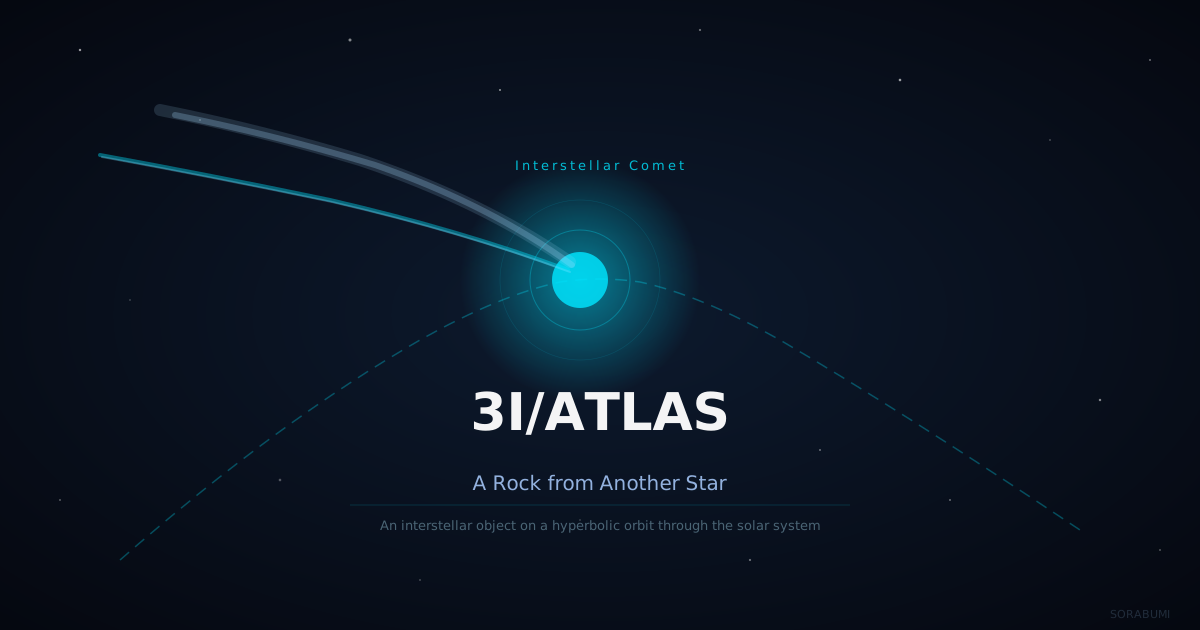
In 2025, the ATLAS survey caught a faint moving dot in the southern sky. As the orbital calculations came in, astronomers went quietly electric. The trajectory wasn’t an ellipse. It was a hyperbola. That meant this object isn’t gravitationally bound to the Sun — it was born around some distant star, spent an almost incomprehensible span of time in transit, and has now arrived here as a stranger from somewhere else entirely.
This is the story of 3I/ATLAS, the third interstellar object humanity has ever detected.
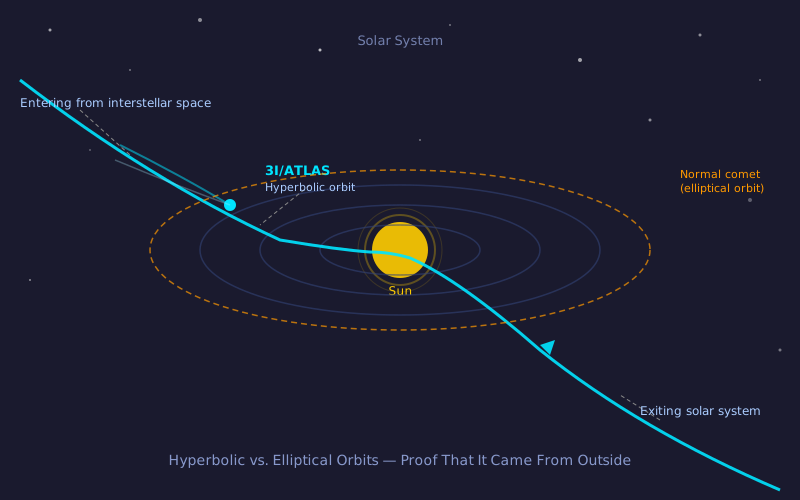
What Does “From Outside the Solar System” Actually Mean?
Nearly everything in the solar system formed together when the Sun ignited 4.6 billion years ago. Comets, asteroids — all of them trace their origins back to the same protoplanetary disk, the swirling cloud of gas and dust that gave birth to our entire neighborhood. So as a rule, those objects travel in elliptical orbits around the Sun, looping back around again and again.
Interstellar objects are different.
Run the orbital math and you get a hyperbola centered on the Sun. The object isn’t captured by our gravity — it just passes through. It plunges in from one direction, swings closest to the Sun, and then curves away in a completely different direction. One encounter, no return.
Its origin is another star system. When planets and comets form around other stars, the leftovers sometimes get flung outward, drifting through the galaxy indefinitely. Statistically, the Milky Way should be full of these wanderers; 3I/ATLAS is simply one that happened to pass close enough for us to see it.
“Close enough,” granted — but humanity has only managed to observe three of them, ever.
The Moment of Discovery — What Stopped the Observers Cold
ATLAS stands for Asteroid Terrestrial-impact Last Alert System. It’s a network of survey telescopes in Hawaii, South Africa, and Chile that scans wide swaths of sky each night, hunting automatically for moving objects that might pose a threat to Earth.
During 2025 observations, one object behaved unexpectedly. It was fast. Too fast, in fact, to be explained by anything native to the solar system. At its distance from the Sun, its velocity was conspicuously out of range. The only way to account for numbers like that is if the object came from outside.
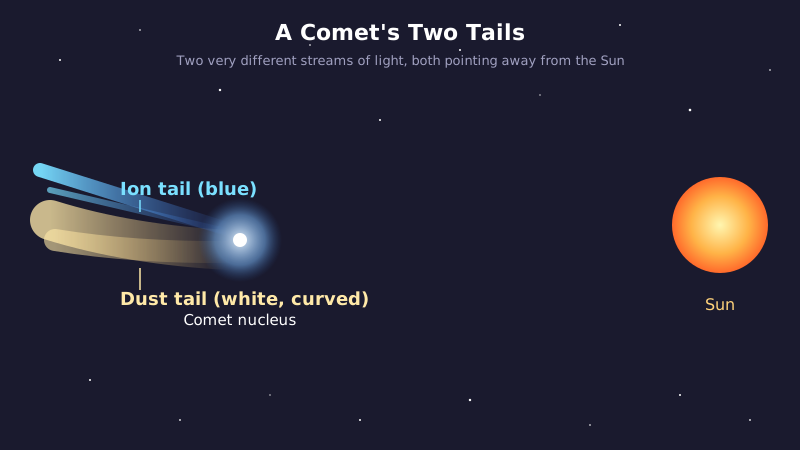
Then a second surprise arrived as the orbit locked in: there was a coma — the bright cloud of gas and dust that envelops an active comet nucleus. ʻOumuamua, by contrast, had no coma at all; it was famous for its bizarre elongated shape and an unexplained acceleration that still hasn’t been fully explained. 3I/ATLAS has a clear, well-behaved coma. In other words, it acts like a comet is supposed to act.
Within weeks of discovery, both ESA and NASA had mobilized their observing resources. The speed of that response owes a lot to the bitter lessons learned from ʻOumuamua.
The Orbit Tells the Whole Story — A Hyperbola as Proof
The shape of an orbit is encoded in a single number called eccentricity. A perfect circle is 0. An ellipse falls between 0 and 1. A parabola is exactly 1. Exceed 1 and you have a hyperbola. Most solar system comets sit just below 1, or very close to it.
3I/ATLAS has an estimated eccentricity above 6. That’s an extraordinary number. Compare it to 2I/Borisov at roughly 3.36 and ʻOumuamua at roughly 1.20, and it becomes clear that 3I/ATLAS arrived carrying far more excess velocity than either predecessor — so much that the Sun’s gravity barely registers as a detour.
In velocity terms, the object’s speed far from the Sun exceeds 30 km/s. Earth orbits the Sun at about 30 km/s, so 3I/ATLAS arrived with more than that as pure surplus on top of any solar gravity effect. That number is the smoking gun for its interstellar origin.
Trace the orbit backward and you can identify the direction it came from. The work of narrowing down which specific star system it departed — using the precise mathematics of orbital mechanics — is still ongoing. If a match is found, 3I/ATLAS will have a named hometown.
How It Compares to the Other Two
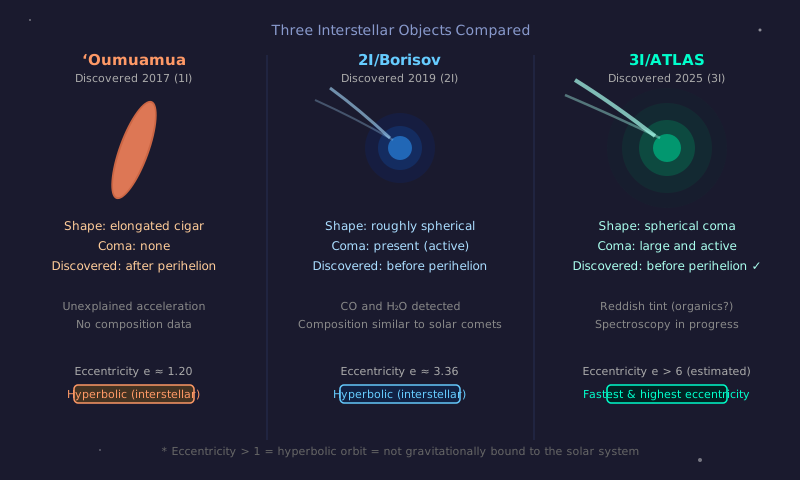
ʻOumuamua (1I/ʻOumuamua), discovered in 2017, was the first interstellar object ever confirmed. Its elongated, blade-like shape drew immediate attention, and the absence of any coma or tail was strange. Stranger still: after its closest approach to the Sun, it accelerated faster than gravity alone could explain. The cause of that acceleration remains genuinely unsettled, which is partly why the “alien artifact” speculation got so much airtime. It remains a mystery.
2I/Borisov, spotted in 2019, looked much more like a conventional comet. It had both a coma and a tail. Carbon monoxide (CO) and water (H₂O) were detected in its spectrum. Its composition turned out to be strikingly similar to solar system comets — strong evidence that analogous planet-forming processes play out around other stars.
3I/ATLAS, at least so far, resembles 2I/Borisov in being a “comet-type” object. But its dramatically higher eccentricity suggests it was ejected from its home system with considerably more violence than Borisov was. Its spectrum also shows a reddish tint, possibly pointing to organic compounds — carbon-bearing molecules — in its makeup.
The biggest practical difference, though, is timing. ʻOumuamua was found after perihelion — after it had already made its closest pass to the Sun — which left only a narrow window for follow-up observations. 3I/ATLAS was caught on the inbound leg, before closest approach. That means astronomers can watch it evolve in real time as it heats up and brightens. For researchers, this is the opportunity ʻOumuamua denied them.
Why ESA and NASA Moved So Fast
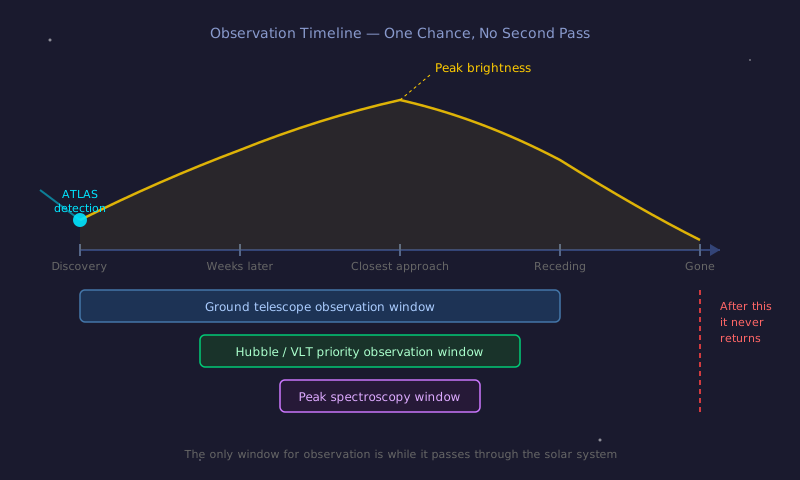
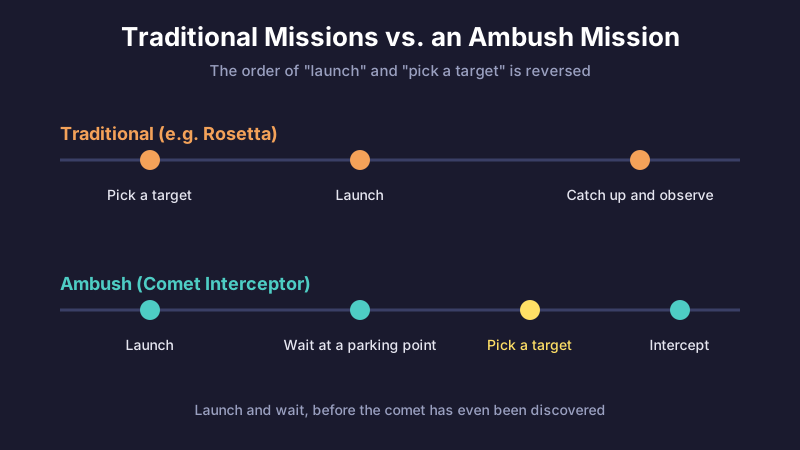
“You won’t get a second chance” is a phrase astronomers use often. With interstellar objects, it’s literally true. This thing will cross the solar system and keep going, and with current spacecraft technology, chasing it is essentially impossible.
ESA coordinated observation time on facilities including the Very Large Telescope (VLT). NASA slotted 3I/ATLAS into the schedules of both the Hubble Space Telescope and the James Webb Space Telescope (JWST).
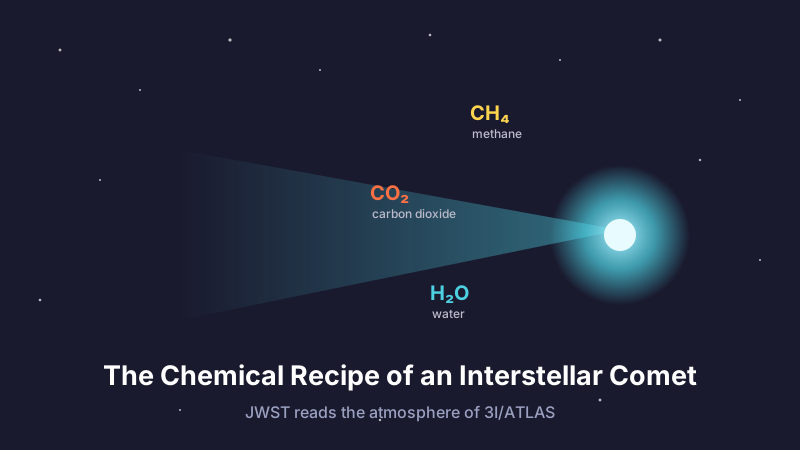
The urgency comes down to spectroscopy — the technique of splitting light into its component wavelengths to identify which molecules are present. As the comet approaches the Sun, it becomes more active: the coma expands, and the spectral signal grows stronger. But once it starts pulling away, it fades fast, and the window closes. The months around closest approach are when it counts.
A good spectrum would reveal which molecules are present — water, carbon monoxide, organic compounds, what kind of rocky material. That information is essentially a chemical logbook from whatever star system 3I/ATLAS was born in.
After It Leaves — What the Data Will Do
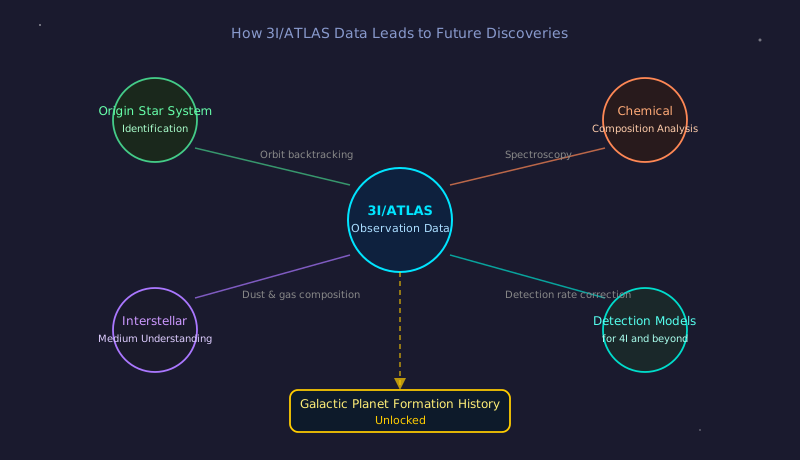
Eventually 3I/ATLAS will dim past the reach of any telescope, and that will be that for direct observation. But the work doesn’t end there.
Orbital back-tracing will continue as researchers narrow down which star system the comet came from. If its trajectory lines up with a known star, astronomers can use that star’s age and its planet-formation timeline to reconstruct what kind of environment 3I/ATLAS was born in.
The chemical composition data will tell us something about the chemical history of matter drifting through interstellar space. Compared against what we know of solar system comets, it becomes a data point for asking how universal the planet-forming process really is.
There’s also a practical statistical payoff. With three examples — 1I, 2I, 3I — we finally have enough to begin estimating how many interstellar objects are passing through the galaxy at any given moment. That will help build observation models designed to catch the next one — 4I, or whatever it turns out to be — sooner and in better position.
When the Vera C. Rubin Observatory reaches full operation, the detection rate is expected to climb significantly. The trail 3I/ATLAS carved through our sky is the first few pages of a catalog that will grow for decades.
Humanity is slowly learning to read the letters that arrive from across the galaxy — one stranger at a time.