Have you ever really looked at a photograph of a comet?
That long, hazy band of light sweeping across the sky. In cartoons and animations it’s usually drawn as a single clean line — a “whoosh” mark behind a speeding rock. But real comets are a bit more complicated than that. Look closely at a properly shot image, and you’ll see two tails, not one. They point in different directions, they’re different colors, and they have a completely different texture.
Why two? Why do they diverge? The answer lies in some genuinely interesting physics happening between the Sun and the comet’s nucleus. I remember the first time I learned this — it was one of those “oh, that’s why those old photos looked that way” moments.
Let me walk you through it.
What Is a Comet Made Of?
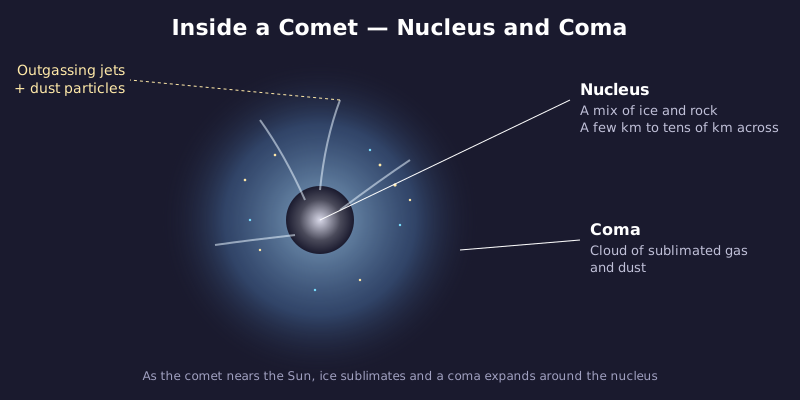
Start with the comet itself. Comets live on the outer edges of the solar system — farther out than Pluto, in the deep cold. Most of them are best described as “dirty snowballs”: lumpy mixtures of ice, rock, and dust. They range from a few kilometers to a few tens of kilometers across. Think mountain-sized.
Every few decades, centuries, or sometimes millennia, some of these objects get nudged onto new trajectories and begin falling toward the Sun. As they close the distance, sunlight starts warming them. The ice begins to change.
More precisely, it doesn’t melt so much as sublimate — turning directly from solid to gas without passing through a liquid phase, because space is effectively a vacuum. It’s like watching dry ice smoke on a table, but at a vastly larger scale.
The closer a comet gets to the Sun, the more intense the sublimation becomes. Water ice doesn’t kick into high gear until the comet is within roughly 3 astronomical units (three times the Earth-Sun distance). But carbon monoxide and carbon dioxide ices start sublimating much farther out, which is why comets can already show signs of activity even beyond Earth’s orbit.
As gas escapes, it carries dust grains with it — particles that were locked inside the ice. These spread out around the nucleus into a diffuse, glowing cloud called the coma. That’s the fuzzy “head” you see in comet photos.
So far, so familiar. The interesting part is what happens next: how do that gas and dust become a tail?
Two Very Different Types of Material
The stuff released from the coma falls into two broad categories.
First, dust: tiny particles of rocky material, ranging in size from something like cigarette smoke to a grain of sand. Second, gas molecules — water, carbon monoxide, carbon dioxide — which the Sun’s ultraviolet radiation ionizes into positively charged particles.
These two types of material behave completely differently. They have different masses. They respond to different forces. So even though they start at the same place, they end up being pushed in different directions by the Sun.
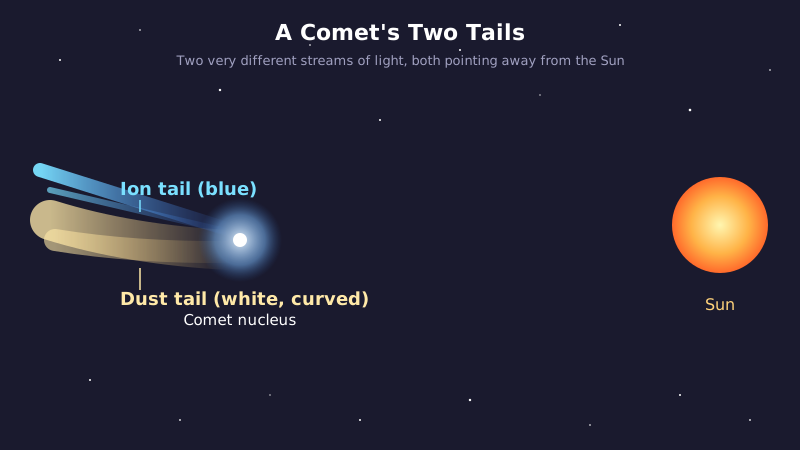
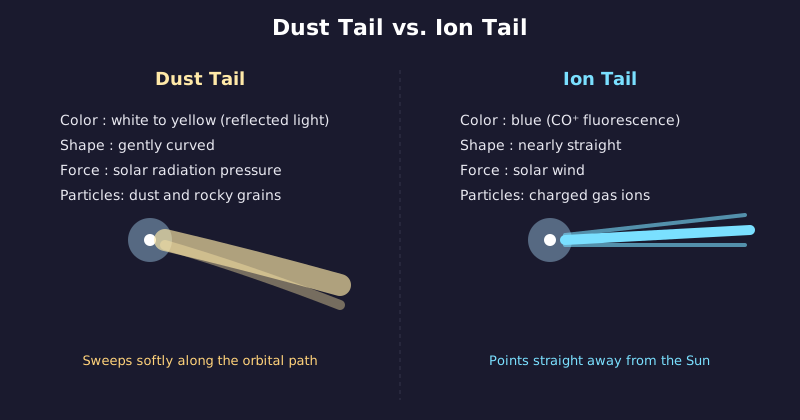
- The white, gently curved tail is the dust tail (also called the Type II tail).
- The blue, nearly straight tail is the ion tail (Type I, or plasma tail).
Together they form a wide V-shape spreading away from the comet’s nucleus. Once you know what to look for, you can spot them immediately in any good photograph.
The Dust Tail Is Pushed by Light
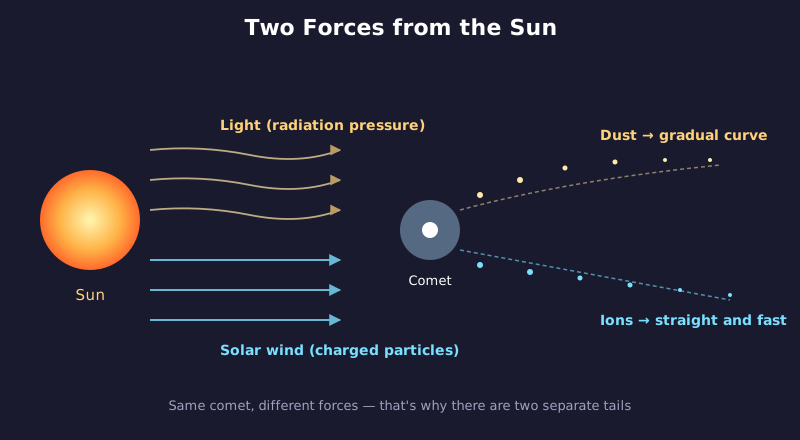
Here’s where it gets good. The force pushing the dust tail is light itself.
Light carries momentum. When photons stream out from the Sun and strike a physical object, they exert a tiny pressure — called radiation pressure or light pressure. In everyday life you’d never feel it. But in the vacuum of space, when your target is a particle barely larger than a smoke grain, the math starts to matter.
Dust particles are small and light. They also have a relatively large surface area compared to their mass, so radiation pressure can get a grip on them. Over time, they’re nudged — slowly but steadily — in the direction away from the Sun.
There’s a complication, though. Each dust particle was already moving when it left the nucleus, carried along by the comet’s orbital momentum. So the radiation pressure doesn’t just push them straight back; it gently brakes and curves their path.
The result is a dust tail that sweeps outward along the comet’s orbital track — wide, diffuse, gently arced. Its color is the natural color of reflected sunlight: white, or faintly yellow.
As for scale: under good conditions, a dust tail can stretch tens of millions of kilometers through space. Earth sits about 150 million kilometers from the Sun, so we’re talking about a ribbon that’s a significant fraction of that distance. It looks serene in photographs. When you actually think about the size, it’s a little startling.
The Ion Tail Is Pushed by the Solar Wind
The ion tail is driven by something else entirely: the solar wind.
The solar wind is a continuous stream of electrically charged particles — electrons and protons mostly — blowing outward from the Sun at 400 to 600 kilometers per second. These are the same particles that slam into Earth’s magnetic field and produce the aurora. They’re fast, and they’re everywhere in the inner solar system.
When they hit the comet’s ions — particles that are also electrically charged — the interaction is electromagnetic rather than mechanical. There’s no gentle nudge here. The ions get swept away from the Sun almost instantly, in a direction essentially opposite to it.
Because the solar wind blows in a fairly constant direction, the ion tail doesn’t curve along the comet’s orbit. It ignores the orbit entirely. It just points straight away from the Sun, wherever the comet happens to be moving.
Its color is blue. That comes from carbon monoxide ions (CO⁺) absorbing solar radiation and re-emitting it as blue fluorescence. That electric blue streak you see in long-exposure comet photos — that’s the ion tail.
When the Solar Wind Hiccups, the Tail Snaps
The ion tail has one more trick. Because it’s driven by the solar wind, it responds when the wind changes.
The Sun’s surface isn’t calm. Solar flares and coronal mass ejections (CMEs) periodically hurl large bursts of particles outward. When one of these gusts hits a comet’s ion tail, the tail can actually detach — breaking off and drifting away while a new one forms behind it. This is called a disconnection event, and it’s been photographed multiple times by the Hubble Space Telescope and ground-based observatories.
Because of this sensitivity, comets sometimes serve as natural probes of the solar wind. Watching a comet’s ion tail can tell you something about the state of the wind before it reaches Earth — a kind of upstream weather report.
The dust tail doesn’t do any of this. Radiation pressure doesn’t care about CMEs, and dust particles aren’t electrically charged, so the solar wind barely touches them. That contrast — one tail stable, one tail volatile — is itself evidence that the two tails are physically distinct phenomena.
The Tail Always Points Away from the Sun
One thing worth taking away from all of this:
A comet’s tail does not trail behind it in the direction it came from. A lot of people picture comets the way they imagine shooting stars — something blazing forward with the tail streaming back like hair in the wind.
That’s not how it works. No matter which direction a comet is moving, both tails point away from the Sun, because that’s the direction the Sun is pushing them. Always.
This leads to a genuinely odd-looking situation. When a comet has rounded the Sun and is heading back outward into the solar system, its tails are actually pointing forward — in the direction of travel. The comet is, in effect, chasing its own tail. It looks bizarre the first time you picture it.
Next time you see a photograph of a comet, take a moment to orient yourself. Where is the Sun relative to the image? Which way do the tails point? If both tails are visible, notice how the white one sweeps in a gentle curve — tracing the comet’s path — while the blue one cuts straight as an arrow. Same nucleus, same gas and dust, but two completely different forces pulling them apart.
Sometimes physics writes itself onto the sky in a form you can actually see. That’s one of the things I find most satisfying about this stuff.