Every May, just before sunrise, streaks of light cross the sky. It looks almost routine — but what you’re actually watching is debris from a comet that humans have been tracking for thousands of years.
The Eta Aquariid meteor shower peaks around May 4–6. From Japan and other Northern Hemisphere locations, you might see 20–40 meteors per hour. From Australia or New Zealand in the Southern Hemisphere, that number jumps to 50–80 or more. How can the same meteor shower look so different depending on where you stand? And what exactly is that streak of light in the first place?
The Eta Aquariids Come From Halley’s Comet
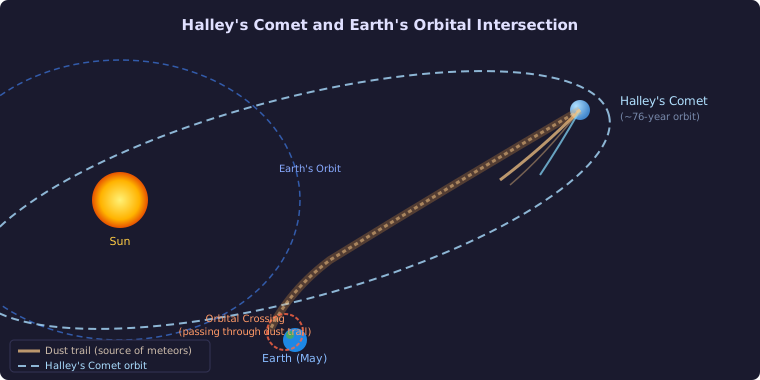
Every meteor shower has a parent body — a comet or asteroid whose debris Earth runs into each year. For the Eta Aquariids, that parent is Halley’s Comet.
Halley’s Comet orbits the Sun roughly every 76 years. It last swung through the inner solar system in 1986; the next visit is expected around 2061. Each time it passes close to the Sun, heat vaporizes the ice on its surface, releasing enormous amounts of dust and gas. That’s the famous tail you see in photographs. But the dust doesn’t disappear — it stays behind, spread along the comet’s orbital path.
Over millennia, this dusty trail has grown thick. Earth crosses it twice a year. The May crossing gives us the Eta Aquariids; the October crossing gives us the Orionids. Both are gifts from the same comet, two chances a year to watch ancient debris light up the sky.
Meteors Don’t Burn — They Vaporize
The phrase “meteors burning up in the atmosphere” is close but not quite right. What’s actually happening is more dramatic: the particles turn into glowing plasma.
Comet dust ranges from about 0.1 mm to a few centimeters across. When an Eta Aquariid particle hits Earth’s atmosphere, it’s traveling at roughly 66 km/s — about 240,000 km/h, or nearly 900 times the speed of a bullet train. At that velocity, collisions with air molecules generate a shock wave that heats the particle’s surface to several thousand degrees almost instantly. The surface vaporizes, and both the particle material and surrounding air molecules become ionized. As those ions drop back to a lower energy state, they release the excess energy as light. That’s your meteor.
The glow happens at altitudes of roughly 80 to 120 km, in the mesosphere and lower thermosphere — far above where aircraft fly. The color of the streak depends on what the particle is made of: magnesium burns blue-white, calcium glows orange, and sodium produces yellow. A single meteor can show several colors at once if the composition is varied.

Why the Southern Hemisphere Gets the Better Show
One of the Eta Aquariids’ most distinctive traits is how much better they look from south of the equator. This comes down to the position of the radiant.
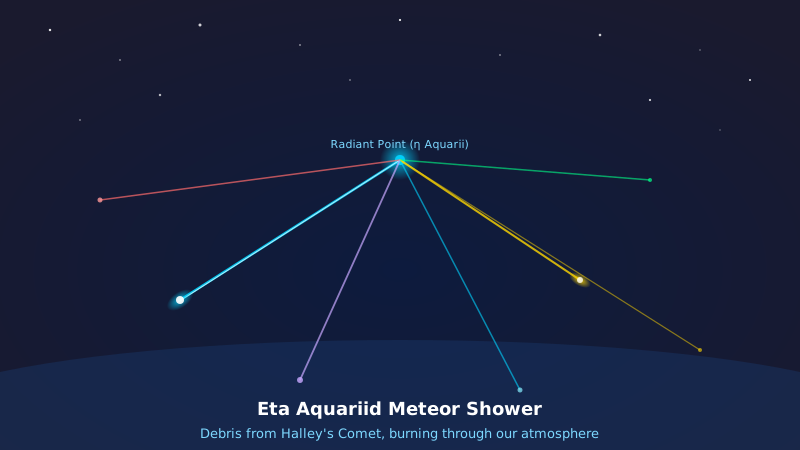
The radiant is the single point in the sky where all the meteors appear to originate — in this case, near the star Eta (η) Aquarii in the constellation Aquarius, which gives the shower its name. The meteors themselves are actually traveling on nearly parallel paths, but perspective makes them seem to fan out from one point, the same way railroad tracks appear to converge in the distance.
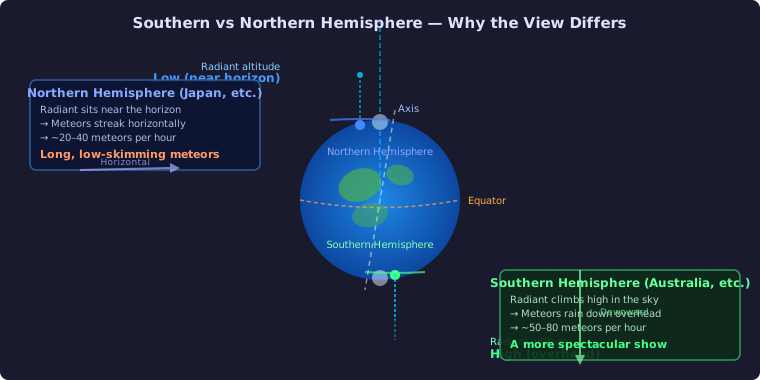
Seen from the Southern Hemisphere, this radiant climbs high in the sky before dawn. The higher it sits, the more meteors appear to rain straight down, filling a wide swath of sky. Observers in Australia can enjoy a rich display for several hours before sunrise.
From the Northern Hemisphere, the radiant barely clears the horizon. Meteors skim across the sky at shallow angles, staying confined to a narrow band near the horizon. That cuts the per-hour count roughly in half compared to southern latitudes.
That said, there’s something uniquely beautiful about the northern view. Meteors that skim in at low angles travel a longer path through the upper atmosphere, producing long, slow-moving trails that wouldn’t be visible at all from the south.
Earth-Grazers: The Long-Tailed Meteors
The Eta Aquariids are particularly well known for their long, persistent trails. Astronomers sometimes call the most dramatic examples “Earth-grazers.”
A typical meteor hits the atmosphere at a steep angle and burns out in a few seconds. Eta Aquariid particles, arriving from a low radiant, often enter at a shallower angle. The shallower the angle, the longer the path through the atmosphere — and the longer the glowing trail. This is exactly what happens in the Northern Hemisphere: fewer meteors per hour, but each one tends to drag a longer, more dramatic streak across the sky.
Occasionally a particle large enough to produce a fireball — magnitude −4 or brighter — will blaze into view, visible even in partly lit skies. These fireballs are evidence that the original particle was substantially larger than the usual dust grain.
When and How to Watch
The peak falls around May 5–7 each year. Your best window is the two to three hours before local sunrise. The reason is simple geometry: in the predawn hours, your location on Earth is facing into the direction of its orbital motion, so you’re scooping up more debris head-on. In the evening, you’re on the trailing side, and the count drops.
Moonlight is the main spoiler. If the Moon is up and bright, it washes out fainter meteors. Check the lunar phase and try to observe during the moonless portion of the night.
You don’t need any equipment. Binoculars and telescopes actually make things worse by narrowing your field of view. Lie flat on your back, face up, and take in as much sky as possible. Give your eyes 20 minutes to dark-adapt before you start counting. If you can get away from city lights, all the better — the difference between suburban and genuinely dark skies is real.
Halley’s Comet and 2061
Watching the Eta Aquariids, it’s worth pausing on where this dust actually came from. Many of the particles glowing overhead tonight left Halley’s Comet centuries ago. Some may have drifted away from the comet’s surface over a thousand years back, slowly spreading along its orbit until Earth finally swept through them.
The first confirmed written records of Halley’s Comet come from Chinese astronomers in 240 BC. The debris that comet scattered is still falling through Earth’s atmosphere every May.
The next perihelion — Halley’s closest approach to the Sun — is expected around 2061. Many people alive today will be alive to see it. There’s something satisfying about watching this year’s Eta Aquariids and thinking: that’s the same comet, and I might actually get to see the real thing. In cosmic terms, a human lifetime is short enough that most people see Halley’s only once. But some people born in the right decade get to see it twice — and every May, the meteor shower is a kind of advance payment on that promise.
SORABUMI is a space media outlet that makes the universe a little easier to think about.