Have you ever noticed that stars aren’t all the same color?
Take Orion in winter. Betelgeuse, on the hunter’s right shoulder, glows orange. Rigel, at the left foot, blazes blue-white. Same constellation, same night sky — but they couldn’t look more different. The reason comes down to temperature. A star’s color is a direct readout of how hot its surface is, and how hot it burns determines how fast it burns through its fuel. That, in turn, decides how long it lives.
In other words: look at the color, and you can read a star’s lifespan.
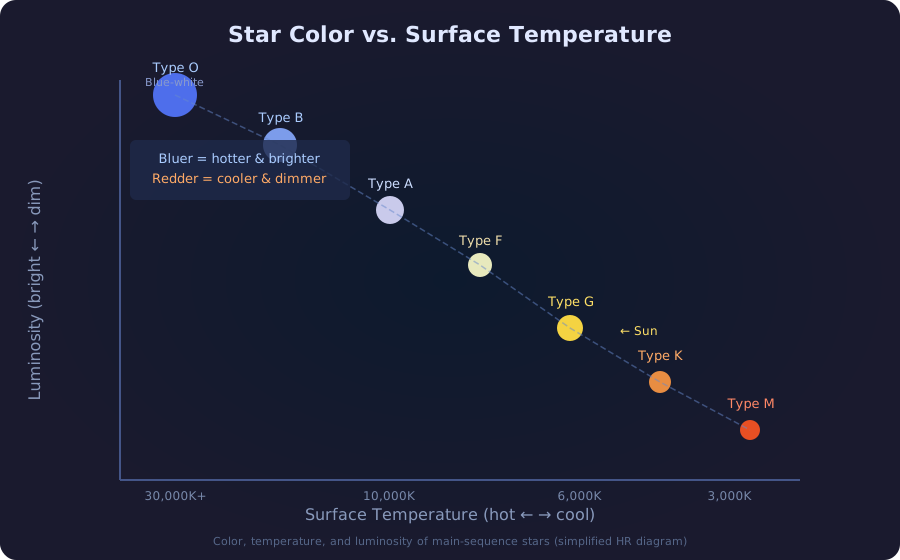
Temperature sets the color — basic physics, big consequences
If you’ve ever heated metal, you already have the intuition. Iron glows red at low heat, shifts to orange and yellow as it gets hotter, and eventually goes white or blue-white at extreme temperatures. The physics behind this is called blackbody radiation: the hotter an object, the shorter the peak wavelength of the light it emits. In the visible spectrum, short wavelengths are blue and long wavelengths are red — so hot things look blue and cooler things look red.
Stars work exactly the same way. Nuclear fusion deep in a star’s core produces an enormous amount of energy, which radiates outward and escapes from the surface as light. A hot surface emits blue-white light; a cooler surface emits red.
The Sun’s surface sits at around 5,800 K (kelvin, the unit of absolute temperature). That puts it in yellow-white territory. Seen from space, sunlight is actually close to white, but Earth’s atmosphere scatters blue light, making the Sun look yellowish from the ground.
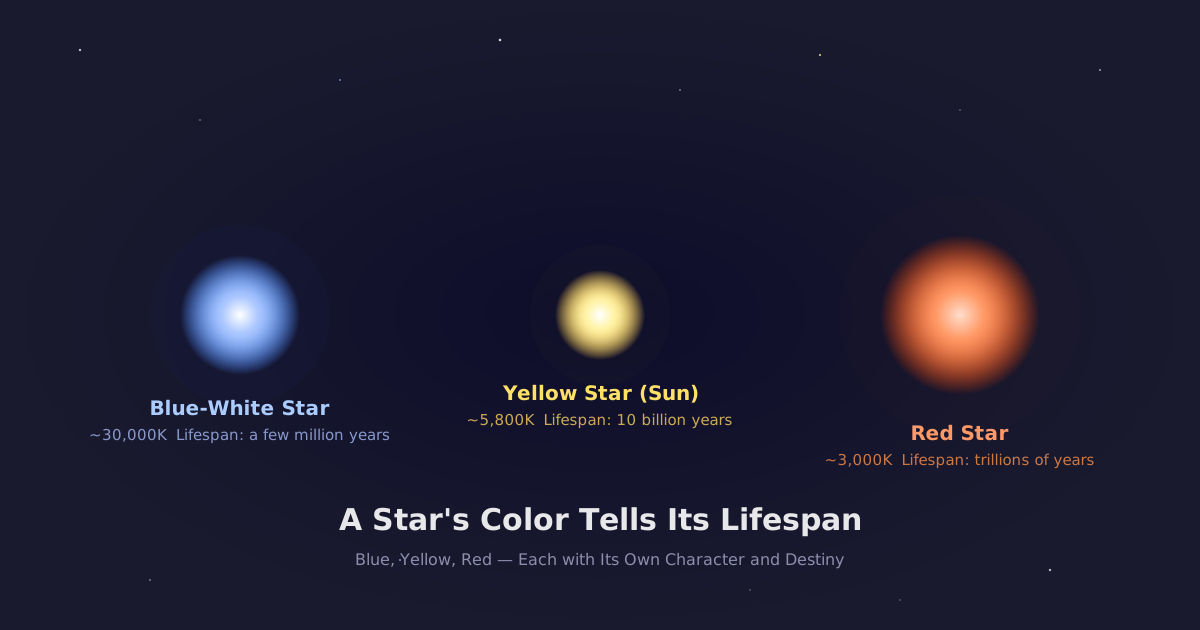
On the hot end, O-type stars — one of the spectral classification types — exceed 30,000 K. On the cool end, M-type red dwarfs come in below 3,000 K. That’s a tenfold difference in surface temperature.
Blue stars burn out fast; red stars are misers
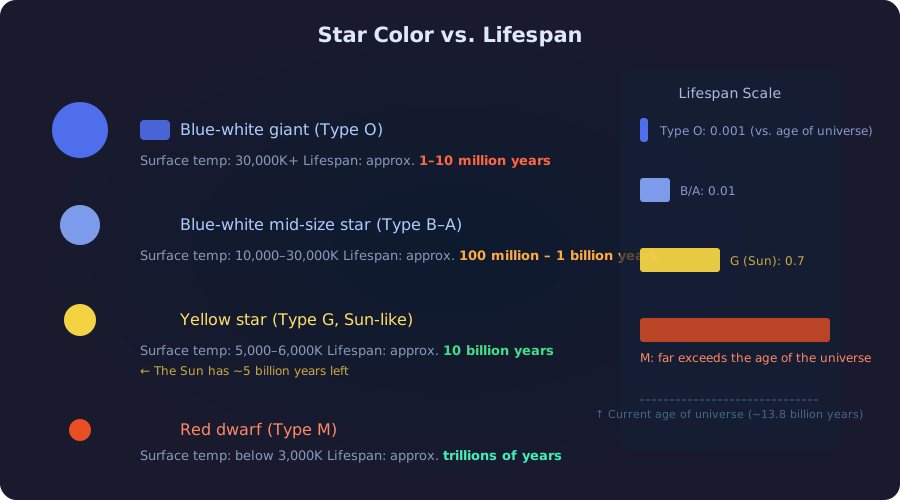
Higher temperature means faster nuclear fusion. Blue stars rip through their fuel at a ferocious pace. A typical O-type blue giant may have tens of times the mass of the Sun, yet its lifespan is only a few million to ten million years.
To put a few million years in perspective: dinosaurs went extinct about 66 million years ago, and our earliest hominin ancestors appeared around 7 million years ago. A blue star might only outlast the time since the first humans walked the Earth — a blink against the 13.8-billion-year history of the universe.
Red stars are the opposite. Red dwarfs (M-type stars) have small masses and fuse hydrogen at a glacial pace. Think of them as the frugal slow-burners of the galaxy — their estimated lifespans reach into the trillions of years, far longer than the universe has even existed. Which means every red dwarf alive right now is almost certainly still in its prime. Not one has likely died of old age yet.
The Sun sits comfortably in the middle
The Sun is a G-type yellow main-sequence star with a surface temperature of about 5,800 K and an estimated lifespan of roughly 10 billion years. We’re currently about 4.6 billion years in, so the Sun is close to its halfway point.
The term “main sequence” comes from the Hertzsprung-Russell diagram, a classic chart that plots stars by brightness (vertical axis) against surface temperature or color (horizontal axis). The vast majority of stars fall along a diagonal band — bluer and brighter at one end, redder and dimmer at the other. That band is the main sequence, and the Sun sits somewhere in the middle of it.
Nothing about the Sun is particularly special. It’s one of countless ordinary stars scattered through the Milky Way. That said, there’s an argument that this ordinariness is exactly what made Earth possible — a stable, moderate star in a stable, moderate spot.
When a blue star dies, the universe shakes
What happens at the end of a star’s life depends heavily on its mass.
Massive blue stars (O and B types) go out with a bang: a supernova explosion, one of the most energetic events in the universe. For a brief moment, a single exploding star can outshine an entire galaxy. It’s genuinely alarming how much energy that involves. What’s left behind is often a neutron star or a black hole.
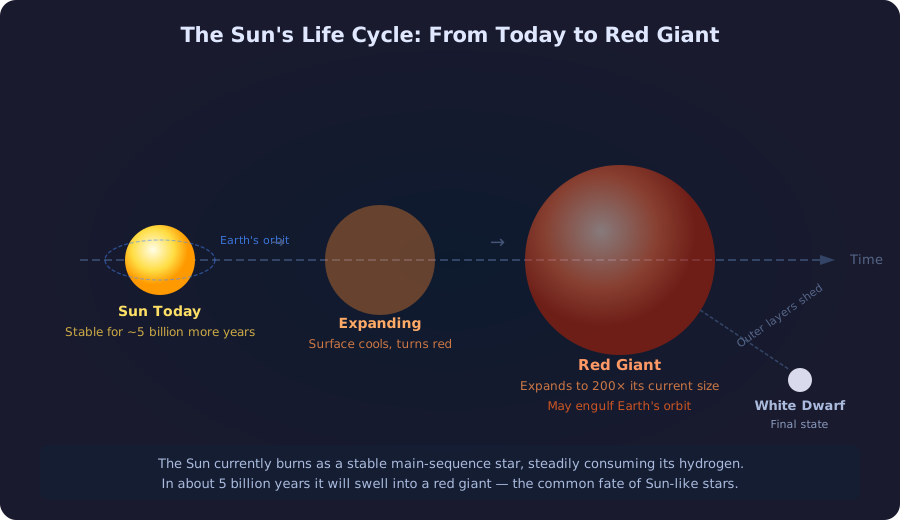
Sun-like G-type stars have a quieter exit. As they run low on fuel, they puff up into red giants, slowly shedding their outer layers into space. The dense leftover core cools and crystallizes into a white dwarf. Not dramatic, but those released gases don’t go to waste — they become raw material for the next generation of stars and planets. A tidy kind of ending.
As for red dwarfs (M-type stars), no one has ever witnessed one die. Their lifespans outlast the current age of the universe, so what they look like at the end is purely theoretical. The leading expectation is that they won’t go supernova; they’ll just fade quietly into white dwarfs over an unimaginably long time.
Color even shapes whether life is possible
A star’s color and lifespan have direct implications for whether life can arise on any planets orbiting it.
Blue giants are spectacular, but they don’t stay around long enough. Complex life on Earth took billions of years to develop — first oceans had to stabilize, simple organisms had to evolve, and that gradual complexity had to compound over enormous timescales. A blue star simply doesn’t give its planets that window.
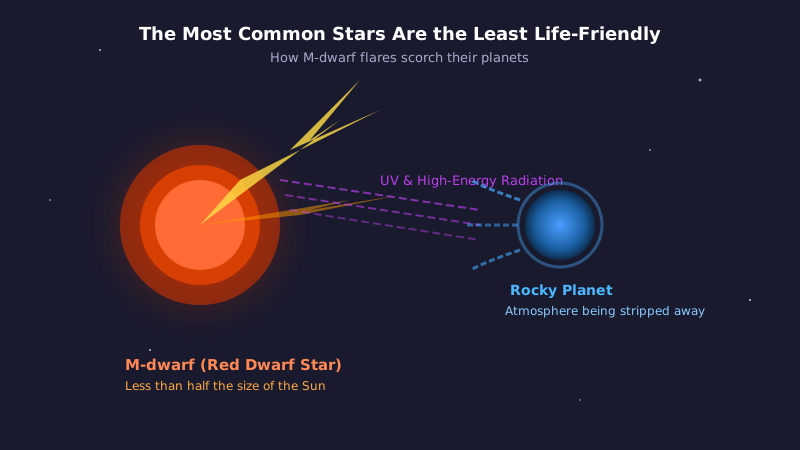
Red dwarfs live long enough, but they come with their own problems. M-type stars frequently produce intense flares — violent eruptions that can blast nearby planets with radiation and strip away their atmospheres. Long-lived, yes. But rough landlords.
Right now, the consensus is that G-type (yellow) and K-type (orange) stars offer the best balance: long enough lifespans, steady enough behavior. How many of those exist in our galaxy? Some estimates put it in the tens of billions.
Learning to read the sky
A star’s color is not just a visual detail. It encodes the star’s temperature, how fast it’s burning, how much time it has left, and what it does to the worlds around it.
When you spot a blue-white point blazing in the night sky, it’s reasonable to think: that star might already be near the end of its life. When you notice a faint, reddish speck, you can flip the logic: the universe could double in age and that star would still be young.
Astronomers extract an entire life history from something as simple as color. It’s a kind of practiced seeing — not the casual glance of someone lying on their back looking up, but a way of looking that’s been sharpened by accumulated knowledge. Still, the doorway into that way of seeing is open to anyone.