Galaxies Don’t Travel Alone
Look up at the night sky and the stars seem scattered at random. But the universe, at larger scales, is a much more social place.
Galaxies clump together in groups of dozens to thousands. These are galaxy clusters — and our own Milky Way sits on the outer edge of one such structure, the Virgo Supercluster. A typical cluster spans several million light-years across, with member galaxies hurtling through it at speeds exceeding 1,000 km per second.
What fills the space between those galaxies matters a lot. It isn’t empty. A scalding hot plasma called the intracluster medium, or ICM, permeates the entire volume. Temperatures can reach 100 million degrees Celsius. The density is vanishingly thin — nothing like the heat you’d feel near a flame — but this gas has the power to fundamentally reshape any galaxy that passes through it.
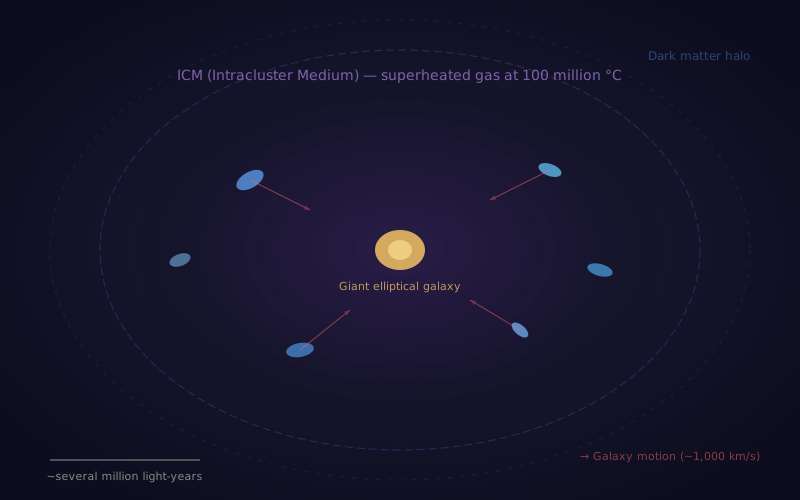
Think of a galaxy cluster as an ocean. The galaxies are fish swimming through it. The ICM is the seawater. That analogy will carry us through everything that follows.
The Headwind at Cosmic Scale
A galaxy diving into a cluster hits a ferocious wall of resistance.
You’ve felt something like it on a bicycle: sprint hard enough and the air pushes back against your face. Now scale that up to a galaxy traveling at 1,000 km/s through a plasma sea. The pressure from the ICM slamming into the galaxy’s leading edge is what physicists call ram pressure.
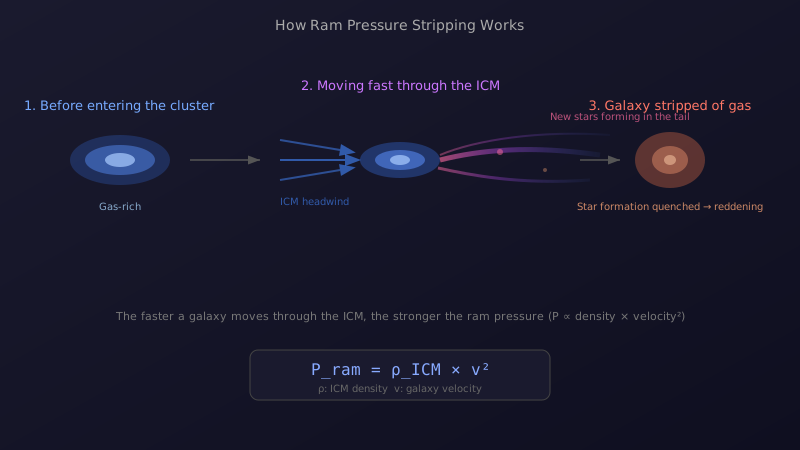
Ram pressure scales with the ICM’s density and the square of the galaxy’s velocity. The faster the galaxy moves, and the denser the ICM around it — which is to say, the closer the galaxy gets to the cluster core — the harder the wind blows.
That wind peels gas away from the galaxy. The cold molecular clouds that would otherwise collapse into new stars get shredded and dragged backwards, like a bedsheet torn off a clothesline. This is ram pressure stripping.
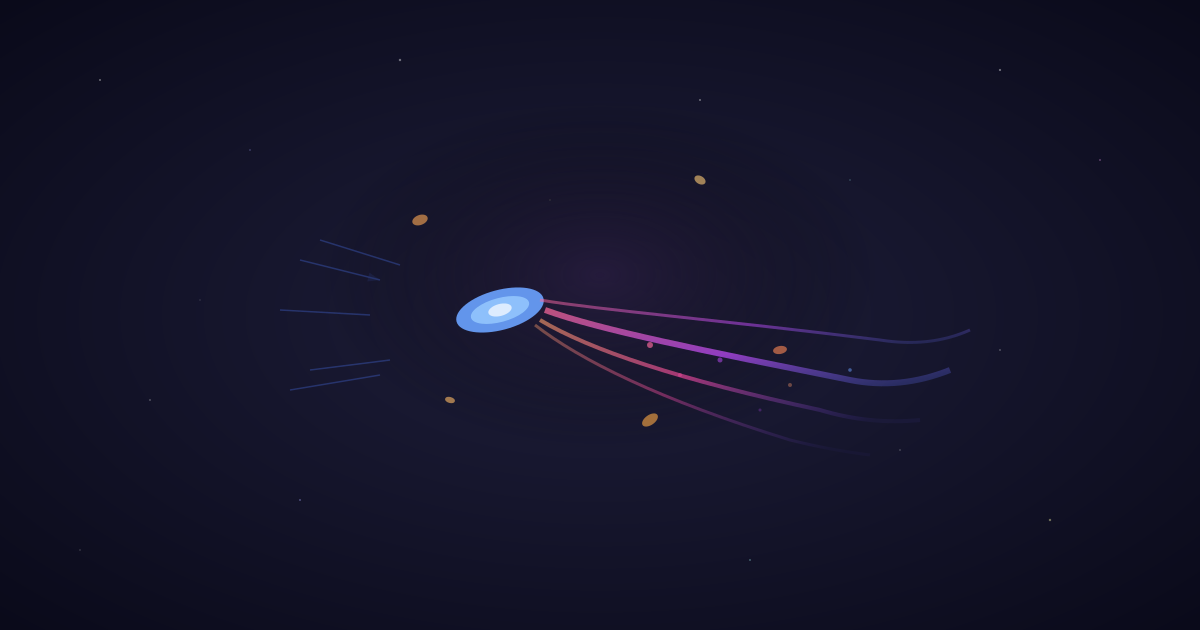
The stripped gas doesn’t simply vanish. It streams out behind the galaxy in a long, luminous tail. That shape — a compact body with trailing filaments — is exactly what a jellyfish looks like. Astronomers have been calling them jellyfish galaxies ever since, and the name has stuck.
What’s Happening Inside the Tentacles
Here’s where it gets genuinely surprising. When people talk about gas being stripped from a galaxy, the default framing is one of loss. But wait.
Stars are forming inside those stripped tails. Gas torn away from the galaxy gets compressed as it streams out, density rises, gravity takes over, and new stars ignite — outside the main body of the galaxy entirely.
A 2025 study from Yale focused on NGC 4858, a galaxy in the Coma Cluster. Under intense ram pressure, its spiral arms had warped into strange ear-like protrusions. More unexpectedly, some of the stripped gas wasn’t escaping cleanly — it was falling back onto the galaxy. A kind of galactic fountain.
That fountain effect complicates the tidy story of “gas leaves, star formation shuts down.” Instead, gas sloshes in and out while the galaxy slowly morphs. A jellyfish galaxy is, in this sense, a living laboratory for understanding how galaxies change over time.
JWST Found One 8.5 Billion Years Ago
Until recently, jellyfish galaxies had mostly been spotted in relatively nearby clusters. The early universe — meaning the distant universe — was a blind spot. Researchers weren’t sure whether the conditions needed for ram pressure stripping were even in place back then.
In 2025, JWST broke through that barrier.
A galaxy catalogued as COSMOS2020-635829 turned up at redshift z = 1.156 — meaning its light took 8.5 billion years to reach us. JWST’s sharp infrared imaging caught a symmetric stellar disk with a one-sided tail of star-forming clumps streaming away from it. Spectroscopy from the Gemini Observatory confirmed the ionized gas in the tail was dynamically connected to the disk.
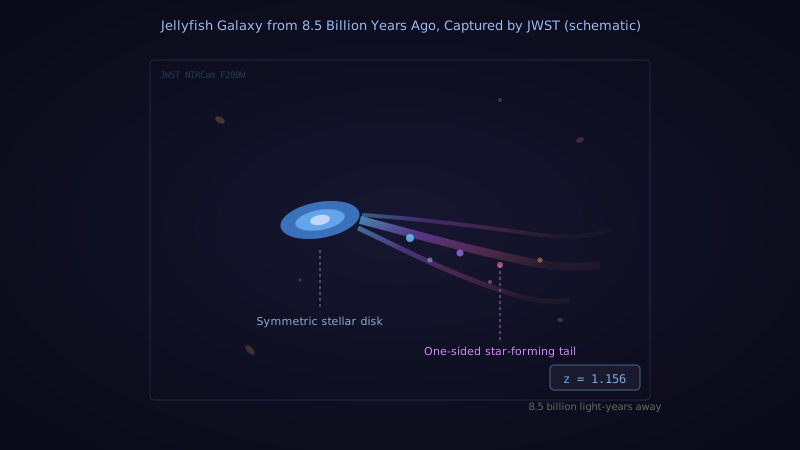
Why does that matter? At 8.5 billion years ago, the universe was still young. Galaxy clusters were still assembling. Many researchers had assumed that ram pressure stripping at this scale wouldn’t kick in until later. That assumption turned out to be wrong.
The finding means environmental effects on galaxy evolution were already operating during what cosmologists call cosmic noon — the era when star formation across the universe was at its most intense. Galaxy clusters were already powerful enough to transform their members that early.
Magnetic Fields Decide How Long the Tentacles Last
So why do some galaxies grow long, spectacular tails while others — under similar ram pressure — barely develop any? That question had been open for years.
In 2026, South Africa’s MeerKAT radio telescope picked up a clue.
Polarized radio emission was detected from the tail of JO147, a jellyfish galaxy. Polarization is a fingerprint of magnetic fields. The measured Mach numbers ranged from 1.3 to 1.6 — supersonic, but on the gentler end of the shock spectrum.
The research team’s interpretation: magnetic fields are draping themselves across the boundary between the ICM and the stripped cold gas. That magnetic layer suppresses heat conduction, shielding the cold gas from the scorching ICM around it. Protected from evaporation, the gas survives long enough for stars to keep forming in the tail.
Without that magnetic shielding, the cold gas boils away quickly and the tail stays short. The length of a jellyfish galaxy’s tentacles may ultimately be a measure of its magnetic field strength and geometry. Put another way, jellyfish galaxies double as probes of cosmic magnetism.
How a Galaxy Dies
The end of the story is straightforward enough.
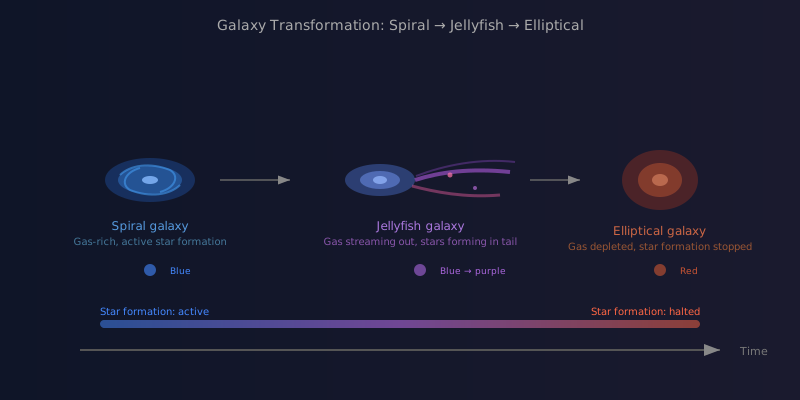
Strip a galaxy of its gas and it runs out of raw material for star formation. Existing stars keep shining, but the supply line is cut. This process is called quenching. With no fresh blue stars being born, the galaxy’s overall color gradually shifts toward red.
Astronomers sometimes call this reddening. What starts as an active, gas-rich spiral — blue and bright — ends up as a passive elliptical galaxy, old and red. The preponderance of ellipticals near the centers of galaxy clusters is the long-term result of exactly this transformation, played out over billions of years.
A large 2024 survey found systematic patterns in which direction jellyfish tails point relative to the cluster center. About 33% trail away from the center — consistent with galaxies on their first infall. Around 18% point toward the center — interpreted as galaxies that have already passed through the core once and are falling back in, a population known as backsplash galaxies. The remaining 49% point in other directions.
That first plunge matters enormously. Many galaxies lose a massive fraction of their gas on the initial pass through the cluster, long before they settle into a stable orbit.
Caught in the Web of Gravity and Hot Wind
A galaxy cluster is a gravitational web.
Dark matter weaves enormous filaments across the cosmos, and clusters sit at their intersections. Galaxies fall in along those filaments, get hammered by the ICM headwind, shed their gas, and slowly change shape. A jellyfish galaxy is one of those galaxies caught mid-transformation.
JWST showed this was happening 8.5 billion years ago. MeerKAT revealed that magnetic fields govern how long the tentacles survive. Hubble has watched gas fountains rising from galaxies in nearby clusters. Each telescope adds another piece.
The universe offers galaxies several different ways to die. Some exhaust their fuel and dim quietly. Some collide with a neighbor and erupt in chaos. And some are stripped bare by the ICM as they sail through a cluster, passing through a jellyfish phase before fading slowly to red.
What draws me to jellyfish galaxies, personally, is that the whole spectacle looks like resistance. These galaxies are plowing through a ferocious headwind, trailing streamers of gas behind them, and still — right out at the tips of those tentacles — making new stars. They’re being reshaped by their environment, but they keep building until the very end.
Out in those vast cosmic oceans, the jellyfish are still swimming.