The Same Saturn, Two Very Different Pictures
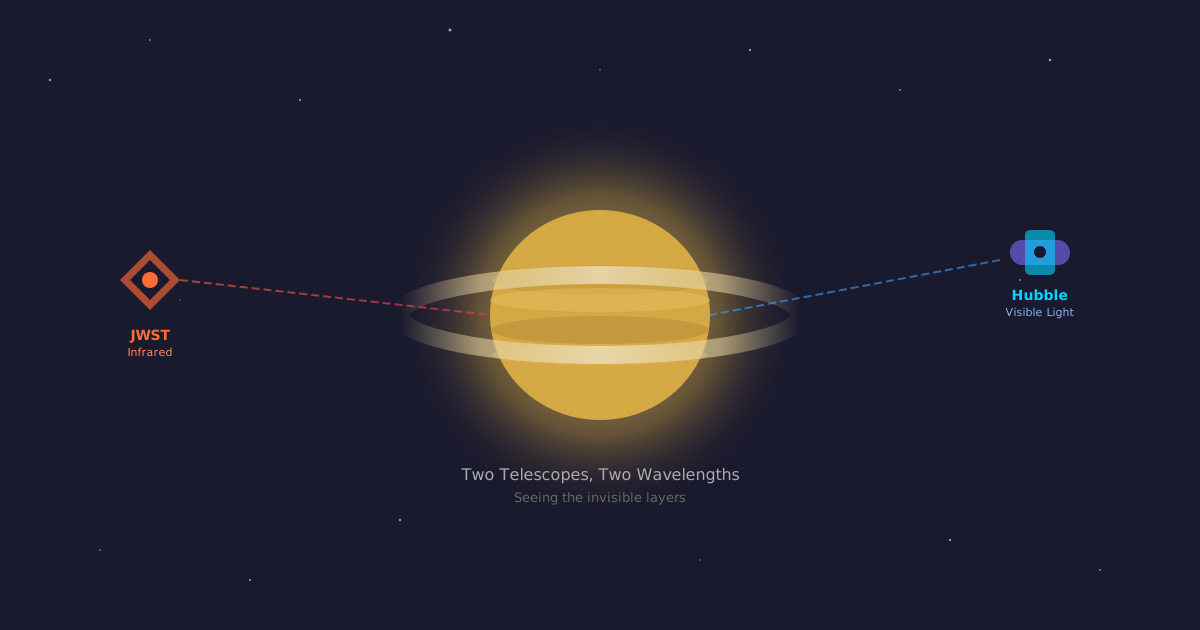
Late in 2024, something quietly remarkable happened in planetary science. The James Webb Space Telescope (JWST) and the Hubble Space Telescope both turned their eyes to Saturn at nearly the same time. The images they produced looked like they came from two different worlds.
Hubble captured Saturn on August 22, 2024, and the result was exactly what you’d expect from a textbook: that familiar pale yellow orb, its icy rings glowing, a faint bluish tint at the poles, gentle banding across the disk. Reassuringly Saturn-like.
JWST photographed the same planet on November 29 of the same year — but in infrared. The result was a dark orange sphere, with polar regions lit up in an eerie gray-green, the banding arranged in patterns that looked almost nothing like Hubble’s version. Same planet, same moment in history, completely different face. That contrast turns out to be a key that unlocks how planets are actually put together.
Visible Light Sees the “Skin”; Infrared Sees the “Guts”
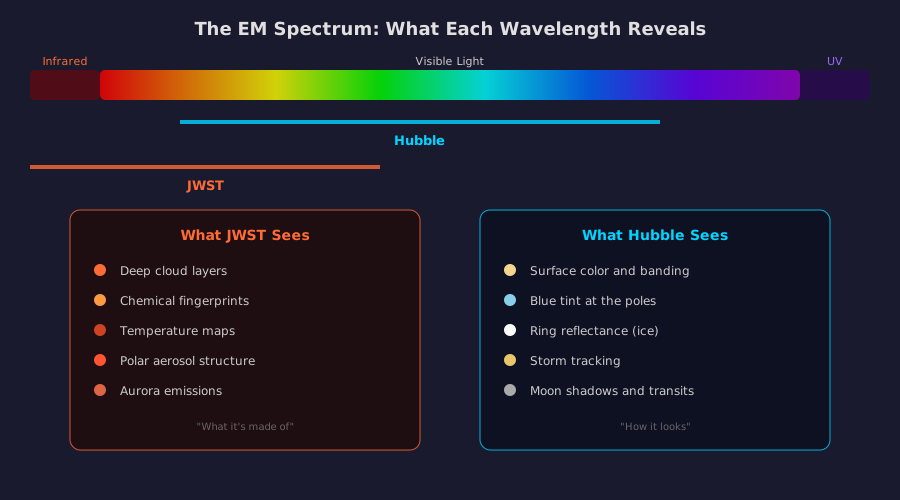
Why do the images differ so dramatically? It comes down to wavelength.
Hubble works in visible light — the same narrow band the human eye uses. That light bounces off the very top of Saturn’s atmosphere, where ammonia crystals and hydrocarbon particles reflect sunlight back into space. In other words, everything Hubble shows us is the planet’s outermost skin.
JWST’s infrared light penetrates far deeper. It passes through multiple cloud layers and captures the chemistry and temperature structure well below the surface we can see. If Hubble photographs Saturn’s face, JWST is more like taking an X-ray of its organs.
NASA’s research team combined these two perspectives to produce the most detailed three-dimensional map of Saturn’s atmosphere ever made. Neither telescope could have done it alone.
Saturn’s Atmosphere Is a Layer Cake
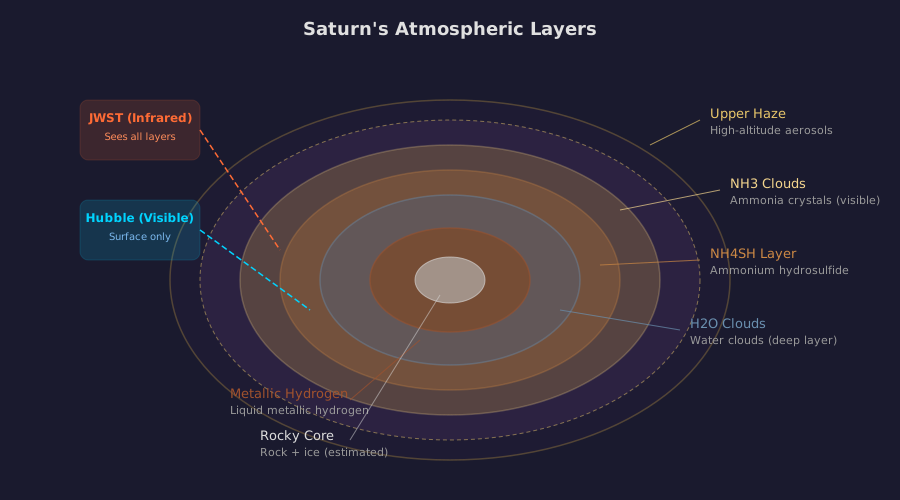
Working from the top down, Saturn’s atmosphere turns out to be organized into strikingly distinct layers.
At the very top sits a layer of high-altitude aerosols — fine suspended particles. The gray-green glow JWST picked up at Saturn’s poles is thought to come from these high-altitude particles scattering infrared light in a distinctive pattern. In visible light, you’d never know they were there.
Beneath that lies a deck of ammonia (NH3) ice crystals. This is the layer responsible for Saturn’s characteristic creamy yellow color — sunlight reflecting off frozen ammonia clouds.
Deeper still is a layer of ammonium hydrosulfide (NH4SH), and below that, water clouds made of the same H2O as Earth’s thunderstorms. On Saturn, though, that water is locked far below the visible surface, invisible to Hubble.
Deeper yet, the planet transitions into an ocean of liquid metallic hydrogen, and at the very center sits what is probably a core of rock and ice. That “probably” is the right word: even JWST can’t see that far down.
The Ribbon Wave and a 15-Year-Old Storm
One of the most striking features the joint observation revealed was a jet stream in Saturn’s northern mid-latitudes called the “Ribbon Wave” — a sinuous, planet-encircling current that weaves for a distance many times Earth’s diameter. It stirs atmospheric material as it goes, partially disrupting the layer structure below it.
Just to the south of the Ribbon Wave, researchers spotted a cluster of small bright patches. These are thought to be the lingering remnants of the “Great Springtime Storm” that raged from 2010 to 2012 — a disturbance whose signature is still readable in the atmosphere nearly fifteen years later.
On Earth, a typhoon from 2010 would leave no detectable trace today. But Saturn is 9.5 times Earth’s diameter, and its atmosphere runs incomparably deep. A large-scale disturbance doesn’t just dissipate — it fades out across decades, slowly but irreversibly.
Then there’s Saturn’s north pole, where Voyager 1 spotted a hexagonal jet stream back in 1981. More than forty years on, it has barely changed shape. Saturn operates on timescales that make Earth’s weather seem like a brief flicker.
Gas Giants and Ice Giants: Very Different Recipes
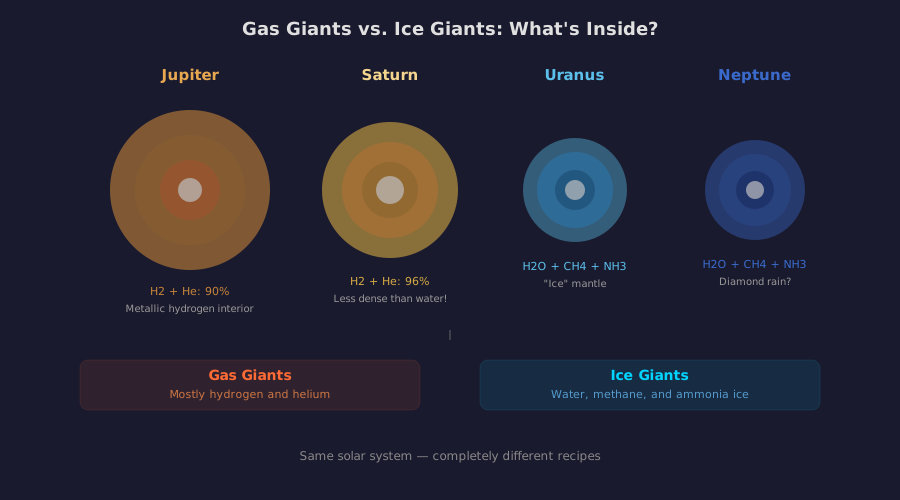
Zoom out from Saturn, and the contrast between the outer solar system’s planets becomes even more striking.
Jupiter and Saturn are “gas giants.” Their atmospheres are dominated by hydrogen and helium — about 90% for Jupiter, and roughly 96% for Saturn. Everything else is trace amounts of methane, ammonia, and a handful of other compounds.
One of Saturn’s more disorienting properties: its average density is lower than water. If you could fill a bathtub the size of a solar system, Saturn would float. A planet 9.5 times Earth’s diameter, lighter than water — it sounds wrong until you remember it’s mostly hydrogen and helium, two of the lightest elements that exist.
Uranus and Neptune are classified differently: “ice giants.” The “ice” here isn’t what you pull out of a freezer. It refers to water, methane, and ammonia compressed under extreme pressures into exotic high-temperature states. Their outer atmospheres are hydrogen and helium, but their interiors are dominated by this pressurized “ice” mantle.
Inside Neptune, the pressure gets so extreme that methane molecules are thought to break apart, freeing carbon atoms that may then crystallize and fall as diamonds — a literal diamond rain. The gems that cost a fortune on Earth might be tumbling through Neptune’s interior right now. Not that you could retrieve them: the pressure would crush you millions of times over before you got close.
Same Sun, Same Starting Material — So Why Are They So Different?
It’s a fair question. Jupiter, Saturn, Uranus, Neptune — they all formed from the same solar nebula, the same swirling disk of gas and dust around the young Sun. How did such different planets emerge from the same raw ingredients?
The answer lies in where and when each planet formed.
Close to the Sun, temperatures ran high enough to blow away lightweight gases like hydrogen and helium. That’s why the inner planets — Earth, Mars — ended up rocky. There was nothing else left to build with.
Jupiter and Saturn formed in a colder region where gas could accumulate under gravity. Jupiter, in particular, grabbed enough mass early enough to pull in surrounding gas without limit, becoming the solar system’s largest planet. Saturn followed a similar path, albeit with a lower final mass.
Uranus and Neptune formed even farther out, in a region where the raw material of the solar nebula was spread thinner. By the time they’d assembled enough solid mass to attract gas, much of the surrounding disk had already dispersed. The result: a thin hydrogen-helium atmosphere over a deep interior of compressed “ice.” Not quite a gas giant, not quite a rock.
Same ingredients, different recipes. The outer solar system is living proof that timing and location shape everything.
Two Telescopes, One Long Game
Hubble has been running a long-term survey of the outer planets called OPAL — Outer Planet Atmospheres Legacy — since the program launched. Every year or so, it schedules checkups of Jupiter, Saturn, Uranus, and Neptune, building a record of how each planet’s weather evolves over time.
With JWST’s infrared capabilities now added to the mix, planetary science has entered a new phase. Chemical composition, temperature gradients, aerosol behavior in the deep atmosphere — these were largely invisible before. Now they can be tracked in something close to real time.
Saturn is currently moving from northern summer through its equinox (2025) toward southern spring. By the 2030s, the southern hemisphere will be entering summer. Both telescopes plan to monitor how the atmosphere shifts with the seasons.
Here’s the thing: on Earth, a season lasts three months. Saturn’s year is 29.5 Earth years long. A single Saturnian season stretches for more than seven years. Tracking that kind of slow change requires patience measured in decades. Hubble’s 35-year archive, combined with JWST’s anticipated decades of operation, means we’re finally in a position to watch a planet breathe across something approaching its full seasonal cycle.
We live in the same solar system as Saturn. We’ve sent spacecraft past it. And we still don’t fully understand what’s happening inside it. That gap between proximity and knowledge is exactly what makes these observations worth doing. Two eyes see more than one — and two telescopes, it turns out, see a great deal more than either could alone.