The Universe Has Stars That Get Eaten
From a distance, the night sky looks peaceful. But out there, objects are colliding, tearing apart, and swallowing each other whole. Few events are more extreme than a neutron star merging with a black hole.
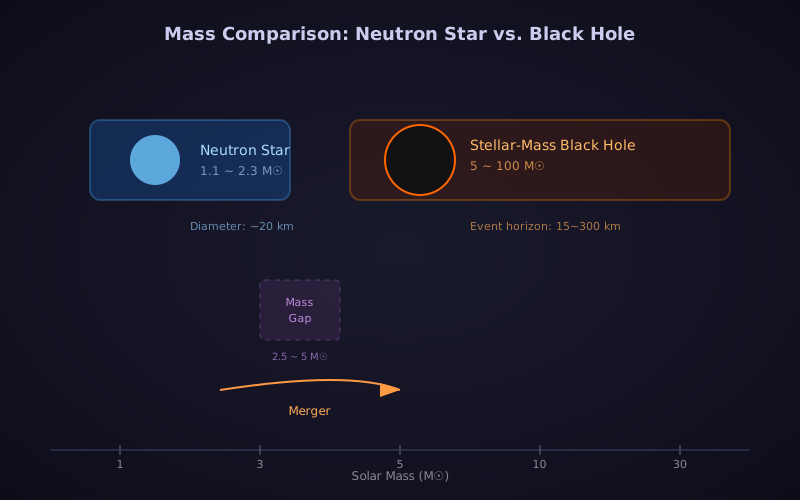
A neutron star is what’s left after a star more than eight times the mass of our sun runs out of fuel and collapses. The result is an object only about 20 kilometers across, yet it packs one to two solar masses into that tiny volume. A cube of neutron-star material the size of a sugar cube would weigh roughly a billion tons. Nothing on Earth comes close.
Then there’s the black hole — a gravitational prison from which not even light can escape. Cross the event horizon, and there’s no coming back.
So what happens when these two meet? In 2021, the gravitational-wave detectors LIGO and Virgo finally caught the evidence.
Tens of Millions of Years Spiraling In
The merger doesn’t happen overnight. The two objects spend an enormous stretch of time as a binary system, circling each other in a long, slow dance.
With every orbit, though, they lose a little energy. They radiate ripples in spacetime — gravitational waves — and as they do, their orbit shrinks. For tens of millions of years, the inspiral is almost imperceptibly gradual. Then, in the final few minutes, everything accelerates dramatically.
In the last second alone, the neutron star can complete hundreds of orbits around the black hole — moving at over 100,000 kilometers per second, about a third the speed of light. Newtonian gravity can’t describe this. Only Einstein’s general relativity captures what’s happening.
The gravitational wave frequency climbs all the while. It starts as a low rumble and races up to thousands of hertz by the end. This rising-pitch signal — called a chirp — is exactly what LIGO picks up on Earth. Play it back in the audible range and it sounds like a rising whistle, something a little like a bird call. Strange, that a cosmic collision should sound so delicate.
A Fork in the Road: Torn Apart or Swallowed Whole
Here’s where it gets interesting. When the neutron star makes its closest approach, two very different things can happen.

Scenario A: Tidal Disruption
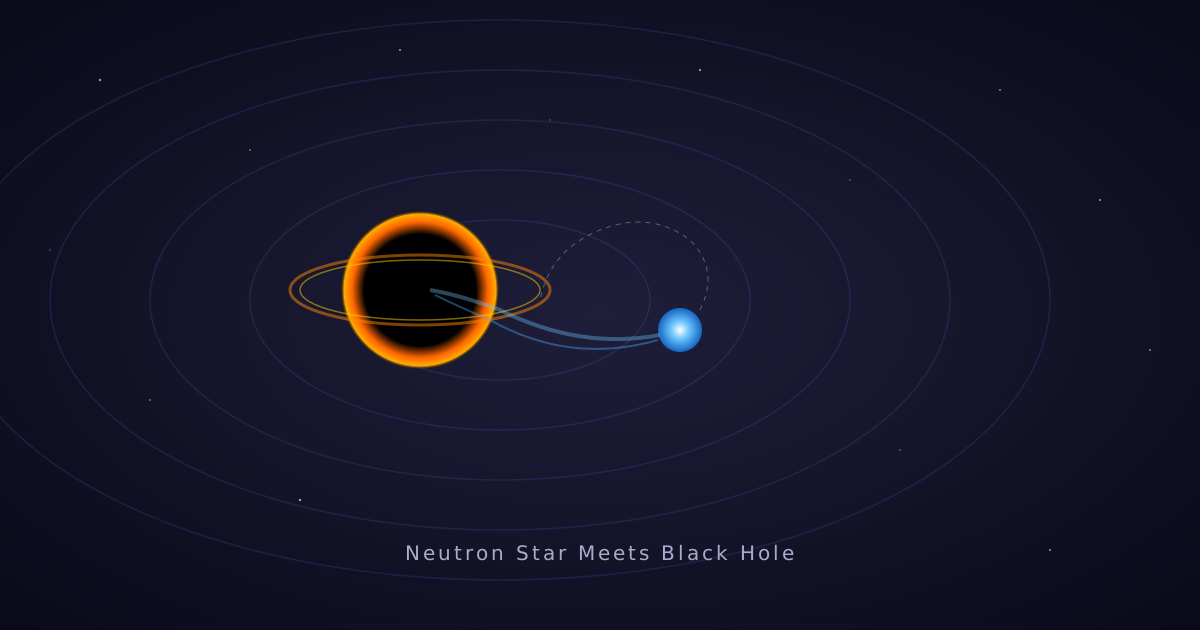
If the black hole is relatively light — roughly 5 to 8 solar masses — or if it’s spinning rapidly, the neutron star never makes it to the event horizon intact. The tidal forces rip it apart first.
Tidal forces are the same principle that makes the Moon pull Earth’s oceans into tides, just operating at an incomparably greater scale. The side of the neutron star facing the black hole feels dramatically stronger gravity than the far side. When that difference exceeds the neutron star’s own self-gravity, the star stretches and shreds — spagettified in a matter of milliseconds.
Around 80% of the neutron star’s material falls into the black hole almost instantly. The remaining 20% spirals out through a one-armed streamer and forms an accretion disk. Some fraction of that is flung outward at high velocity into open space.
That ejected material matters enormously. Inside it, neutrons are rapidly captured by atomic nuclei in a process called the r-process, forging heavy elements — gold, platinum, uranium, neodymium. The gold in a wedding ring almost certainly originated in a neutron star disruption, somewhere in some galaxy, billions of years ago. Cosmic violence quietly underlies earthly beauty.
Scenario B: Direct Plunge
If the black hole is large — ten or more solar masses — the neutron star crosses the event horizon before tidal forces can tear it apart. It gets swallowed whole.
In this case, almost nothing escapes. No fireworks, no flash of light, no ejected material worth measuring. Gravitational waves alone carry the news that something happened. The universe sometimes ends a story with a whisper.
Which scenario plays out depends on the mass ratio and the black hole’s spin. LIGO can estimate both from the gravitational-wave data alone.
The “Final Cry” Waveform
The gravitational-wave signal contains a complete record of the merger. It breaks naturally into three phases.

Inspiral. The two objects spiral toward each other. Amplitude and frequency both climb slowly but steadily. Physicists read off the masses and orbital parameters from this phase.
Merger. The moment of closest approach and coalescence. The waveform peaks here. If tidal disruption occurred, the signal looks subtly different from a black-hole-on-black-hole collision — the neutron star’s “softness” leaves a faint imprint. Nuclear physicists get to probe the state of matter at densities no laboratory can replicate.
Ringdown. The newly formed black hole settles, damping its oscillations like a bell going quiet. Spacetime stops ringing.
The tidal disruption signature is the most exciting part. When a neutron star is torn apart, the signal cuts off sharply rather than tapering smoothly. That abrupt change tells scientists something about the internal structure of neutron stars — whether the core is “soft” or “stiff” — in conditions that can’t be created on Earth.
GW200105, GW200115, and the Mass-Gap Mystery
In 2020, LIGO and Virgo confirmed the first two definitive neutron-star–black-hole mergers: GW200105 and GW200115.
GW200105 involved a black hole of about 8.9 solar masses and a neutron star of about 1.9 solar masses. GW200115 paired a roughly 5.7-solar-mass black hole with a roughly 1.5-solar-mass neutron star. Neither event produced a detectable electromagnetic counterpart — no gamma-ray burst, no kilonova flash. The mass ratios suggest both neutron stars were swallowed largely intact, with minimal tidal disruption.
Then in 2024, things got stranger. Detectors picked up a merger between a neutron star and an object sitting squarely in the so-called “mass gap” — between roughly 2.5 and 5 solar masses, too heavy for a neutron star and too light for what we thought a stellar-mass black hole could be. What that object actually is remains an open question.
As of early 2026, the LIGO-Virgo-KAGRA network has logged 391 gravitational-wave events in total, and the count keeps rising. The next observing run, O5, is scheduled to begin in fall 2026 with improved detector sensitivity. Neutron-star–black-hole mergers will come into view in sharper detail than ever before.
The Origin of Everything Heavy
This research goes well beyond astrophysics for its own sake. It touches the question of where the heavy elements in your body — and in your jewelry — actually came from.
Stars are excellent at fusing light elements up to iron. Beyond iron, ordinary stellar fusion stalls. For decades, supernovae were the leading candidate for producing heavier elements. But the evidence has steadily shifted toward neutron-star mergers as the dominant factory for gold, platinum, and other r-process elements.
The 2017 neutron-star–neutron-star merger GW170817 made that case concretely. Observers around the world caught the kilonova — the burst of light powered by freshly synthesized heavy elements — and spectroscopy confirmed strontium production in real time.
Neutron-star–black-hole mergers with tidal disruption produce the same kind of nucleosynthesis. The amount of ejected material varies with the merger’s parameters, but somewhere between 0.01 and 0.1 solar masses of neutron-rich matter can be flung across the galaxy. Gold and platinum are in there.
So somewhere in some galaxy, a black hole rips a neutron star apart, and heavy elements scatter into the interstellar medium. Billions of years later, those atoms find their way into a new solar system, into the crust of a young planet, and eventually into a ring on someone’s finger. The gold didn’t come from a mine. It came from a catastrophe.
The Story Is Just Getting Started
Neutron-star–black-hole mergers rank among the most extreme events the universe produces — near-light-speed collisions, fates decided in milliseconds, heavy elements forged on the spot. And all of it is encoded in a single gravitational-wave signal.
The LIGO-Virgo-KAGRA network grows more sensitive with each observing run. Starting in fall 2026, signals from more distant and fainter mergers will cross the detection threshold. Outstanding questions remain: the exact internal structure of neutron stars, what lives in the mass gap, how much of the universe’s gold inventory these mergers actually account for.
Personally, the one I’m most curious about is whether we’ll ever catch a tidal disruption simultaneously in gravitational waves and light. A combined detection would let us read the physics of the merger in full, like finally opening the most violent chapter of the universe’s recipe book.
Gravitational-wave astronomy is barely a decade old. The next time LIGO sounds an alarm, who knows what it’s bringing.