Start tallying up everything that fills the universe, and at some point the numbers stop making sense.
Ordinary matter — atoms, molecules, everything made of them. Stars. Galaxies. Earth. You. All of it together accounts for roughly 5% of the universe. The other 95% is something that current physics simply cannot identify.
The first time I came across that figure, I didn’t find it funny. Five percent. The universe, by its own reckoning, is almost entirely something else.
The Cosmic Ingredient Label
Modern cosmology can actually measure what the universe is made of, with impressive precision. The breakdown looks like this:
- Ordinary matter (baryons): ~5%
- Dark matter: ~27%
- Dark energy: ~68%
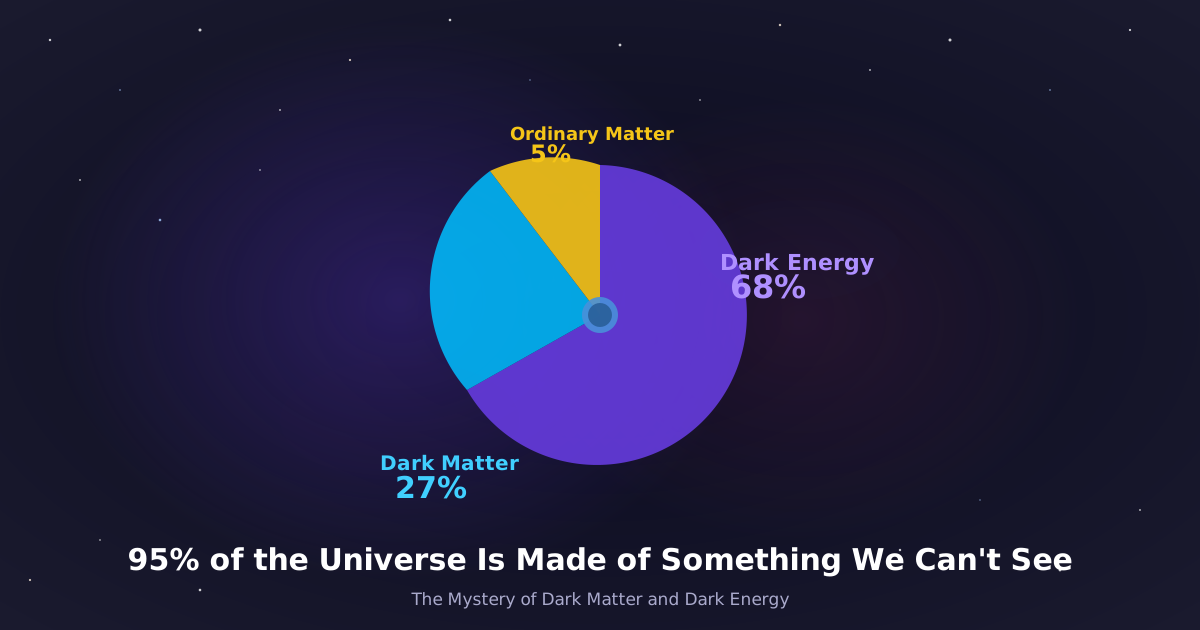
These numbers come from observations of the cosmic microwave background (CMB) and the large-scale distribution of galaxies — they represent our best estimates today. Dark matter and dark energy together account for 95%. Everything we know, everything we’ve ever touched or seen, is the remaining sliver.
The word “dark” here isn’t just about dimness. It also signals ignorance. Maybe these things don’t emit light. Maybe they don’t interact with light at all, making them fundamentally undetectable with conventional instruments. Either way, no detector has caught them in the act.
Dark Matter: Mass Without a Face
Start with galaxies.
A galaxy is brightest at its center and grows sparser toward the edges. So intuitively, stars near the outer rim should orbit more slowly, just as planets farther from the sun move at lower speeds. That’s basic orbital mechanics.
But in the 1970s, American astronomer Vera Rubin measured galactic rotation speeds in detail — and the numbers refused to cooperate. The outer edges weren’t slowing down at all. The rotation curve stayed flat, all the way to the rim.
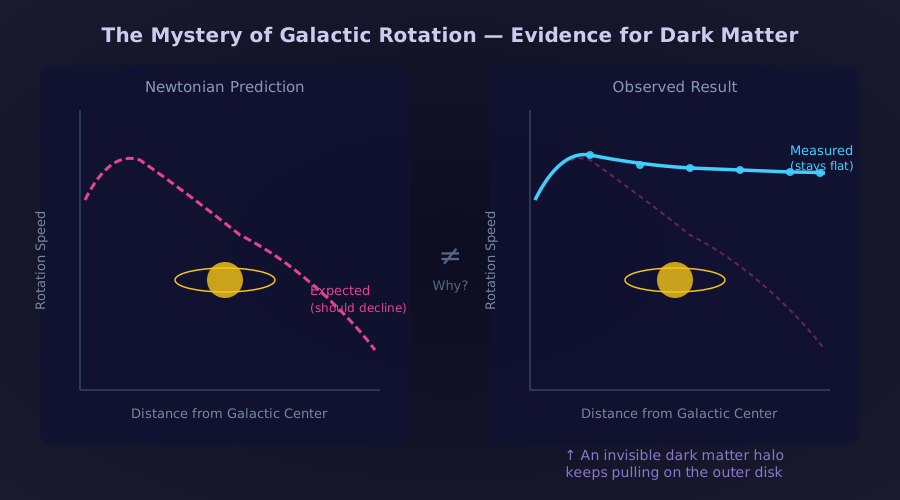
Physically, that’s strange. If the speed isn’t dropping off, there must be mass out there — something pulling on those outer stars. But there’s no visible matter to speak of at the edges. The leading explanation: an invisible sphere of mass surrounding each galaxy, a “dark matter halo,” providing the extra gravitational pull.
When Rubin first published her results, many scientists pushed back. Measurement error, they said. Bad data interpretation. But the same result showed up in galaxy after galaxy, using multiple independent methods. The case for invisible mass kept building.
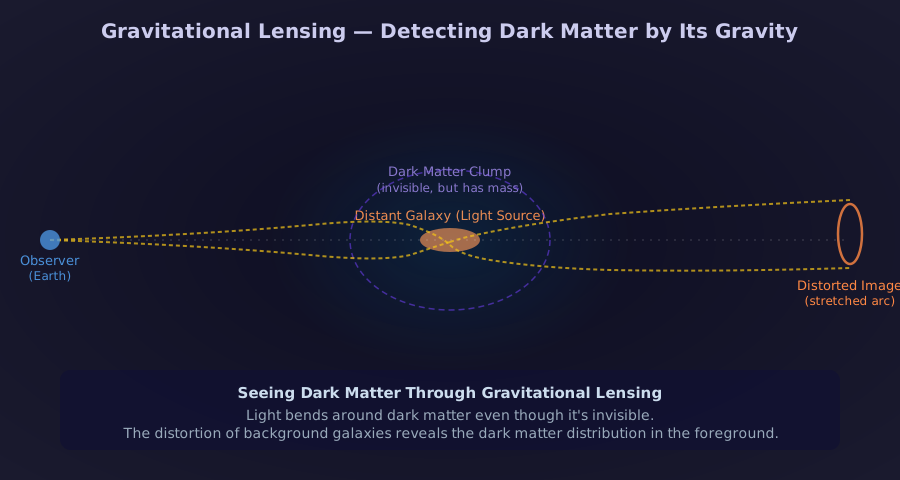
The other powerful line of evidence is gravitational lensing. Einstein’s general relativity predicts that gravity warps space itself, bending the path of light passing through it. If a clump of dark matter sits between us and a distant galaxy, it will distort the background galaxy’s image — even though the dark matter emits nothing. By mapping those distortions, astronomers can reconstruct where the invisible mass lives.
Candidates for what dark matter actually is range from WIMPs (weakly interacting massive particles, hypothesized in supersymmetry theories) to ultralight particles called axions to primordial black holes. None of them has been definitively detected. Experiments deep underground, designed to catch a dark matter particle as it passes through Earth, have been listening for decades.
So far, nothing.
Dark Energy: The Force Pushing Everything Apart
The second mystery starts in 1998.
The universe is expanding — Hubble established that in 1929. The Big Bang set things in motion, and the cosmos has been stretching ever since. The expected story was that this expansion would gradually slow down. Gravity pulls matter together, so over time it should act as a brake.
Then in 1998, two independent research teams observing supernovae arrived at the same unsettling conclusion: the universe isn’t slowing down. It’s speeding up.
Distant galaxies were farther away than predicted, receding faster than they should. Something was pushing the universe outward. That something got named dark energy.
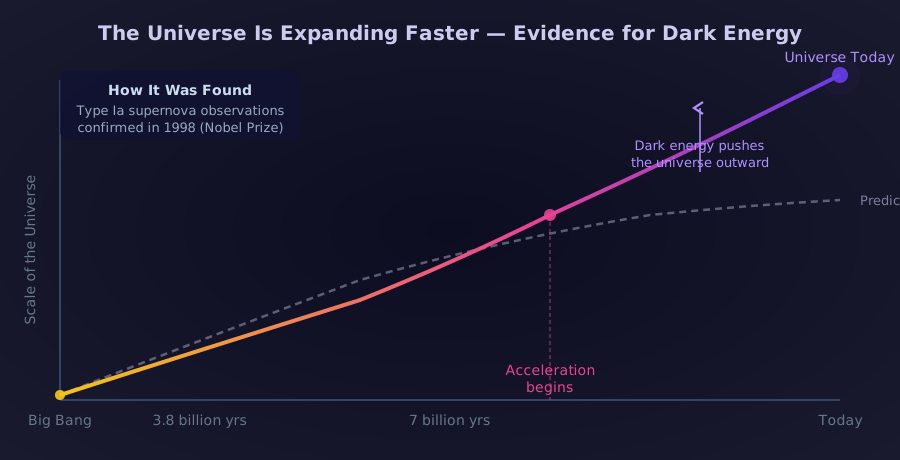
The discovery earned the 2011 Nobel Prize in Physics. That alone tells you how much it shook the field.
The leading candidate for dark energy is the cosmological constant — a term Einstein added to his field equations, which can be interpreted as the energy of empty space. The idea is that the vacuum isn’t truly empty; it carries a baseline energy, uniform throughout the universe, and that energy generates an outward pressure.
There’s a problem, though. The vacuum energy predicted by quantum field theory and the dark energy inferred from observations differ by roughly 120 orders of magnitude. That’s the worst prediction in the history of physics. Calling it a cosmological constant gives us a label, not an explanation.
An alternative idea — called quintessence — holds that dark energy isn’t a fixed constant but a field that changes over time. If that’s true, the ultimate fate of the universe could look very different from what we currently expect.
A Telescope Built for the Unknown
In 2026, NASA plans to launch the Nancy Grace Roman Space Telescope.
Roman shares Hubble’s 2.4-meter primary mirror, but its field of view is about 100 times wider. A single Roman image covers as much sky as a hundred Hubble frames. Over its five-year mission, it will observe more than a billion galaxies and use that data to map the distribution of dark matter and chart how dark energy has evolved across cosmic history.
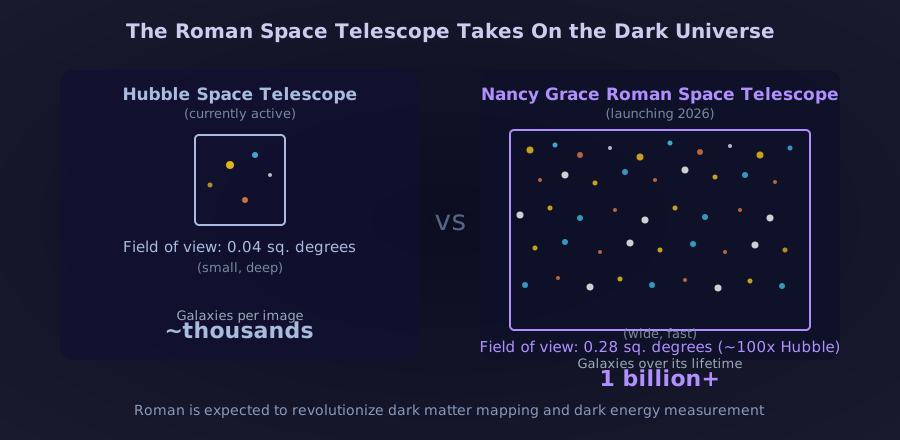
Roman will pursue this through two main techniques. The first is a large-scale weak gravitational lensing survey. By statistically analyzing the subtle shape distortions of hundreds of millions of galaxies, astronomers can work backward to reconstruct the dark matter distribution in the foreground — not by studying individual galaxies, but by reading the pattern in aggregate.
The second is Type Ia supernova observation. These explosions all peak at roughly the same intrinsic brightness, making them reliable distance markers. Measuring them across different cosmic epochs reveals how fast the universe was expanding at each moment in history — and therefore how dark energy’s strength has shifted over time.
ESA’s Euclid telescope, launched in 2023, is running a parallel program. The combined datasets from Roman and Euclid are expected to reshape cosmology in fundamental ways.
Living With Not Knowing
Honestly, dark matter and dark energy are, at this stage, little more than names attached to ignorance. We call something dark matter because it pulls on galaxy edges. We call something dark energy because it’s accelerating the expansion. The names create an illusion of understanding. But we haven’t identified the particles. We haven’t built a theory that truly explains either.
That’s not a failure of cosmology. It’s cosmology being honest — saying “we don’t know” about the things we don’t know. That kind of transparency is what science is actually supposed to do.
The two mysteries may be entirely unrelated, two separate puzzles that happen to be vexing astronomers at the same time. Or some deeper, undiscovered theory might eventually explain both at once.
We’re mapping 100% of the universe with 5% of the ingredients. As maps go, it’s pretty rough. But look at it another way: when the other 95% finally comes into focus, the view is going to change everything.
That’s worth looking forward to.
Sources: NASA Roman Space Telescope website / NAOJ News