Galaxies rarely travel alone. Most belong to communities — groups of dozens or even thousands bound together by gravity into structures called galaxy clusters. These clusters are the largest gravitationally bound objects in the universe.
And it turns out we may have been getting their mass badly wrong.
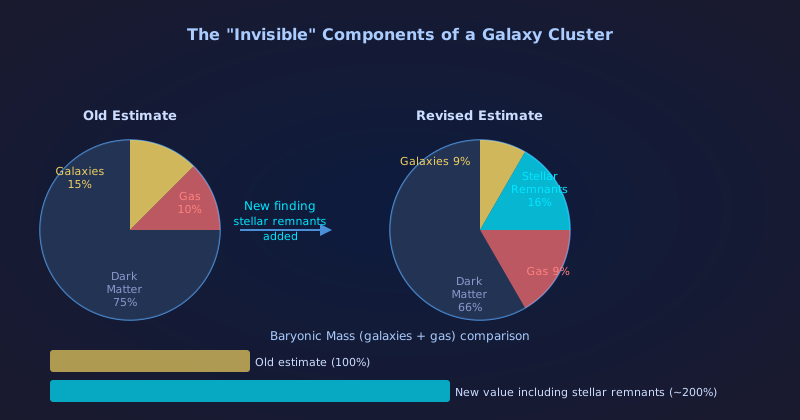
A team at the University of Bonn calculated that the total baryonic mass — the ordinary, visible stuff — in galaxy clusters could be nearly twice as large as previous estimates suggested. The reason? Stellar remnants. The dead husks of stars that astronomers had never seriously added to the books.
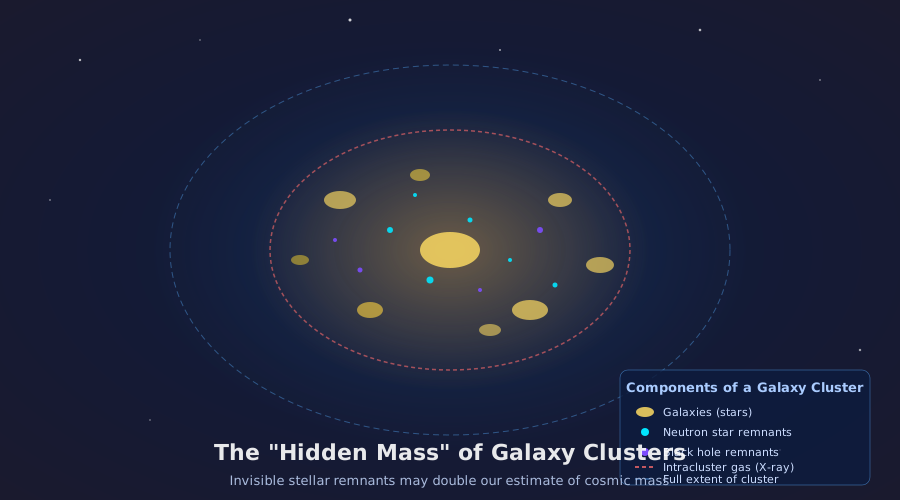
What a Galaxy Cluster Actually Is
A galaxy cluster is a gravitationally bound collection of dozens to thousands of galaxies. The Milky Way itself belongs to one — the Virgo Supercluster — which might come as a surprise to people who think of our galaxy as sitting alone in space.
Cluster composition breaks down into three broad categories. First, the galaxies themselves. Second, hot intracluster gas filling the space between them — this gas glows in X-rays and is relatively easy for telescopes to detect. Third, and by far the largest component, dark matter, which can’t be seen directly but dominates the gravitational budget.
The conventional breakdown has been roughly this: dark matter at around 75–80%, hot gas at about 15%, and galaxies contributing 5–10%. With decades of high-quality observations piling up, astronomers had grown fairly confident in these numbers.
The Bonn team’s research challenges that confidence — specifically the “galaxies” slice, which turns out to have been seriously underestimated.
The Graveyard No One Was Counting
Stars don’t shine forever. When they exhaust their fuel, what happens next depends on how massive they were.
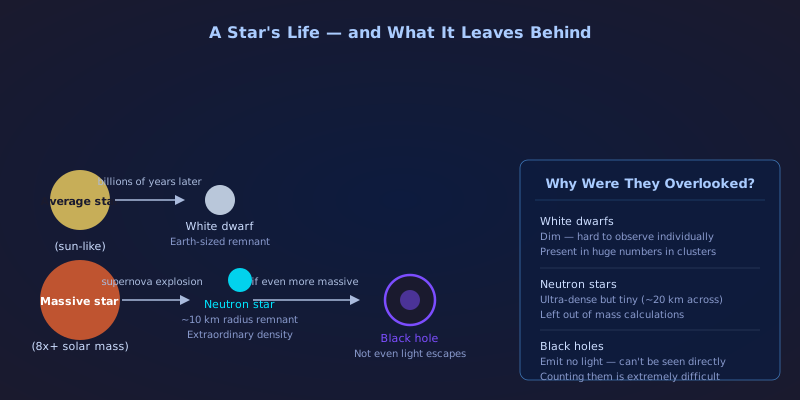
A star like the Sun ends its life by shedding its outer layers and leaving behind a white dwarf — a dense, Earth-sized remnant carrying roughly a solar mass of material. White dwarfs are extremely faint and difficult to detect in isolation.
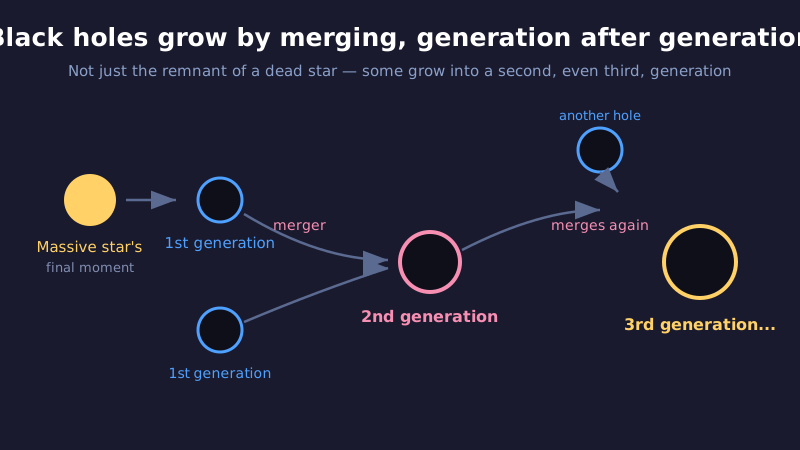
More massive stars — those heavier than about eight times the Sun’s mass — go out in a supernova explosion. What’s left is either a neutron star or, if the star was heavy enough, a black hole. A neutron star packs a solar mass into a sphere just 20 kilometers across; its density matches that of an atomic nucleus. A black hole emits no light at all.
These remnants don’t go anywhere. Over billions of years, as galaxies have cycled through wave after wave of star formation, the corpses have accumulated. The problem is that astronomers never properly accounted for them when tallying up a cluster’s mass.
Why Nobody Counted Them
Honestly? It was a technical problem.
White dwarfs are dim. Neutron stars are far too small to detect by conventional means. Black holes don’t radiate, so direct observation is off the table. Everyone knew they existed in large numbers — but calculating exactly how many of them were lurking inside a galaxy cluster was genuinely hard.
The Bonn team took a different approach. Rather than trying to observe remnants directly, they combined models of stellar birth rates with stellar death rates and worked backward through a cluster’s entire history to estimate how much detritus had piled up over cosmic time.
The resulting numbers were larger than expected. White dwarfs alone account for a substantial mass. Add neutron stars and black holes, and the total ordinary matter in a cluster could be close to double the previous figure.
Worth clarifying: this doesn’t mean the total mass of galaxy clusters has doubled. The revision is specific to the baryonic component — the visible-matter fraction. Dark matter is a separate budget. That said, revising the baryonic count does affect how dark matter’s share is calculated.
The Confidence That Just Collapsed
Here’s what makes this unsettling: galaxy cluster mass has long been one of the better-measured quantities in observational astronomy.
Researchers have triangulated it from multiple independent directions — X-ray brightness of hot gas, gravitational lensing (the bending of light by gravity), and the velocities of individual galaxies within the cluster. When these methods agree with each other, that’s usually a sign you’re getting things right.
But the Bonn study raises an uncomfortable possibility: those methods all agreed because they were all ignoring the same thing. When everyone overlooks the same component, the answers converge — they’re just consistently wrong together.
Researchers are now working through how to incorporate these corrections. The fix isn’t as simple as multiplying by two; the models need reworking.
Redrawing the Universe’s Gravity Map
The implications run well beyond galaxy clusters themselves.
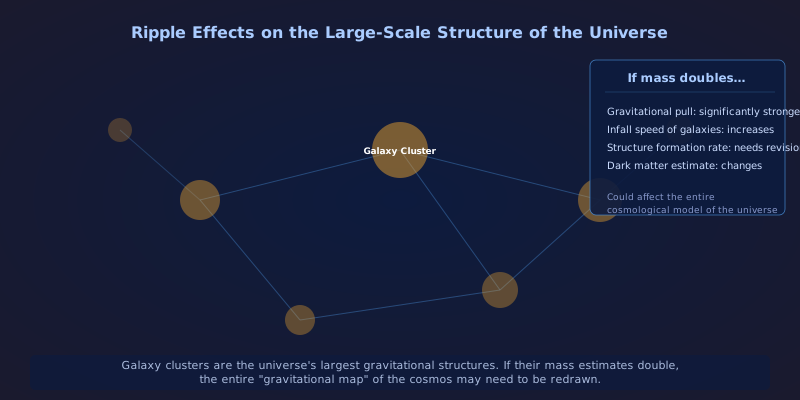
In cosmology, the mass distribution of galaxy clusters is central to understanding how the large-scale structure of the universe formed. Clusters sit at the intersections of cosmic filaments — the web-like threads along which galaxies and gas accumulate. Get their gravitational pull wrong and the story of how those structures grew over billions of years starts to look different.
There’s also a knock-on effect for dark matter estimates. If the baryonic fraction of cluster mass increases, the dark matter fraction adjusts accordingly. The “cosmic inventory” — that carefully refined accounting of what the universe is made of — may need a line item changed.
For cosmologists, this isn’t a detail. It’s a foundational number.
A Fossil Record of Galactic History
Flip the perspective, though, and those accumulated remnants become something interesting: a log of a cluster’s past.
A large population of neutron stars and black holes means the cluster hosted a lot of massive stars at some point — stars that lived fast and exploded hard. The density of remnants is directly tied to a galaxy’s star formation history. Which means that if you could measure remnant populations precisely, you’d have a new way to trace when and how actively each cluster was making stars across cosmic history.
Several next-generation X-ray telescopes are in development that may help. ESA’s Athena mission is designed to pick up faint X-ray emission that current instruments miss entirely — including the collective glow from white dwarf populations and electromagnetic signatures from neutron stars. Gravitational wave astronomy provides another angle: the merger events detected by LIGO, Virgo, and KAGRA constrain the population density of compact objects across the universe. Whether those constraints can be tightened for individual galaxy clusters is one of the open questions this research opens up.
”Hard to See” Is Not the Same as “Absent”
You might be thinking: wait, this sounds a lot like dark matter. Both are invisible. Both affect mass calculations.
The difference matters, though. Neutron stars and black holes are, in principle, observable. They’re not some exotic unknown particle — they’re familiar physics, just extraordinarily small or dim. With better instruments, they can be detected and counted. Dark matter remains a genuine unknown.
These remnants have always been there. They’re “hard to see” matter, not “unknowable” matter. And that distinction means the systematic undercount is a problem we can actually fix.
Every Cosmic Ledger Is a Draft
Discovering that our mass calculations were off isn’t a new experience in astronomy. Dark matter itself was a correction. So was the accelerating expansion of the universe and the dark energy that drives it. Every generation of measurements finds something the previous one missed.
The stellar remnants story fits the same pattern. The universe isn’t done letting us count it.
What strikes me is how this keeps happening at the edge of “we pretty much have this figured out.” The moment a number feels settled, something quietly accumulates in the gaps. Galaxy clusters were supposed to be among the well-measured objects. Turns out they had a whole graveyard’s worth of mass sitting in the books as zero.
The cosmic accountants are still finding uncounted entries — and they probably will be for a while yet.