When you photograph the Sun in ultraviolet light, you sometimes see large, shadowy patches with no fixed shape — wide enough to swallow dozens of Earths side by side. These are coronal holes.
The name sounds almost medical, like something gone wrong. But the Sun isn’t wounded. A coronal hole is simply a region of the corona — the Sun’s outer atmosphere — where the magnetic field behaves in a fundamentally different way from everywhere else. And that difference is exactly what drives some of Earth’s most disruptive space weather.
Why the Sun’s Surface Looks Like It Has Holes
The corona is one of astrophysics’ most stubborn puzzles. The Sun’s visible surface sits at around 6,000 kelvin (K), yet the corona above it exceeds one million kelvin. A hot atmosphere sitting above a cooler surface should be impossible by everyday thermodynamics — and nobody has fully explained why it happens.
Within this already-strange environment, coronal holes run slightly cooler than their surroundings: roughly 0.7 to 1.0 megakelvin, a few hundred thousand kelvin below the neighboring corona. That’s all relative, of course — from Earth’s perspective the temperature is still incomprehensible — but the contrast is enough to make these regions appear dark in ultraviolet images. Hence the “hole.”
Temperature, though, isn’t really the point. What makes coronal holes special is their magnetic structure.
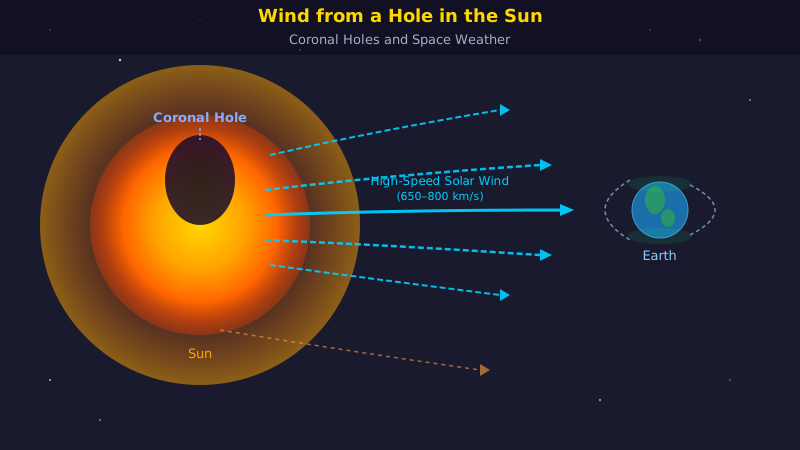
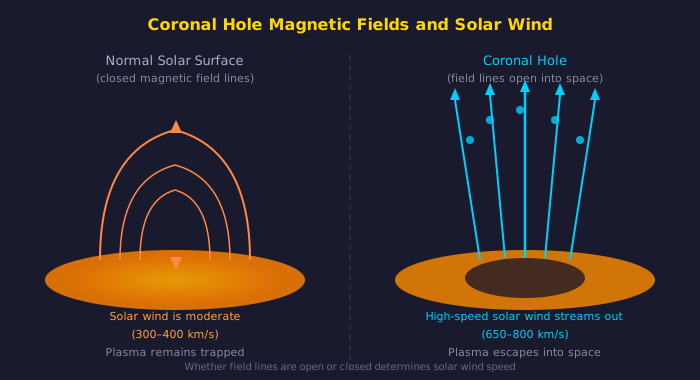
In the normal corona, magnetic field lines arc into closed loops. Because plasma — charged particles — travels along field lines, a closed loop keeps it confined. In a coronal hole, the field lines don’t loop back. They splay outward and connect directly to interplanetary space. Think of a faucet left open: plasma streams out continuously, with nothing to stop it. That outflow is the solar wind.
A Wind Blowing at 650 Kilometers Per Second
Not all solar wind is created equal — and the difference mostly comes down to where it originates.
Solar wind from ordinary parts of the corona travels at around 300 to 400 km/s, which is already extraordinary. Wind from a coronal hole, though, reaches 650 to 800 km/s — roughly double. The open field lines let plasma accelerate more freely before it escapes into space.
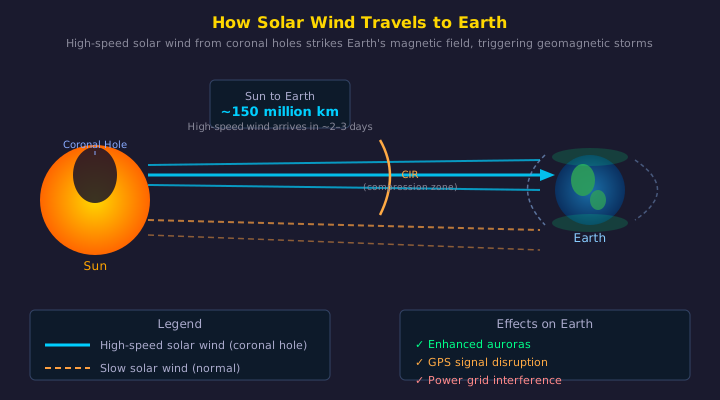
The Sun sits about 150 million km from Earth. High-speed solar wind covers that distance in two to three days. For reference, light takes about eight minutes. The wind moves slowly compared to light, but it moves fast enough to matter.
When this stream arrives at Earth, it doesn’t hit the surface directly. Earth’s magnetic field — the magnetosphere — deflects most of the incoming particles, the way a ship’s bow pushes water aside. But when the solar wind’s own magnetic field lines up with Earth’s in just the right way, a process called magnetic reconnection kicks in, and particles begin funneling into the magnetosphere. The result is a geomagnetic storm.
88% of Coronal Holes Share a Key Trait
Researchers have been working to sharpen space weather forecasts, and a recent study offers a useful clue.
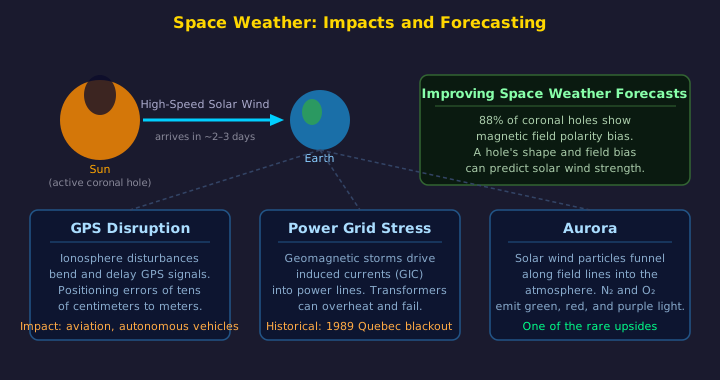
A team at New Mexico State University analyzed 70 coronal holes using data from NASA’s Solar Dynamics Observatory (SDO). They found that about 88% of coronal holes showed a pronounced magnetic imbalance — one polarity strongly dominated over the other within the hole.
The stronger that imbalance, the faster the resulting solar wind tends to be. That gives forecasters a new lever: by looking at a coronal hole’s shape and magnetic asymmetry, they can estimate, with some confidence, how fierce the incoming wind will be. It’s the kind of physical handle that turns rough trend-watching into something closer to genuine prediction.
NOAA’s Space Weather Prediction Center already issues daily forecasts — “G1-class geomagnetic storm expected tomorrow” — that satellite operators, airlines, and power companies use for planning. Better coronal hole characterization feeds directly into those predictions.
GPS Errors and Grid Failures
The practical consequences of a geomagnetic storm reach into daily life more than most people realize. GPS is probably the most relatable example.
A geomagnetic storm disturbs Earth’s ionosphere — the electrically charged layer of the upper atmosphere between about 60 and 1,000 km altitude. GPS signals from satellites pass through the ionosphere on their way to your receiver. When the ionosphere is agitated, those signals bend and slow in unpredictable ways, introducing positioning errors that range from centimeters to meters. Precision applications — survey equipment, drone navigation, autonomous vehicles — take the worst of it.
The power grid is a more alarming story. Geomagnetic storms drive geomagnetically induced currents (GICs) through the ground, which then push unwanted current into long-distance transmission lines and transformers. In March 1989, a severe geomagnetic storm left nine million people in Quebec without electricity for more than nine hours. Coronal hole activity may have contributed to the conditions that set it off.
Satellites also feel the effect. Storm-time atmospheric heating expands the upper atmosphere slightly, increasing drag on low-Earth-orbit spacecraft. Orbit maintenance becomes more demanding; without corrections, altitudes decay faster. Every Earth-imaging satellite and communications platform in low orbit is exposed to this.
The one silver lining is visually spectacular: auroras. Solar wind particles that make it into the magnetosphere spiral down along magnetic field lines into the polar atmosphere, exciting nitrogen and oxygen atoms into glowing. Green, red, and purple appear at different altitudes and with different atmospheric constituents. When a coronal hole sits close to the Sun’s equator, the resulting storm can push auroras far enough toward the equator that they become visible across mid-latitude skies.
When Coronal Holes Show Up
Coronal holes follow the Sun’s roughly 11-year activity cycle, though not in a simple way.
During solar minimum — when sunspot numbers are at their lowest — coronal holes tend to anchor themselves near the Sun’s polar regions and persist for months or even years. Earth receives a nearly steady stream of high-speed wind from these stable, polar holes.
As the cycle climbs toward solar maximum, coronal holes drift toward lower latitudes and become more irregularly shaped. When one sits near the equator, Earth passes through its wind stream once every solar rotation — about 27 days — producing a pattern of recurring geomagnetic storms that infrastructure operators learn to anticipate.
Compared to solar flares and coronal mass ejections (CMEs), coronal holes get relatively little media attention. CMEs are dramatic — sudden, explosive, and potentially enormous. Coronal holes are quieter: slow, steady, repetitive. But the cumulative stress that repeated storms place on infrastructure adds up, and over a prolonged active period, that quiet persistence can be its own kind of hazard.
Learning to Read the Sun’s Personality
Space weather forecasting is still young. Terrestrial weather prediction took decades of data and modeling to reach its current accuracy, and space weather is earlier along that same curve.
The finding that 88% of coronal holes carry a magnetic imbalance gives forecasters a new way to triage them: a strongly polarized coronal hole near the equator deserves more attention than a weakly polarized one near the poles. It’s not a complete prediction system, but it’s a meaningful handle on what’s coming.
Meanwhile, the observation infrastructure keeps improving. NASA’s SDO captures continuous imagery of the Sun at multiple wavelengths. When the Sun’s far side rotates out of Earth’s view — about two weeks per rotation — other missions fill in the gap so that no significant structure goes unobserved. Scientists are tracking a hole 150 million km away, trying to give two to three days’ warning before whatever it’s exhaling arrives.
Once you know this is happening, looking at the Sun feels different. That steady, familiar light is also a source of invisible weather — a ceaseless wind blowing outward from dark patches that open and close on their own schedule. Calming and unsettling at the same time, maybe. Both seem about right.