There’s something oddly disorienting about being told that the Sun is “just a star.”
You know it intellectually. But the tiny scattered lights across the night sky and that enormous yellow fireball rising in the east every morning — it’s hard to feel like they belong in the same category. Physically, though, they do. Both are spheres of hydrogen and helium gas, held in balance between two opposing forces: gravity trying to crush them inward and nuclear fusion pushing back from the core. That balance keeps them shining for billions of years.
And if the Sun is just a star, it follows that the Sun has a lifespan — just like all the others.
What’s more, its ending is pretty dramatic. It will bloat and cool and turn red, swallow the Earth in the process, then shed its outer layers into space and leave behind nothing but a small, white, glowing corpse.
That’s the story I want to tell today.

The Sun Is Exactly at Halftime
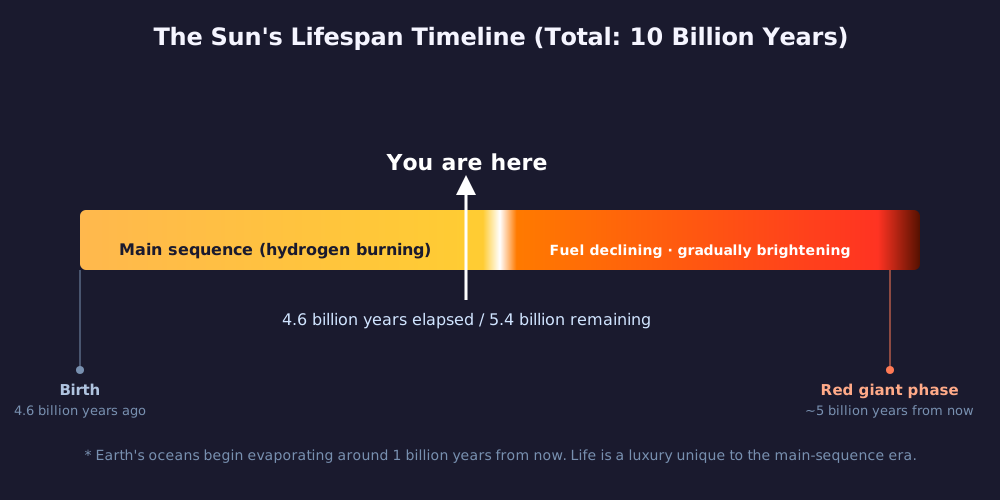
Let’s start with where things stand. The Sun formed about 4.6 billion years ago — roughly the same time as the rest of the solar system.
A star’s lifespan is determined by its mass. More massive stars have hotter, denser cores, which means they burn through their hydrogen fuel at a furious rate. The tradeoff: a short life. A blue-white supergiant like Rigel in Orion burns out in just tens of millions of years.
For a run-of-the-mill star like the Sun, the hydrogen-burning phase lasts around 10 billion years. That puts the Sun almost exactly at the halfway point right now. About 5 billion years to go.
Five billion years sounds like an incomprehensible amount of time. The dinosaurs roamed Earth around 66 million years ago. Human civilization goes back maybe 10,000 years. On those scales, 5 billion years might as well be a different universe. But in astrophysics terms, being at “halftime” just means the Sun is solidly middle-aged.
Why the Sun Is So Stable Right Now
At the Sun’s core, nuclear fusion is constantly running: four hydrogen nuclei fuse into one helium nucleus. In the process, a tiny amount of mass disappears — and per Einstein’s E=mc², that mass converts into energy. That energy radiates outward as light and heat, eventually reaching Earth.
What makes the Sun so remarkably stable is the balance between two forces. The energy from fusion pushes outward; the Sun’s own gravity pulls inward. They cancel each other out with extraordinary precision. This state is called hydrostatic equilibrium — the star is simultaneously trying to expand and collapse, and neither wins.
As long as that equilibrium holds, the Sun stays roughly the same size and brightness, year after year, billion after billion.
The catch: the balance only holds while there’s hydrogen fuel in the core.
What happens when the fuel runs out?
When the Fuel Runs Out, the Star Starts to Swell
The Sun’s lifespan is set by how much hydrogen sits in its core. The moment all that hydrogen has fused into helium, nuclear fusion stops.
Without the outward push, gravity wins. The core starts to collapse.
As it collapses, the pressure and temperature shoot up. That triggers something new: hydrogen in the shell just outside the helium core — hydrogen that hadn’t been burning before — suddenly ignites. It wraps around the inert helium center like a burning husk. This is called shell hydrogen burning.
This shell burning is more intense than the core fusion it replaces. It releases so much energy that the outer layers of the star get blasted outward. The Sun starts to expand.
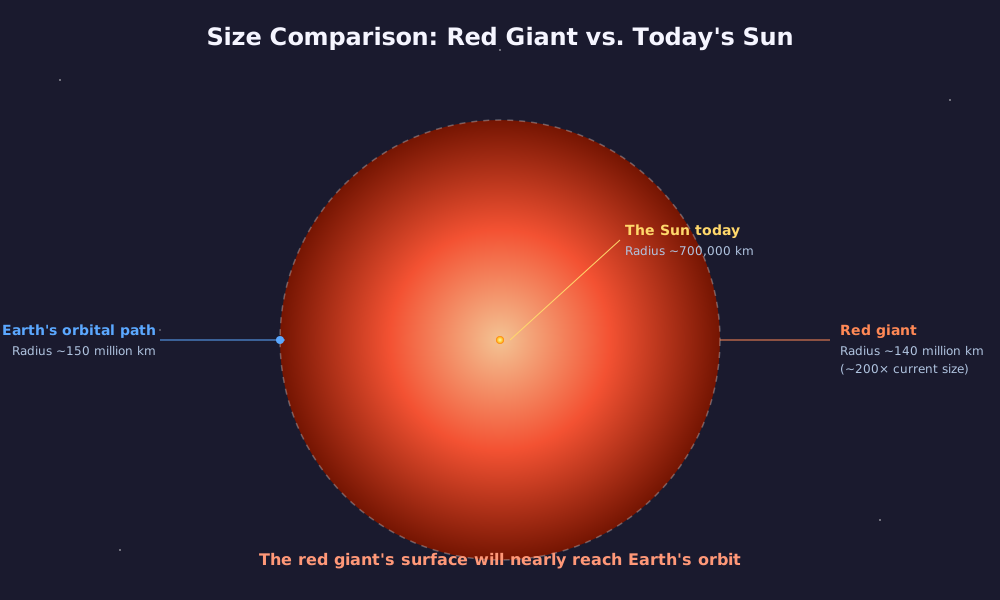
How big does it get? The Sun’s current radius is about 700,000 km. Models predict it will swell to roughly 200 times that — a radius of around 140 million km. Earth’s orbital distance is about 150 million km. The surface of the bloated Sun will reach nearly to where Earth is today.
This is what astronomers call the red giant phase.
Why It Turns Red: The Counterintuitive Answer
As the Sun expands, it turns red.
This seems backwards at first. If it’s growing and getting more energetic, why is it cooling down? But the red giant’s surface temperature is actually lower than the Sun’s surface today. The present-day Sun runs at roughly 6,000°C at its surface; a red giant drops to around 3,000°C.
The reason is simple: the same amount of energy spread over a vastly larger surface area. The total energy output increases enormously, but the surface area grows even faster. So the energy per unit of area — which is what determines temperature — falls.
Cooler objects emit redder light. This isn’t just a stellar phenomenon; it’s the same principle as heating a piece of iron. Low temperature glows red; high temperature glows white to blue. The red of a red giant is literally the color of something that has cooled down.
Even so, the Sun’s total luminosity will be thousands of times what it is today. For Earth, that’s catastrophic.
What Happens to Earth
This is the question everyone asks: when the Sun bloats up, what becomes of Earth?
Short answer: Earth almost certainly gets swallowed. And actually, the situation becomes dire well before that.
Hundreds of millions of years before the red giant phase begins, the Sun will gradually grow hotter and brighter. Around 1 billion years from now, Earth’s oceans will have evaporated completely and the atmosphere will be stripped away. Earth as a living world will be over. That part is essentially settled science.
The question that used to be debated is whether the red giant’s physical surface would actually engulf Earth’s orbit. One camp argued that the Sun loses mass as it expands, which causes Earth’s orbit to drift outward — maybe just enough to escape. The other camp said tidal drag would more than cancel that out, pulling Earth inward.
Recent simulations favor the second scenario. Yes, Earth drifts outward slightly as the Sun sheds mass. But the Sun’s expanded atmosphere exerts drag on Earth’s orbit, and the net effect is inward migration. Most models now predict Earth gets dragged in.
Either way, the planet ends up vaporized inside a sea of superheated gas. The idea of Earth dissolving inside the Sun is striking, even by cosmic standards.
The Final Act: A White Jewel
The red giant phase lasts a few hundred million years — brief by stellar standards.
During that time, something new is happening at the core. The helium that accumulated from all those years of hydrogen fusion gets compressed until it’s hot and dense enough to fuse. Three helium nuclei smash together to form carbon. This is helium burning, and it’s the Sun’s last major energy source.
When the helium runs out, that’s it for fusion in a solar-mass star. To burn carbon would require even higher temperatures and pressures — temperatures the Sun’s core can never reach. The Sun doesn’t have enough mass.
So the Sun expands again, becomes unstable, and starts blowing off its outer layers into space. Over time, those layers drift outward in a beautiful, glowing shell. We call this a planetary nebula — those colorful, jewel-like nebulae that show up in astronomy photos. (The name is historical confusion: early astronomers saw them as round and disc-like through small telescopes and thought they looked like planets. They have nothing to do with planets.)
Once the outer layers are gone, what’s left at the center is a dense sphere roughly the size of Earth, made mostly of carbon and oxygen. A white dwarf — the Sun’s cooling corpse.
The white dwarf doesn’t fuse anything. It has no energy source. It simply radiates away the heat it has stored, very slowly. How slowly? It takes hundreds of billions to trillions of years to cool completely.
Which means the white dwarf will outlive the Sun’s active life by a ridiculous margin. Whether you call that death or just a change of mode is a matter of perspective.
Something to Think About the Next Time You Look Up
One last thought.
The solar system is 4.6 billion years old. The universe is 13.8 billion years old. That makes the Sun a reasonably seasoned star — it has lived through about a third of cosmic history.
And this star, too, has an end coming. The fuel will run out. That yellow ball that rises every morning has a definite beginning and a definite end, even if both are almost unimaginably far away.
Maybe the next time you see the Sun, it will look a little different to you. A middle-aged star, right at halftime. Already scheduled to expand and consume the Earth in 5 billion years.
When you think about it that way, ordinary sunlight starts to feel like something worth appreciating. We were born at exactly the right moment in the Sun’s long life — while it’s still steady, still warm, still ours. In cosmic terms, that’s not a given. It’s genuinely lucky.