Uranus has 13 rings. Most of them are thin, dark, and easy to overlook. But the two outermost ones have been puzzling researchers for years.
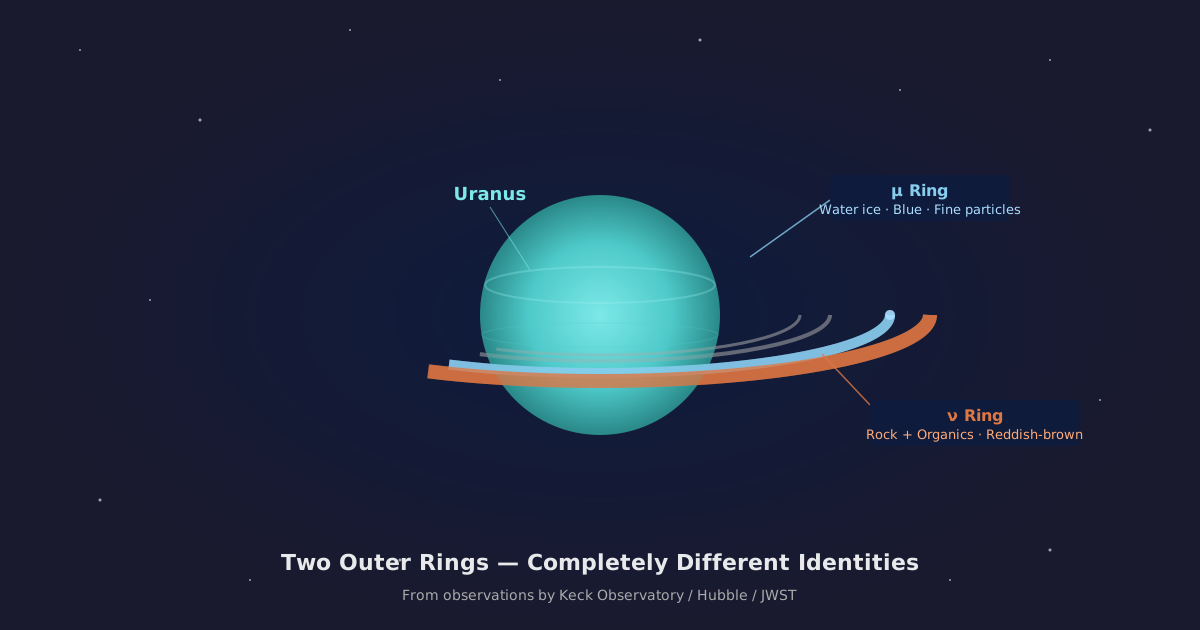
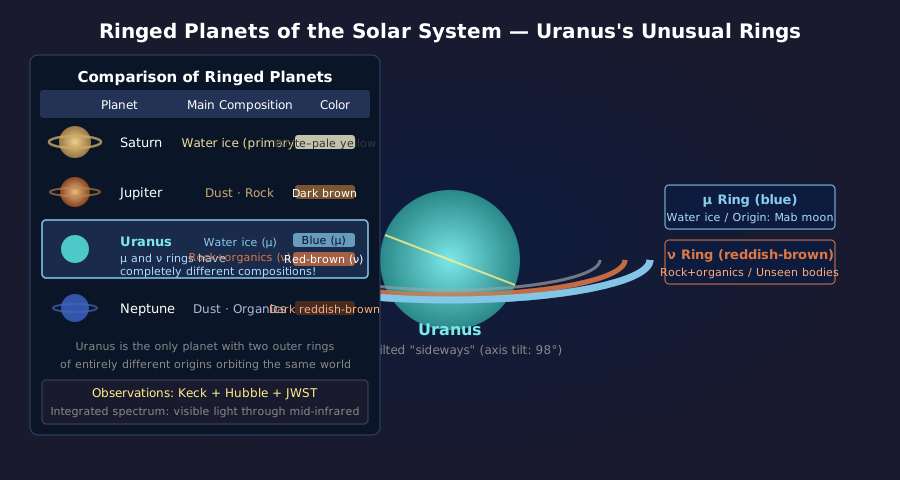
The μ (mu) ring and the ν (nu) ring. They orbit the same planet in much the same way — yet they’re different colors. One has a bluish tint, the other is reddish-brown. Normally you’d expect rings around the same planet to be made of the same stuff. These two aren’t.
In 2026, a new study combining observations from Keck Observatory, the Hubble Space Telescope, and JWST finally gave us an answer. The two rings don’t just look different — they’re fundamentally different in origin.
Why Uranus’s Rings Are So Hard to See
A bit of background first.
Saturn’s rings are famous. Those brilliant white bands are made mostly of water ice, spanning a distance comparable to that between Earth and the Moon. They reflect sunlight well enough to spot with a modest backyard telescope.
Uranus’s rings are nothing like that. When they were discovered in 1977, astronomers were startled by how dark they were — about as light-absorbing as coal. Saturn’s rings are like white mist; Uranus’s are more like dark soot.
Why so dark? The full picture isn’t settled, but the leading explanation is that the particles making up the rings have been chemically altered by cosmic radiation. Constant bombardment by charged particles slowly “chars” them, converting surface material into dark organic compounds over long timescales.
Against that gloomy backdrop, something stood out in the 2000s. Hubble noticed that the two outermost rings were different from the rest — they actually had color.
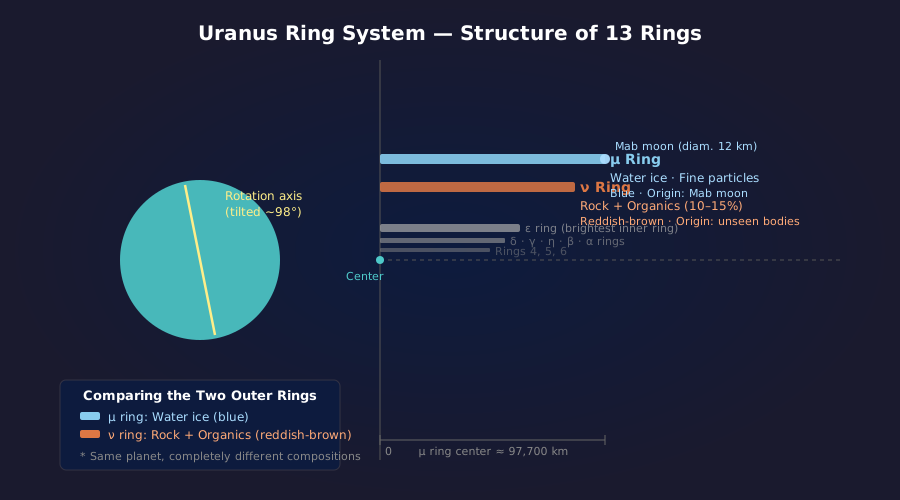
The μ ring leaned blue. The ν ring leaned reddish-brown. Nothing as vivid as Saturn’s rings, but clearly distinct from the other eleven. The question of why they were colored differently kept researchers busy for two decades.
Blue Means Water Ice, Reddish-Brown Means Rock and Organics
What made the 2026 study decisive was its approach: for the first time, researchers built a seamless spectrum spanning visible light all the way through the infrared by combining data from three separate telescopes.
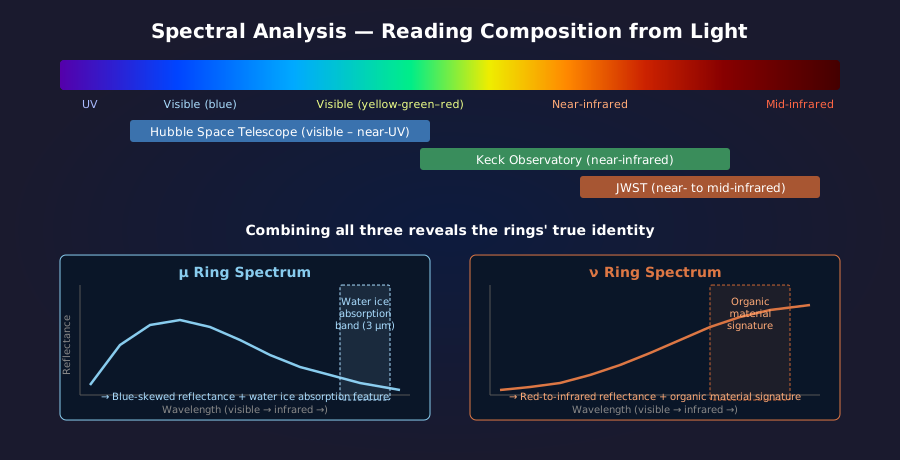
A spectrum is essentially the “color breakdown” of light reflected by an object. Every element and molecule has a characteristic fingerprint — it absorbs or reflects specific wavelengths. Read those fingerprints and you can determine what a distant object is made of, even from billions of kilometers away.
The μ ring’s spectrum was bright at short (blue) wavelengths and showed a clear absorption dip near 3 micrometers — the signature of water ice, the same material that dominates Saturn’s rings.
The ν ring was the mirror image. It brightened toward the red and infrared, with no trace of the water-ice signature. Instead, it showed the fingerprints of rocky material and carbon-rich organic compounds, with organics making up roughly 10 to 15 percent of the mix — typical of cold outer solar system environments.
So the color difference was real, not an optical illusion. Blue really does mean water ice. Reddish-brown really does mean rock and organics. Two rings circling the same planet, built from materials that might as well belong to different worlds.
Where Did Each Ring Come From?
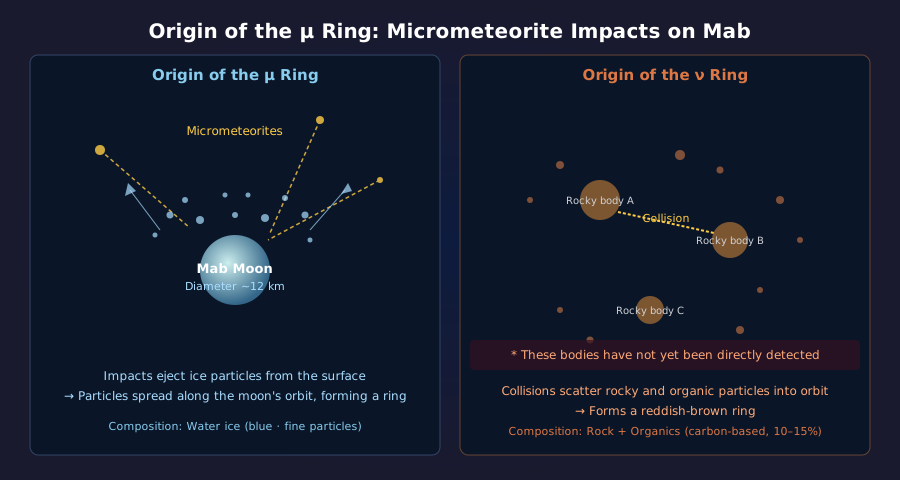
So how does the same planet end up hosting rings of such different composition? The answer is that they have different origins.
The μ ring: Mab’s secret
Nestled inside the μ ring is a tiny moon called Mab — just 12 kilometers across, roughly the width of a mid-sized city.
Mab gets pelted constantly by micrometeorites drifting through space. Each impact blasts ice particles off the moon’s surface. Because Mab’s gravity is so weak, those particles easily escape, spreading out along the moon’s orbit and building up the ring over time.
Mab is an icy body, so its ring is icy too. The blue color comes from fine ice grains scattering short wavelengths of light preferentially — the same basic physics that makes the sky blue.
The ν ring: evidence of something invisible
The ν ring has no corresponding moon. So what built it?
The team noticed that the ν ring sits in a region between the orbits of known Uranian moons like Portia and Rosalind. The current best hypothesis is that several small, rocky bodies lurk in that zone — objects too faint to resolve with existing telescopes. Collisions among them, or with passing debris, send rocky and organic particles cascading into orbit, forming the reddish-brown ring we see.
In other words, the ν ring may be evidence of objects we can’t yet see. The ring’s composition lets us infer the nature of things that remain, for now, invisible.
What Rings Can Tell Us
The broader implication here is worth pausing on.
A ring’s composition reveals the nature of whatever body created it. If the μ ring is made of water ice, Mab is a water-ice world. If the ν ring is made of rock and organics, its source bodies share that chemistry.
Small bodies in the outer solar system are essentially frozen time capsules of early solar system conditions. Objects that formed beyond Jupiter tend to retain volatile ices — water, methane, and the like. Bodies that formed closer in, within Uranus’s satellite zone, would have been drier and rockier.
The compositional gap between the two rings hints that Uranus’s satellite system incorporates objects from different formation environments and possibly different epochs. Each body carries its own history, built from its own raw materials.
“Two rings orbiting the same planet, yet made of different stuff” — what sounds like an astronomical curiosity may actually be a message: the history of Uranus is more complicated than we thought.
What Three Telescopes Achieved Together
The observational story behind this research is compelling in its own right.
Keck Observatory contributed data from 2007. Hubble had already identified the color difference. After JWST came online, it added observations across multiple infrared wavelengths.
Each telescope alone has its limits. Hubble excels from the ultraviolet through visible light but struggles in the infrared. Keck’s near-infrared data is affected by Earth’s atmosphere. JWST delivers extraordinary infrared sensitivity but is weak in visible wavelengths.
Merge all three and you get something none of them could produce alone: an unbroken spectrum from visible light out to the mid-infrared (~3 micrometers). That seamless coverage is what allowed researchers to confirm the water-ice absorption band in the μ ring and quantify the organic content in the ν ring.
No single telescope could have cracked this. The answer required all three working together.
Why a Uranus Mission Matters
There’s growing urgency among planetary scientists to send a dedicated spacecraft to Uranus.
The 2023–2032 Planetary Science Decadal Survey — NASA’s roadmap for prioritizing missions — ranked a Uranus orbiter as the top candidate for the next large flagship mission.
Part of the reason is simple: Uranus is the least-explored planet in the outer solar system. Voyager 2 flew past in 1986 and that’s it. No orbiter has ever circled it. At that distance, ground-based telescopes can only do so much.
This rings study underscores what a dedicated mission could accomplish. It took twenty-plus years of accumulated ground-based data to crack a single mystery about these rings. An orbiter in place around Uranus could resolve comparable questions far faster and with far greater precision.
And the hidden rocky bodies thought to be generating the ν ring? A spacecraft flying through the system might actually find them. There’s something hiding in those rings — and that alone is reason enough to go looking.
The image of Uranus’s rings as dim, featureless, and unremarkable has taken a serious hit. Those dull-looking bands each have their own backstory, their own raw materials, their own origins. The color difference isn’t incidental — it’s a trace of how they were born.
A distant, cold, understudied planet; rings so faint they’re nearly invisible. And yet, read carefully enough, they hold fragments of the solar system’s complicated early history.
That’s the thing about spectroscopy. Decode the light, and the universe starts talking.