When you hear the name International Space Station, what comes to mind? Maybe footage of astronauts eating in weightlessness. Maybe that iconic window looking down at Earth. Or perhaps the fact that 15 countries built the thing together and somehow kept it running.
Here’s something that might surprise you: the ISS won’t exist in the 2030s.
More precisely, there’s already a plan in motion to retire it — to nudge it out of orbit and let it burn up on reentry before the remains splash into the ocean. The station has been up there for more than 25 years, and the question of what comes next is now moving through the space industry quietly but with real momentum.
Why the ISS Has to Go
The first ISS module launched in 1998, and the station has been continuously crewed since 2000. Over that span, 15 nations have cooperated to maintain it as an international hub for scientific research.
But it’s old. The station has long outlived its original design lifespan, and reports of metal fatigue and hairline cracks have been growing. Annual operating costs exceed roughly $3 billion, which accounts for nearly 10 percent of NASA’s entire budget.
This isn’t really a “it’s broken” situation. It’s more of a “this is no longer the best use of our resources” judgment call. NASA wants to redirect the money it spends keeping the ISS alive toward exploration — the Moon, Mars, deeper space. To do that, they need to hand off low Earth orbit (the roughly 400 km altitude where the ISS flies) to someone else.
That someone else is the private sector.
The Era of Privately Built Space Stations
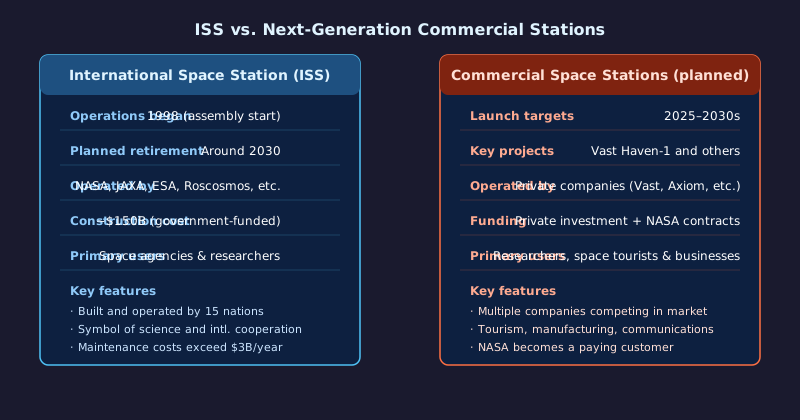
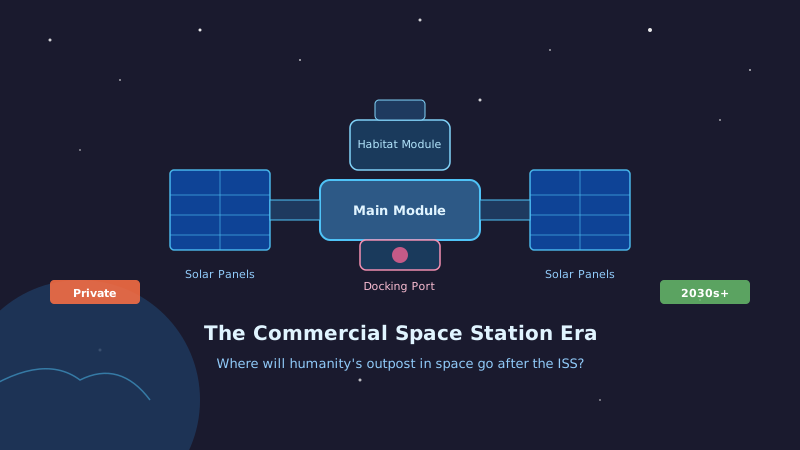
NASA has been seeding this transition through a program called Commercial Low Earth Orbit Destinations (CLD), offering funding to multiple private companies to develop successor stations. Several serious candidates have emerged.
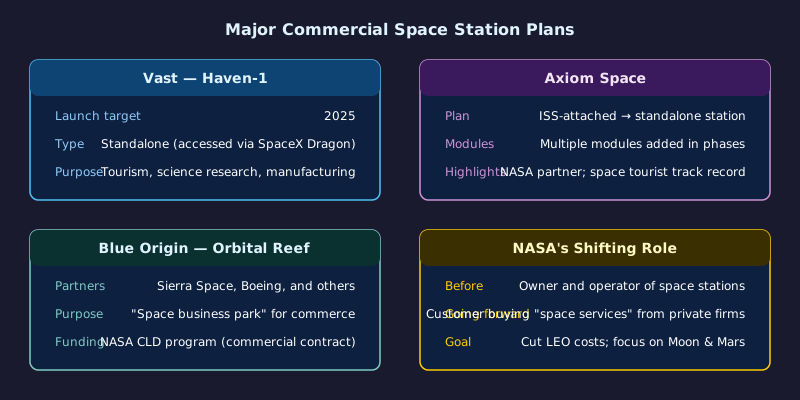
Vast’s Haven-1 is one of the most concrete plans on the table. It’s a standalone station designed to be accessed via SpaceX’s Dragon capsule, with an original launch target of 2025 (timelines have shifted since). The idea is to start with a single module and expand gradually.
Axiom Space already has a working relationship with NASA — it has sent private crews to the ISS multiple times. Its longer-term plan is to attach its own modules to the ISS while it’s still operational, then detach them into an independent station once the ISS retires. In terms of real-world commercial track record, Axiom is arguably ahead of the field.
Blue Origin, in partnership with Boeing and Sierra Space, is developing a concept called Orbital Reef — positioned as a kind of “special economic zone in space,” meant to host research, manufacturing, and tourism under one roof.
The fact that several companies are competing here is the point. NASA isn’t picking one winner; it’s distributing risk across multiple bets.
NASA Becomes a Customer
This shift in structure is a significant one.
Up until now, NASA has been the owner of the space station. The United States led the design, construction, and operations of the ISS. When something broke, NASA fixed it. When astronauts needed a ride, NASA arranged it.
Going forward, NASA becomes a customer. The agency will pay private operators to use their stations for research — like a government agency booking seats on a commercial airline instead of running its own fleet.
This logic didn’t appear overnight. It’s been building since SpaceX took over crew transport to the ISS with the Crew Dragon, freeing NASA from having to operate its own launch vehicles for that purpose. The same logic now applies to the station itself.
The underlying idea: let commercial companies handle the infrastructure of low Earth orbit, so NASA can focus its energy on the harder, farther-out question of where humanity goes next.
Staying Overnight in Space — If You Can Afford It
One of the bigger changes that comes with private stations is the gradual opening of space to non-professional astronauts. Not “anyone” exactly, but a wider circle than before.
Private citizens have visited the ISS before, but those were rare exceptions. The station was fundamentally a workplace for trained astronauts, not a destination for paying guests.
Axiom Space has already run several private missions to the ISS, with ticket prices reportedly in the tens of millions of dollars per person. That’s obviously not affordable for most people. But it does establish something real: private citizens can now formally “stay” in space, and the paperwork, training, and logistics infrastructure to support that exists.
If multiple commercial stations come online and start competing for customers, costs could come down over time. Vast’s Haven-1 business model, for instance, envisions mixing space tourism, scientific experiments, and materials research to spread costs across revenue streams — and eventually lower the per-person price.
When will “staying in space” stop feeling like something out of a James Bond film? Nobody knows. But the direction of travel is clear.
Things You Can Only Make in Microgravity
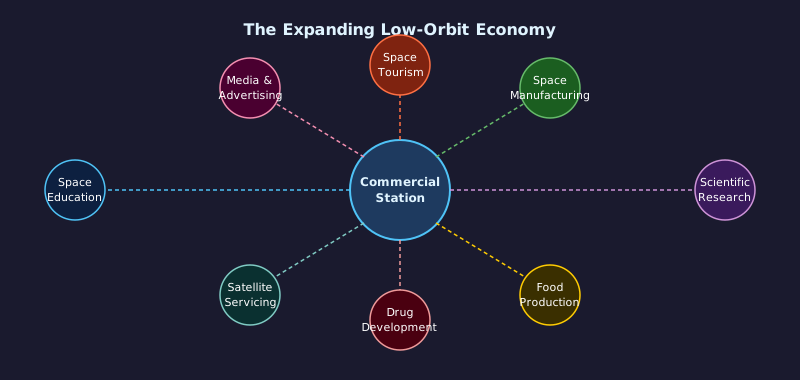
Space tourism gets the headlines, but it’s not the only reason private companies are interested in building orbital stations.
The microgravity environment aboard the ISS has already demonstrated something interesting: there are materials and products you simply cannot make on Earth. Researchers on the ISS have grown high-purity protein crystals that would precipitate out of solution under normal gravity — crystals that have potential applications in pharmaceutical development.
Similar arguments have been made for fiber optics and semiconductor manufacturing. Without gravity pulling on the process, impurities don’t mix in the same way, and you can potentially achieve higher quality. The idea of a “space factory” — make the material in orbit, bring it back to Earth for use — sounds like science fiction, but several companies are already running proof-of-concept experiments along these lines.
If even a handful of space-manufactured goods become commercially viable, the calculus around orbital stations changes entirely. They stop being facilities for scientists and start being factories. And factories generate a steady reason for people to go up.
The Real Challenges of Privatization
All of this is genuinely exciting. But there are real reasons not to be naive about it.
Running a commercial space station means generating revenue. Unlike the ISS, where researchers could apply for time through their national space agencies, a private station that doesn’t turn a profit will close. The history of the space tourism industry is full of ambitious timelines that hit the wall of commercial reality.
There’s also the regulatory question. The ISS operated under a framework of international treaties among participating space agencies. How much of that legal structure applies to privately owned stations — and who enforces it when things go wrong — remains genuinely unresolved.
And there’s a timing risk NASA can’t fully control. If private stations aren’t up and running before the ISS is retired, there will be a gap — a period when no orbital research platform exists at all. Closing that gap is NASA’s problem whether or not it still owns the hardware.
The Day Space Becomes Ordinary
The ISS was born out of post-Cold War optimism. For decades, it represented something striking: Russia, the United States, Japan, and Europe sharing a structure in orbit, maintaining cooperation even as geopolitics grew more complicated below.
Commercial stations may lack that symbolic weight. But they might also do something the ISS never could — make space feel accessible to more people in a more practical way. Not as a monument to international cooperation, but as a place you can actually go.
When does space travel stop being “a billionaire’s luxury” and become something that feels like a logical extension of ordinary ambition? The success or failure of these commercial stations will be one part of the answer.
For now, the ISS is still up there. On a clear night, you can spot it with the naked eye — a steady point of light crossing the sky in minutes. That bright dot has been “humanity’s outpost in space” for more than 25 years. That era is ending. It’s worth looking up while you still can.