Look at the universe from far enough away, and galaxies are anything but random.
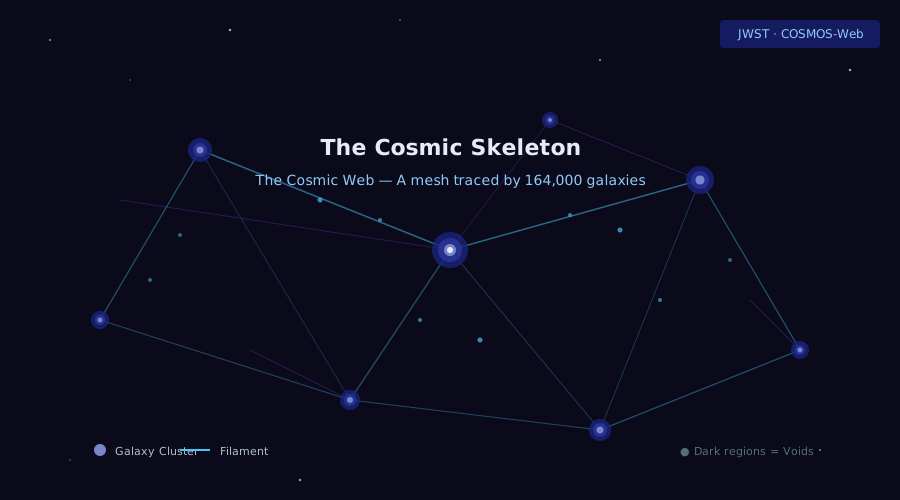
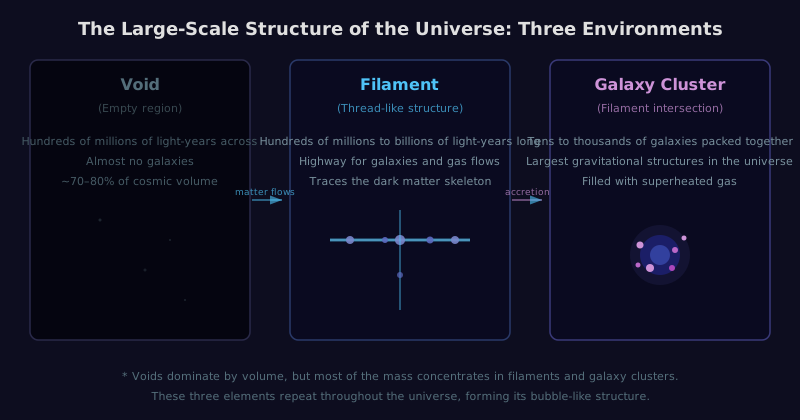
Astronomers have known this for decades. Galaxies cluster along vast thread-like filaments, and where those filaments cross, they pile up into dense knots called galaxy clusters. Between the threads, enormous stretches of space contain almost nothing — the cosmic voids. Together, this three-part architecture is known as the cosmic web.
The catch was that until recently, we could only see the web in its mature, middle-aged form. The universe as it looked billions of years into its life, already grown up. How the skeleton took shape during the first billion years — the universe’s infancy — was still blurry.
In 2026, JWST changed that. A new map built from 164,000 galaxies has finally cleared the view.
The Universe Looks Like a Bundle of Soap Bubbles
To appreciate what the cosmic web actually is, it helps to picture how galaxies are distributed across space.
Standing outside on a clear night, the stars look more or less evenly spread across the sky. But zoom out to the scale of galaxies — hundreds of millions to billions of light-years — and the picture shifts completely. Galaxies clump in some places and are almost entirely absent in others, with a sharpness that feels almost deliberate.
The pattern resembles a cluster of soap bubbles. Galaxies concentrate along the bubble walls — the filaments — while the interiors of the bubbles are nearly empty. Those voids account for roughly 70 to 80 percent of the universe’s total volume. Yet despite dominating by volume, they hold very little of its mass. Most of the matter in the universe is packed into the filaments and galaxy clusters.
Why does the universe look like this? The answer goes back to the Big Bang.
In the very early universe, tiny fluctuations in density existed across space — some regions were fractionally denser than others. Gravity took it from there. Denser patches pulled in surrounding matter, which made them denser still, which pulled in even more. Over 13.8 billion years, those small differences amplified into the towering structures we see today.
But the main character in this story isn’t ordinary matter. Dark matter — still a mystery in terms of what it actually is — formed the filamentary skeleton first, and ordinary matter then flowed in along those invisible highways to build the galaxies. A map of the cosmic web is, in a sense, an indirect map of dark matter.
COSMOS-Web: A Catalog of 164,000 Galaxies
At the center of this result is a JWST program called COSMOS-Web.
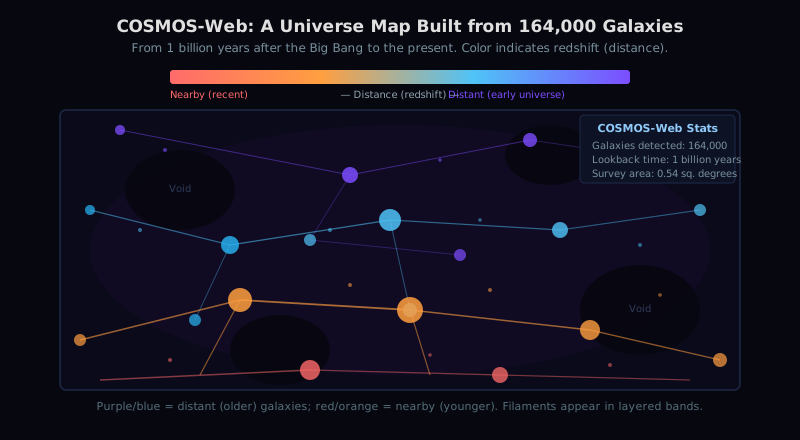
A survey like COSMOS-Web doesn’t target individual objects. Instead, it systematically images a patch of sky — in this case, 0.54 square degrees in the direction of Virgo, roughly the area covered by two full moons placed side by side — using JWST’s Near-Infrared Camera (NIRCam) and Mid-Infrared Instrument (MIRI).
The result: 164,000 galaxies detected in that single patch. For each one, researchers recorded how far away it is (its redshift), how massive it is, and what shape it takes.
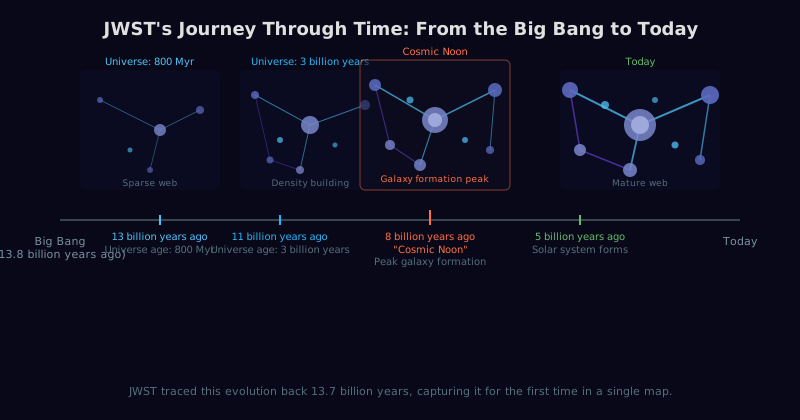
When all those galaxies were plotted together on a single map, something became clear for the first time. The threads of the cosmic web were already visible when the universe was just one billion years old.
At one billion years in — a tiny fraction of the universe’s current age — galaxies were not scattered randomly. They were already stringing themselves along filaments, and at the intersections, the seeds of massive galaxy clusters were beginning to grow. That finding, now backed by statistics from 164,000 galaxies, was genuinely surprising.
The intuitive picture of cosmic structure is that it builds up gradually over immense timescales. Seeing a clear web pattern at one billion years suggests structure formed faster than many models would predict.
Redshift: The Universe’s Built-In Clock
It’s worth pausing to explain what “looking back to one billion years after the Big Bang” actually means — because the tool that makes it possible, redshift, is worth understanding.
The universe is expanding. The farther away a galaxy is, the faster it appears to be receding from us. Light from a receding source gets stretched in transit: its wavelength lengthens toward the red end of the spectrum. That shift is what astronomers call redshift.
Measure a galaxy’s redshift, and you know how much the universe has expanded since that light left the galaxy. From there, you can calculate how old the universe was when the light was emitted. Redshift is, in effect, a lookback-time scale.
JWST’s advantage over the Hubble Space Telescope is its reach into high-redshift territory — the very early universe. Expansion stretches light from ancient galaxies into the infrared, and JWST is precisely designed to detect infrared. That’s why it can see galaxies that Hubble could not.
By nailing down the redshifts of 164,000 galaxies at once, COSMOS-Web effectively color-coded the map by cosmic era. The resulting gradient — showing which structures belong to which moment in time — is what lets researchers trace the growth of the cosmic web across billions of years of history.
Where You Live in the Web Shapes Who You Become
The map also revealed something important about how galaxies grow.
Galaxies sitting along filaments developed faster and reached higher masses than isolated galaxies at the edges of voids. It makes intuitive sense. Filaments are the universe’s equivalent of major highways — dense corridors of dark matter and gas through which material flows continuously. Galaxies in those corridors have a steady supply of fuel. Galaxies stranded in the near-empty voids have far less to feed on.
What’s remarkable is that COSMOS-Web confirmed this filament effect operating as far back as one billion years after the Big Bang. Even in the universe’s earliest formative period — well before it reached anything like its current structure — a galaxy’s environment was already shaping its destiny.
Where you’re born in the universe, it turns out, matters a great deal. That’s the message hidden inside 164,000 data points.
When Did the Skeleton First Appear?
The deeper question remains open. When exactly did the cosmic web form?
COSMOS-Web reaches back to one billion years after the Big Bang, but that’s still not the beginning. Tracing the web to even earlier times — the first few hundred million years, when the very first galaxies were switching on — will require observations of more distant objects than this dataset alone can provide.
The standard cosmological model, ΛCDM, predicts that dark matter filaments began assembling almost immediately after the Big Bang, with ordinary matter following later. The COSMOS-Web results broadly align with that picture.
But the fit isn’t perfect. Early analysis suggests that galaxies along filaments are growing somewhat faster than current theoretical models predict. Whether that’s a hint of something missing in ΛCDM, or simply a refinement waiting to be made, isn’t settled yet.
The dataset itself is far from fully analyzed. Having the map is one thing; reading everything it contains is another, and that work is still very much in progress.
Learning to Write a Cosmic Address
It’s worth stepping back and thinking about what this research actually represents.
Not long ago, we didn’t even know whether anything existed beyond the Milky Way. In the early 20th century, the question of whether there were other galaxies at all was a live scientific debate. Today we estimate there are over a trillion galaxies in the observable universe.
The cosmic web map is something like a street directory for all of them. Knowing which filament a galaxy sits on, which galaxy cluster it’s near, which void it faces — that context lets you predict that galaxy’s history far more accurately than you could from its properties alone.
164,000 galaxies sounds like a lot. Against the trillion-plus in the full universe, it’s a grain of sand. But carefully mapping the positions and relationships of even those grains is how the skeleton becomes visible. You can’t understand the whole without studying the parts.
Understanding the universe, at its core, is patient, cumulative work — trying to read 13.8 billion years of structure from a few years of observation. That’s a remarkable thing to attempt.
JWST’s operational life is expected to extend more than a decade further. The real analysis of COSMOS-Web is just getting started. The deeper layers of the cosmic skeleton are waiting to be uncovered, one data release at a time.