For the first time in history, humans are about to dig for water on the Moon — with their own hands, so to speak.
Look back at the arc of space exploration and this mission seems almost understated. The Apollo program put twelve people on the lunar surface. Now, a goal that sounds far less dramatic — collecting frozen water from the bottom of a deep crater — could determine where humanity plants its next permanent foothold.
China’s Chang’e 7 probe, scheduled for launch in August 2026, is the one going to find out.
What Makes the Lunar South Pole So Special
To understand why this mission matters, start with the Moon’s geometry.
The Moon’s rotational axis tilts just 1.5 degrees relative to its orbital plane. Earth tilts at 23.5 degrees, which is why we get seasons and why the Sun rises and falls across the sky. The Moon has almost none of that. Its sun hangs perpetually near the horizon, sweeping nearly parallel to the ground.
That low, flat sunlight creates a peculiar phenomenon in deep craters.
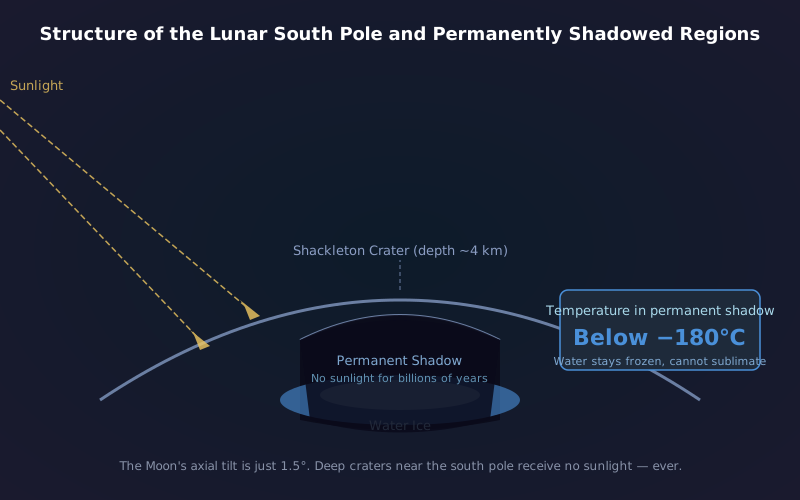
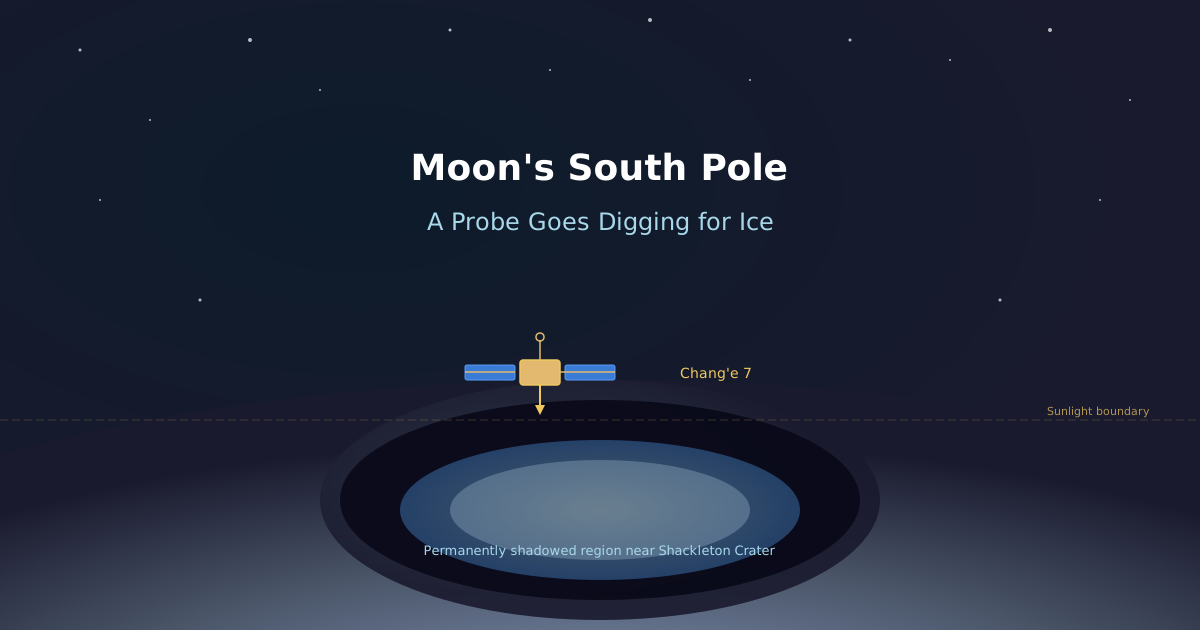
Near the Moon’s south pole, there are several enormous impact craters — Shackleton Crater, at 21 kilometers across and nearly 4 kilometers deep, being the most prominent. No matter what angle sunlight strikes from, it never reaches the bottom. Not now. Not in billions of years.
These are called permanently shadowed regions. Temperatures there drop below −180°C. Meanwhile, the sunlit lunar surface can hit 250°C in the daytime. These craters are isolated from all of that.
The reason this matters: at those extreme temperatures, water molecules can’t sublimate. On Earth and across most of space, heat causes water to evaporate and disperse. Inside a permanently shadowed crater, water simply stays frozen, indefinitely. It can accumulate there over geological timescales.
The idea that water ice might be hiding in these shadows isn’t new — it’s been around for more than two decades. NASA’s LCROSS mission slammed an impactor into a southern crater in 2009 and detected water vapor in the resulting plume. India’s Chandrayaan-1 orbiter returned data suggesting water molecules on the lunar surface.
But all of that was indirect. “There’s probably water there” is very different from “here is the water.”
What Chang’e 7 Is Actually Going to Do
Chang’e 7 is going to close that gap.
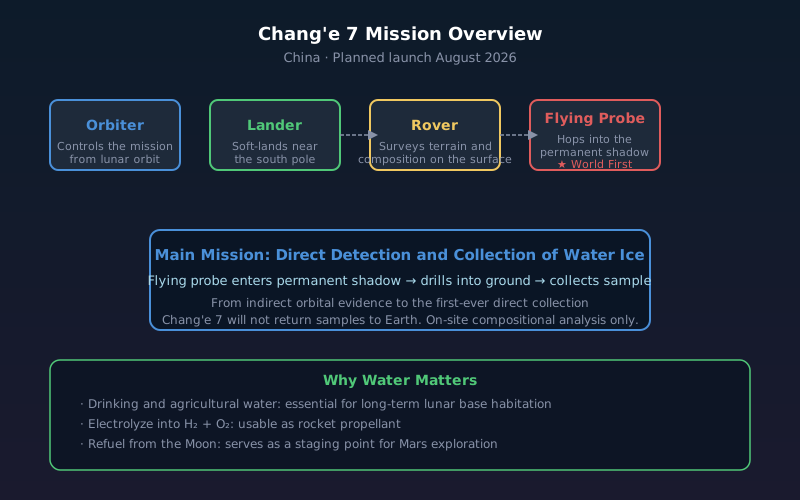
The mission deploys five spacecraft: an orbiter, a lander, a rover, a relay satellite, and — the star of the operation — a small flying probe. After the lander touches down near Shackleton Crater in a sunlit area, the flying probe makes a series of short hops and descends into the permanently shadowed region below. Once inside, it drills into the surface to collect ice samples and analyzes their composition on the spot.
This has never been attempted before. No spacecraft has ever entered a region without sunlight on the Moon. Power comes from the lander via cable or onboard batteries. A relay satellite holds position in lunar orbit to maintain communications that would otherwise cut out.
Honestly, the difficulty is formidable. Whether the drill can penetrate the frozen ground is uncertain. Whether there’s actually ice waiting underneath is not guaranteed. But the only way to find out is to go there — because what’s at stake is significant enough to justify the attempt. The presence or absence of water on the Moon has the potential to reshape the entire strategy for deep space exploration.
Water as Fuel — A Different Way of Thinking About It
It takes a small shift in perspective to understand why water is such a big deal in space.
Water, when you run electricity through it, splits into hydrogen and oxygen. Hydrogen and oxygen, when burned together, produce one of the most powerful rocket propellants known. So if there’s water on the Moon, you can make rocket fuel on the Moon.
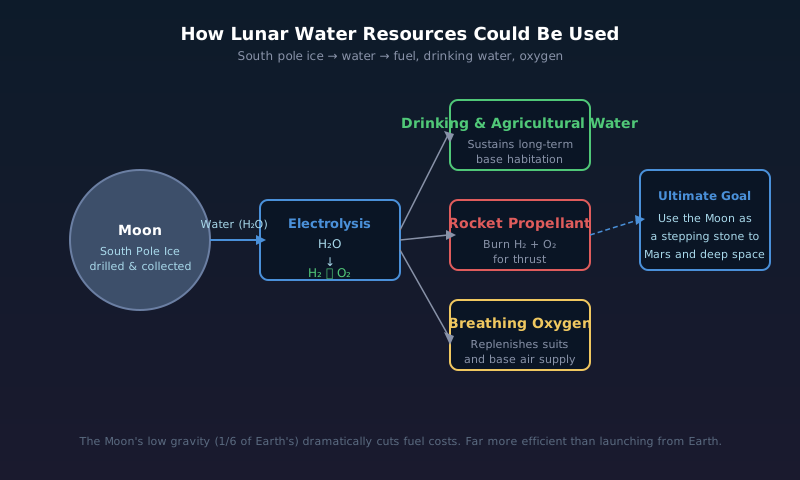
The Moon’s gravity is one-sixth of Earth’s. Launching a spacecraft toward Mars from the Moon instead of from Earth dramatically reduces the fuel required. The concept of using the Moon as a refueling depot has appeared in space agency roadmaps for decades. But without local water, it’s an abstract idea — a plan waiting for a resource that might not exist.
Confirm water is there, and that abstraction becomes concrete. The Moon transforms from a destination into a waypoint — a staging ground for missions to Mars, the asteroid belt, and eventually the outer solar system.
And it’s not just fuel. Long-term lunar bases will need drinking water. They’ll need water for growing food. Shipping water from Earth at roughly $1 million per kilogram is not a sustainable model. Local supply changes everything.
Oxygen for breathing follows the same logic. Electrolyze water, and you get oxygen that can replenish spacesuits and pressurized habitats. One resource, three critical uses: drink it, burn it, breathe it.
The Race — and Something More Than a Race
You can’t discuss Chang’e 7 and the lunar south pole without talking about Artemis.
NASA’s Artemis program is targeting the same region. Artemis III, aimed at putting the first crewed landing near the south pole (the current outlook points to 2026 or 2027), considers the water ice deposits a primary factor in choosing the landing site. JAXA, Canada, and European space agencies are all part of the Artemis coalition.
China, partnered with Russia, is pursuing a separate initiative called the International Lunar Research Station (ILRS), with lunar base construction planned for the 2030s.
Who confirms water first carries political weight, not just scientific significance.
But it’s worth stepping back from the competition framing for a moment. If water ice is confirmed anywhere near the south pole, that fact benefits every program on the planet. The scientific data Chang’e 7 returns could inform where Artemis crews ultimately land. The Moon is large. No single nation can stake a claim to it.
From “Probably” to “Yes”
The history of space science is, in a real sense, the history of converting indirect evidence into direct knowledge.
We figured out the ozone layer was damaged from atmospheric chemistry. We detected black holes from the behavior of nearby matter before we ever imaged one. We inferred exoplanet atmospheres before we could study them directly. In each case, the turning point was the moment someone went from measuring a shadow to touching the thing itself.
Chang’e 7’s data — and potentially the composition of ice samples collected in situ — could be that turning point for lunar water. If the mission succeeds, “the Moon might have water” becomes “the Moon has water, and we can use it.”
Launch is set for August 2026. A few months away. Worth keeping an eye on.
Reference: The Planetary Society - Chang’e 7