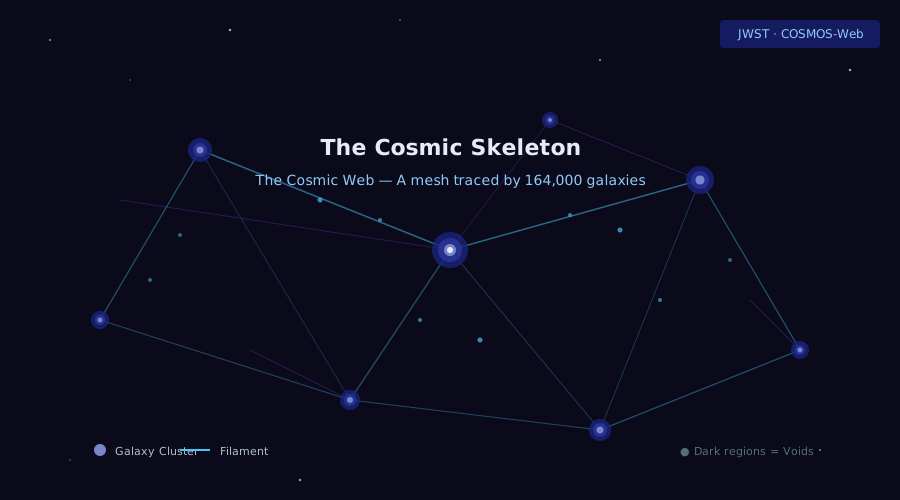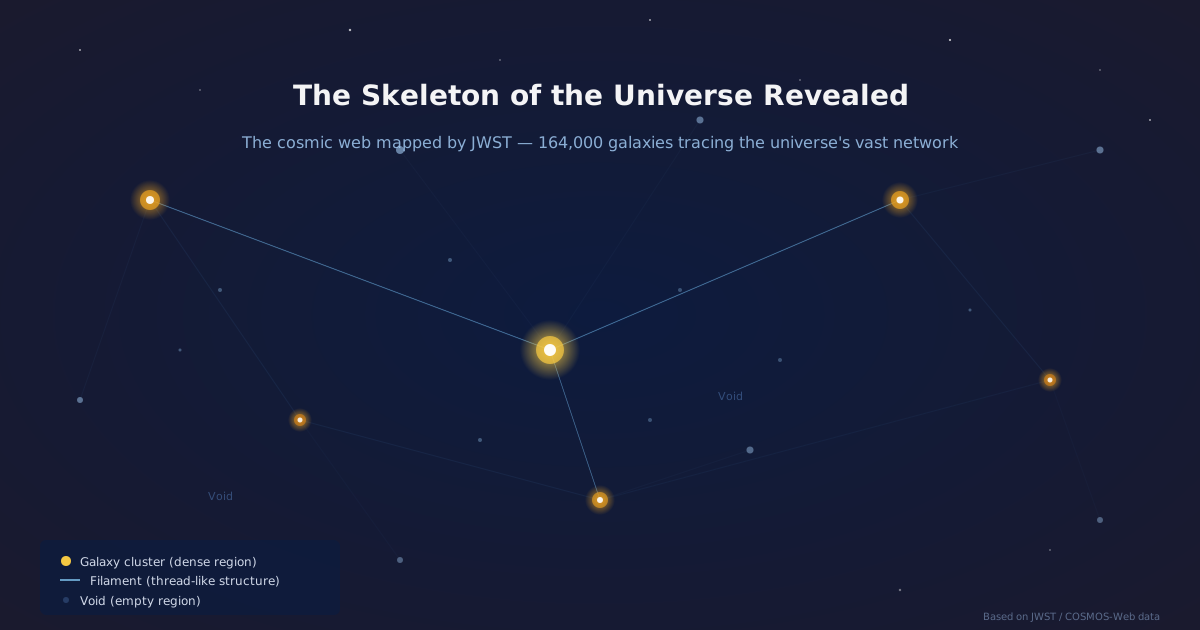
A lot of people picture galaxies as dots scattered randomly across the night sky — honestly, I did too, for a long time. But reality looks nothing like that. Galaxies are perched on the nodes of an enormous, invisible web, like dewdrops clinging to threads of a spiderweb.
In May 2026, researchers published the highest-resolution map of that web ever made. JWST traced 164,000 galaxies to produce what amounts to a structural blueprint of the universe.
What exactly is the cosmic web?
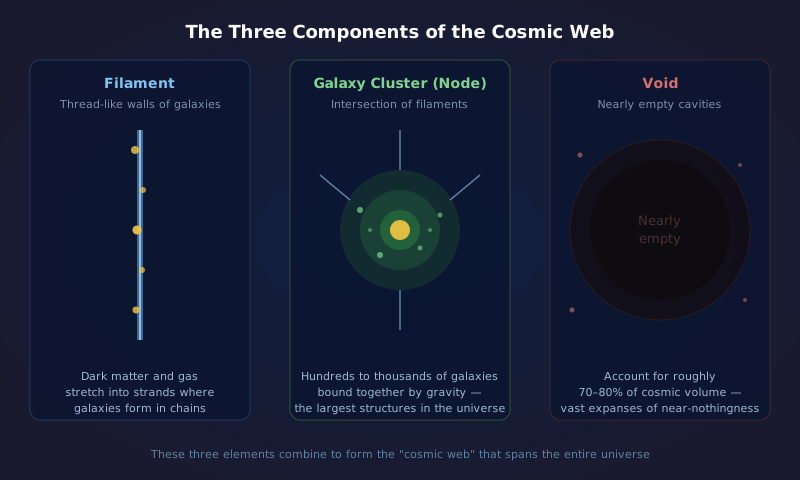
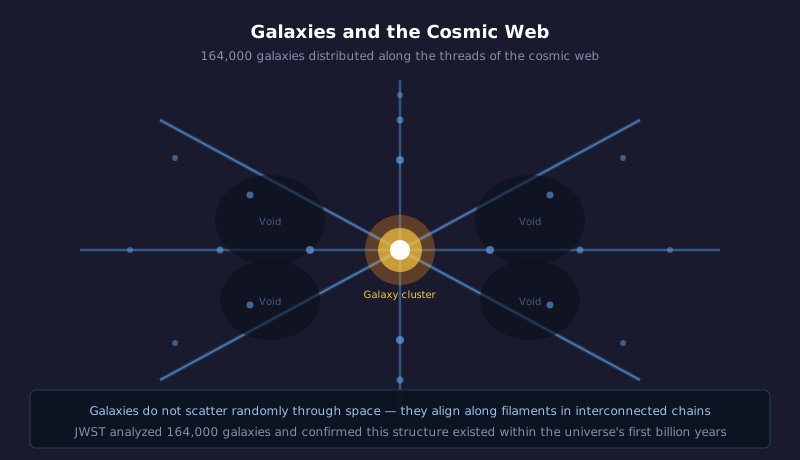
The cosmic web is the large-scale skeleton that runs through the entire universe. Filaments — long, thread-like structures made of dark matter and gas — stretch across space in every direction. Where filaments cross, galaxies pile up and galaxy clusters form. Between the filaments sit vast empty regions called voids, where almost nothing exists.
Picture the cross-section of a sponge. Holes (voids) surrounded by thin walls (filaments), with clumps of material (galaxy clusters) sitting at the corners where walls meet. The entire universe follows that same sponge-like architecture — that’s the cosmic web.
Theorists predicted this structure in the 1980s, and ground-based surveys in the 1990s and beyond sketched the rough outlines. But the distant universe — the early universe — always looked blurry. The resolution just wasn’t there.
What JWST changed
That changed in May 2026, when a team led by researchers at the University of California, Riverside published a paper that upended the picture.
They drew on COSMOS-Web, JWST’s largest survey program to date. The observations covered a contiguous patch of sky spanning the area of three full moons, capturing detail across that whole expanse. From that data, the team extracted 164,000 galaxies, calculated the local density of the universe around each one, and stitched together a cosmic web map stretching all the way back through 13.8 billion years of cosmic history.
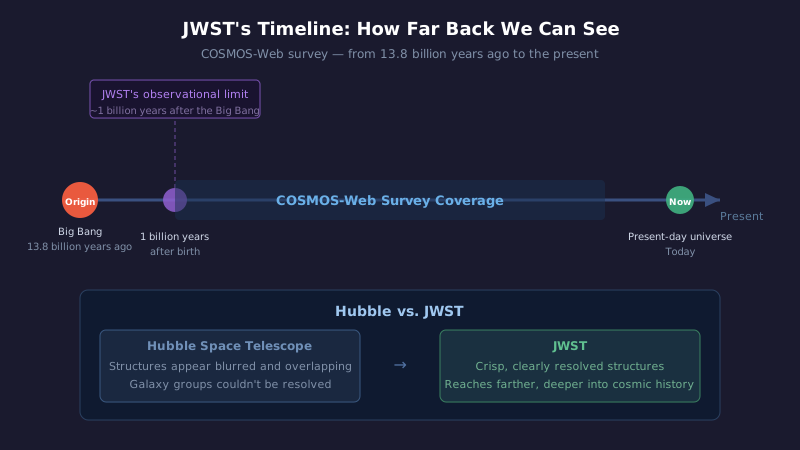
The depth is what makes it remarkable. The map reaches back to roughly one billion years after the Big Bang — a time when the universe was still in its infancy.
Lead author Hassan Hatamnia put it this way: “For the first time, JWST lets us study how galaxies have evolved within clusters and filaments on a truly cosmic scale.”
The same patch of sky had been photographed before, by the Hubble Space Telescope. But in Hubble’s data, structures that JWST can resolve cleanly were blurred together into an indistinct mass. JWST separated things that had never been separable before.
What happens on the web
With the map complete, researchers could confirm something that had long been suspected: where a galaxy sits on the cosmic web strongly shapes what it looks like and how it evolves.
At the intersections of filaments — inside dense galaxy clusters — galaxies are constantly tugging at each other gravitationally, colliding and merging. Those galaxies tend to be older and elliptical in shape. Galaxies that sit further out along the filaments, or near their edges, tend to be younger and still hold their spiral arms.
Where you are born in the universe goes a long way toward determining what you become. It’s a cosmic version of environmental influence — the neighborhood shapes the outcome.
Voids turn out to be interesting in their own right. A small number of galaxies do exist in those vast empty regions, isolated from everything around them. Cut off from the gravitational nudges and collisions that drive most galaxy evolution, they tend to develop slowly and preserve more primitive features. Researchers have a soft spot for these solitary galaxies — quiet survivors out on the fringes of the cosmic web.
The skeleton was there from nearly the beginning
One of the most striking findings: the cosmic web’s structure was already in place less than one billion years after the Big Bang.
In theory, tiny density fluctuations just after the Big Bang should have seeded this structure, with gravity slowly pulling matter into filaments over time. But nobody knew how quickly that process actually played out. JWST’s map shows that the skeleton came together remarkably early in cosmic history.
The research team also released all the data publicly alongside the paper — the catalog of 164,000 galaxies, density measurements for each one, and an animation of the cosmic web evolving across 13.8 billion years. The idea is that other researchers around the world can now use the same dataset to pursue entirely different questions.
What comes next
A detailed map raises new questions as much as it answers old ones.
One is dark matter. Filaments are theorized to be built from dark matter’s scaffolding, but directly confirming that observationally remains difficult. Matching the cosmic web’s shape against dark matter models could reveal where dark matter sits and in what quantities.
The other is the mystery of early galaxies. JWST has already spotted galaxies from within the first 300 million years of the universe — and their existence has sparked debate about whether they formed “too fast.” Cross-referencing those findings with how quickly the cosmic web itself assembled could help determine whether galaxy formation in the early universe was genuinely anomalous.
Saying one map changes everything might be a stretch. But this map showed us the first crisp view of 13.8 billion years of cosmic structure. You don’t need to be a researcher to feel the force of that — the universe turns out to be far more organized than it looks.
Summary
JWST’s COSMOS-Web survey has produced the most detailed map of the cosmic web ever made, using 164,000 galaxies as markers. The three-part skeleton of filaments, galaxy clusters, and voids was already in place within the universe’s first billion years. A galaxy’s appearance and age depend heavily on where it sits in that web, making “cosmic environment” a central theme in the study of galaxy evolution. The full dataset is now publicly available, and it’s likely to fuel a new wave of research.